

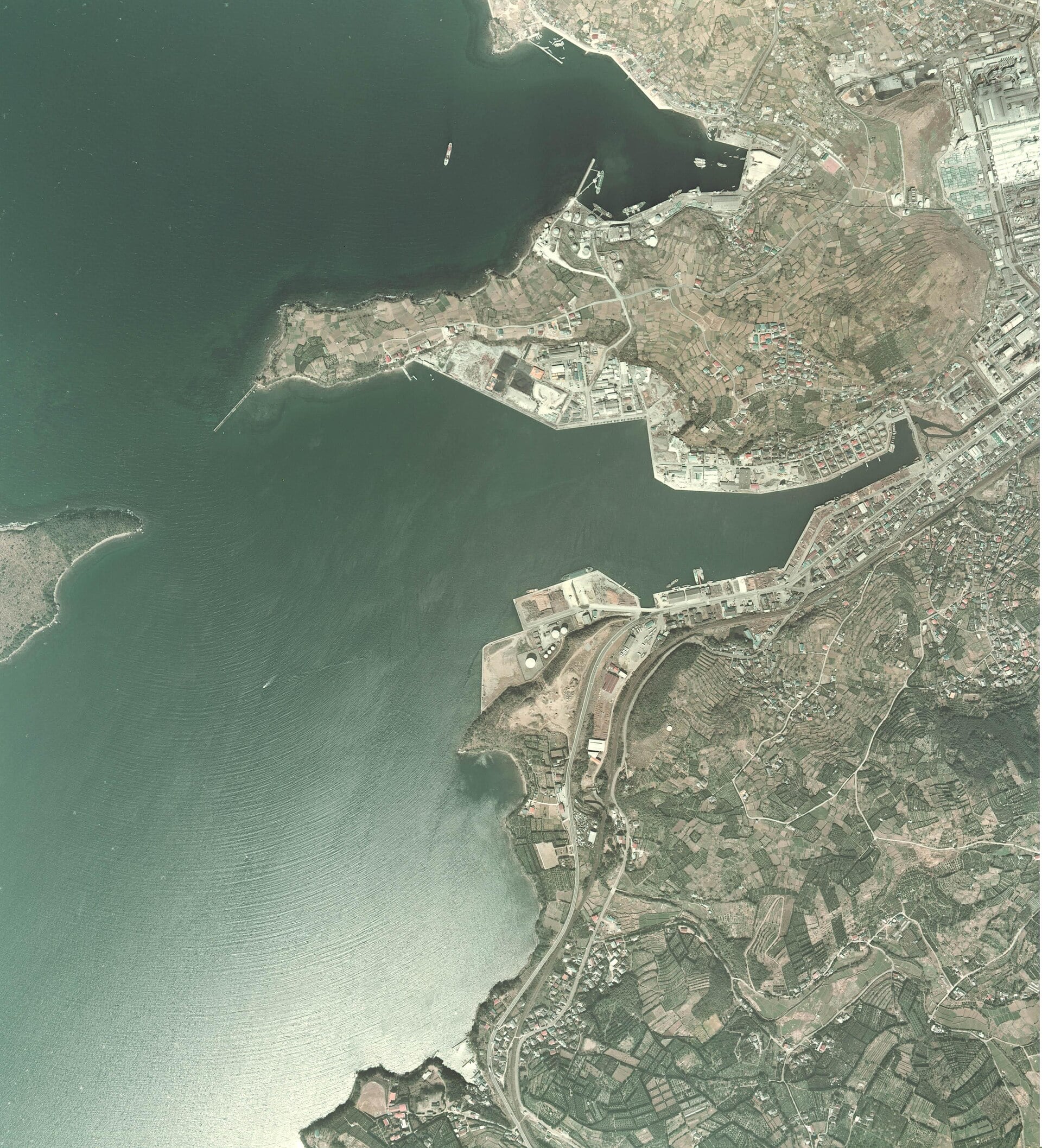
Stand on the eastern shore of Minamata Bay today and part of the ground underfoot is manufactured: 58 hectares of reclaimed land, capped with mountain soil, holding down sediment that was too poisonous to leave on the seafloor. Beneath that surface sits roughly 1,500,000 cubic meters of bottom sludge carrying total mercury above 25 parts per million, dredged up and walled in between 1974 and 1990 by Kumamoto Prefecture. The Japan Ministry of the Environment's account of Minamata disease history and measures records the arithmetic plainly: a dredging and landfill project dealing with about 1.5 million cubic meters of sediment above the 25 ppm removal standard, producing a 58 hectare landfill, at a total cost of 48 billion yen, of which the responsible company, Chisso, bore 30.5 billion yen. Sixteen years of barges, sheet piles, and pumped slurry, for one engineering outcome: the contaminated fraction of a bay floor moved into a sealed box and taken out of circulation.
Why the bay floor still needed handling after the plant stopped
The chemistry that caused Minamata disease ran through Chisso’s acetaldehyde process, and the Ministry of the Environment dates the industrial timeline closely. A so-called perfect circulation system was installed at the plant in 1966, acetaldehyde production ceased in 1968, factory effluent containing methylmercury flowing into Minamata Bay was brought under regulation in 1969, and the Water Pollution Control Law followed in 1970. By the start of the 1970s the pipe had stopped discharging. The bay had not stopped holding what the pipe delivered.
Mercury compounds released over decades of production settled into fine sediment near the plant outfalls and drifted with currents and storms across the inner bay. ICETT, in its summary of the bottom sludge treatment program in Minamata Bay, puts the quantity discharged and deposited in the bay at an estimated 70 to 150 tons of mercury, a range rather than a measured total, and a reminder that the inventory in the mud was reconstructed rather than metered. That reservoir mattered because sediment is not inert storage. Disturbed mud resuspends, benthic organisms work through it, and methylmercury moves back into the food web that fishing communities depend on.
So a removal standard was set at 25 ppm total mercury, and the prefecture’s project was defined around it: not to clean every grain of the bay floor, but to identify and isolate the sediment above that threshold. Everything about the scale of the works follows from where that line was drawn.
Sheet piles, pump dredging, and a 58 hectare box
The Ministry of the Environment’s project table gives the physical footprint. Treated area came to roughly 2,092,000 square meters in total, with about 1,510,000 cubic meters of sludge disposed of. Within that, the landfill portion covers about 582,000 square meters and accounts for roughly 726,000 cubic meters disposed, while the dredged area totals about 1,510,000 square meters and roughly 784,000 cubic meters disposed. Read together, those rows describe a two-part operation: contaminated sediment in one zone was enclosed in place under reclamation, and sediment elsewhere in the bay was lifted and pumped into that same enclosure.
ICETT’s description of the method is brief and worth keeping brief. A watertight embankment built with steel sheet piles separated the reclamation site from the dredging sites; pump dredging moved the sludge as slurry into the reclaimed area rather than lifting it dry through open water; and the finished surface was covered with mountain soil. The design logic is containment plus minimal resuspension, which is why a sealed perimeter went in before the dredge heads started working.
The two authoritative sources frame the calendar differently, and both framings describe one remediation rather than two projects. The Ministry of the Environment gives the project window as 1974 to 1990. ICETT describes the prefectural program running from October 1977 to completion in March 1990, about 14 years, at approximately 48.5 billion yen with Chisso covering roughly 60 percent. The longer window folds in the years of survey, design, standard-setting, and preparatory construction ahead of full operations; the shorter one tracks the works period itself. No single dredge-start date should be read off either.
What the seal settled, and what it did not
A capped landfill resolves a sediment problem. It does not resolve a public health history, and the Ministry of the Environment is careful on this point. Continuous exposure to methylmercury at levels thought capable of causing disease is described as having existed around Minamata Bay until no later than 1968, which places the exposure window before the dredging began. The landfill removed a residual pathway; it did not undo the poisoning that had already occurred, and it did not by itself end Minamata disease. Certification and compensation systems ran on their own long track, with 2,955 people certified as patients as of March 2001 per the Ministry’s figures.
What the project did change was the state of the bay floor and the monitoring picture above it. ICETT reports that residual mercury in the sludge decreased to 4.69 ppm after the program, a figure to hold as ICETT’s own. Fish monitoring continued against provisional standards of 0.4 ppm total mercury and 0.3 ppm methylmercury, and the dividing nets that had partitioned Minamata Bay were completely removed in early October 1997, seven years after the works finished.
That gap between 1990 and 1997 is the honest measure of what this kind of engineering does. About 1.5 million cubic meters of sediment above 25 ppm now sits under 58 hectares of made ground, at 48 billion yen, because containment was the available answer to mercury already in the mud. The landfill is remediation, closing a pathway rather than reversing a history.