
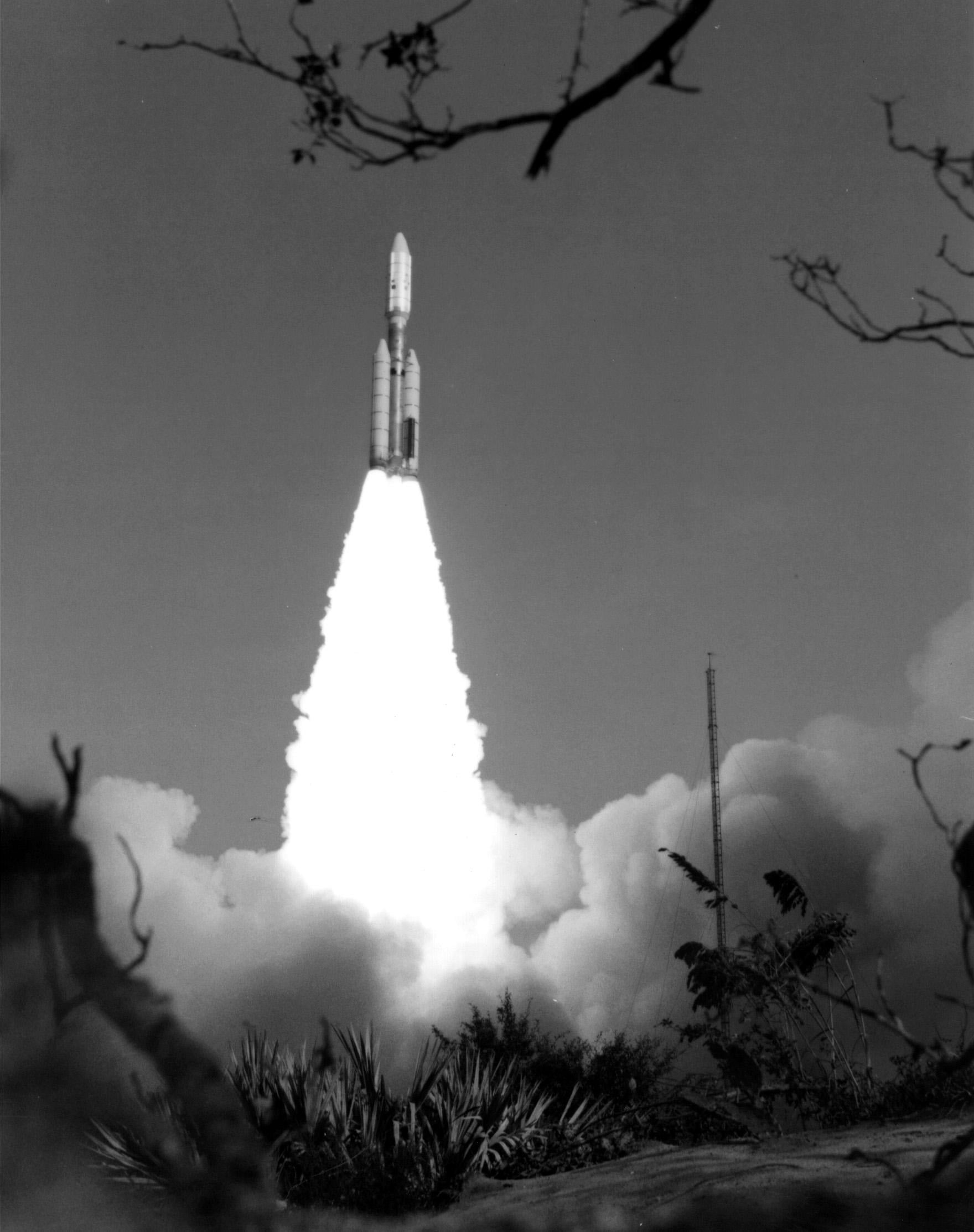
A spacecraft that weighed 721.9 kilograms — 1,592 pounds, roughly the mass of a small car — lifted off from Cape Canaveral, Florida, on September 5, 1977, at 12:56:01 UT. Forty-seven years later, on August 21, 2024, NASA's tally put that same object 164.7 astronomical units from Earth, moving 38,026.79 mph relative to the Sun, and still returning data.
Those three numbers are the whole story, and they are worth holding side by side. The mass is a fixed, stamped quantity from the pad: what the Titan IIIE-Centaur (TC-6) had to lift off Launch Complex 41. The speed — about 38,027 mph, or 17.0 kilometers per second — is what the solar system's gravity wells handed back after two planetary encounters. And the distance is not a live reading but a timestamp: 164.7 AU as of that August date, a snapshot of a number that only grows.
The mass that left the pad
Seven hundred twenty-one point nine kilograms is a strikingly small figure for an object that would become the most distant human-made thing in existence. Inside that budget went the high-gain antenna, the imaging and fields-and-particles instruments, the computers, the hydrazine, and three Multi-Hundred Watt radioisotope thermoelectric generators — the RTGs that would have to supply every watt for the rest of the mission, with no sunlight worth catching past Jupiter.
Per the NASA Voyager 1 mission page, the spacecraft launched after its twin, Voyager 2, which had gone up in August 1977. Voyager 1 was placed on a faster trajectory, and the arithmetic showed quickly: on December 15, 1977, barely three months out, it overtook Voyager 2 and never gave the lead back. The mission was designed and is managed by NASA's Jet Propulsion Laboratory.
The fast route paid off at Jupiter on March 5, 1979, where closest approach produced a thin ring nobody had predicted and two new moons, Thebe and Metis, among the encounter's findings. Then Saturn, on November 12, 1980: five new moons, a new ring designated the G-ring, and the encounter decision that fixed everything that followed.
Why about 38,027 mph, and why north
Speed, for an unpowered spacecraft in the outer solar system, is inheritance. Voyager 1 is not thrusting. The 38,026.79 mph logged on August 21, 2024 is the residue of a launch stack and two gravity assists, minus the Sun's steady, weakening pull on an object already far past the point where that pull matters much.
The shape of the final trajectory was set at Saturn. Voyager 1's flyby of Titan — Saturn's haze-wrapped moon, a target judged worth the cost — bent the outbound path north of the ecliptic plane. That choice meant Voyager 1 would not go on to Uranus and Neptune; that assignment fell to Voyager 2. What Voyager 1 got instead was an escape trajectory climbing out of the plane of the planets at roughly 3.5 AU per year, aimed at nothing in particular and therefore at everything beyond.
The Voyager fact sheet marks the milestones that followed from that geometry. On January 1, 1990, the Voyager Interstellar Mission officially began — the planetary tour formally over, the spacecraft reclassified as a probe of the space between stars. On February 17, 1998, Voyager 1 passed Pioneer 10 to become the most distant human-made object, at 69.4 AU from the Sun. And on August 25, 2012, it crossed out of the heliosphere — the bubble of solar wind and magnetic field the Sun blows around itself — becoming the first human-made object in interstellar space.
Consider the ratio buried in those figures. It took twenty-one years to reach 69.4 AU. It took twenty-six more to reach 164.7. The cruise speed has been nearly steady because there is nothing left out there to slow it down or speed it up in any meaningful way. Thirty-eight thousand miles per hour is, in the end, just a number that the solar system finished writing in 1980 and has not revised since.
164.7 AU, timestamped, still sending
One astronomical unit is the Earth–Sun distance. At 164.7 of them, a radio signal traveling at the speed of light needs the better part of a day to make the one-way trip. Voyager 1 still communicates with NASA's Deep Space Network, and it still returns data — which is the least inevitable part of this entire arithmetic.
The constraint is power. RTGs convert heat from decaying plutonium into electricity, and that heat declines year over year. NASA and JPL have been progressively shutting down instruments to stretch the remaining watts, a sequence of decisions that trades science return now for spacecraft life later. In February 2025, the Cosmic Ray Subsystem on Voyager 1 was turned off. On April 17, 2026, JPL shut down Voyager 1's Low-Energy Charged Particles experiment to keep the spacecraft operating; the mission page notes two science instruments still running after that step.
So the phrase "still returning data" carries a specific, narrowing meaning — not a full instrument suite reporting from the interstellar medium, but a power-managed remnant, chosen deliberately, sending what it can.
Bolted to the side of that 721.9-kilogram frame is a 30-centimeter gold-plated copper disc, the Golden Record, riding along at the same 17 kilometers per second as everything else. It was never the point of the mission. It is simply the part of the mass that will outlast the power budget by an interval too long to describe usefully.
The distance, though, should be read exactly as NASA stamped it: 164.7 AU from Earth, on August 21, 2024. Not today's figure. A marker dropped on a specific date, by a machine that has been climbing away from the ecliptic since 1980, and has not stopped.