

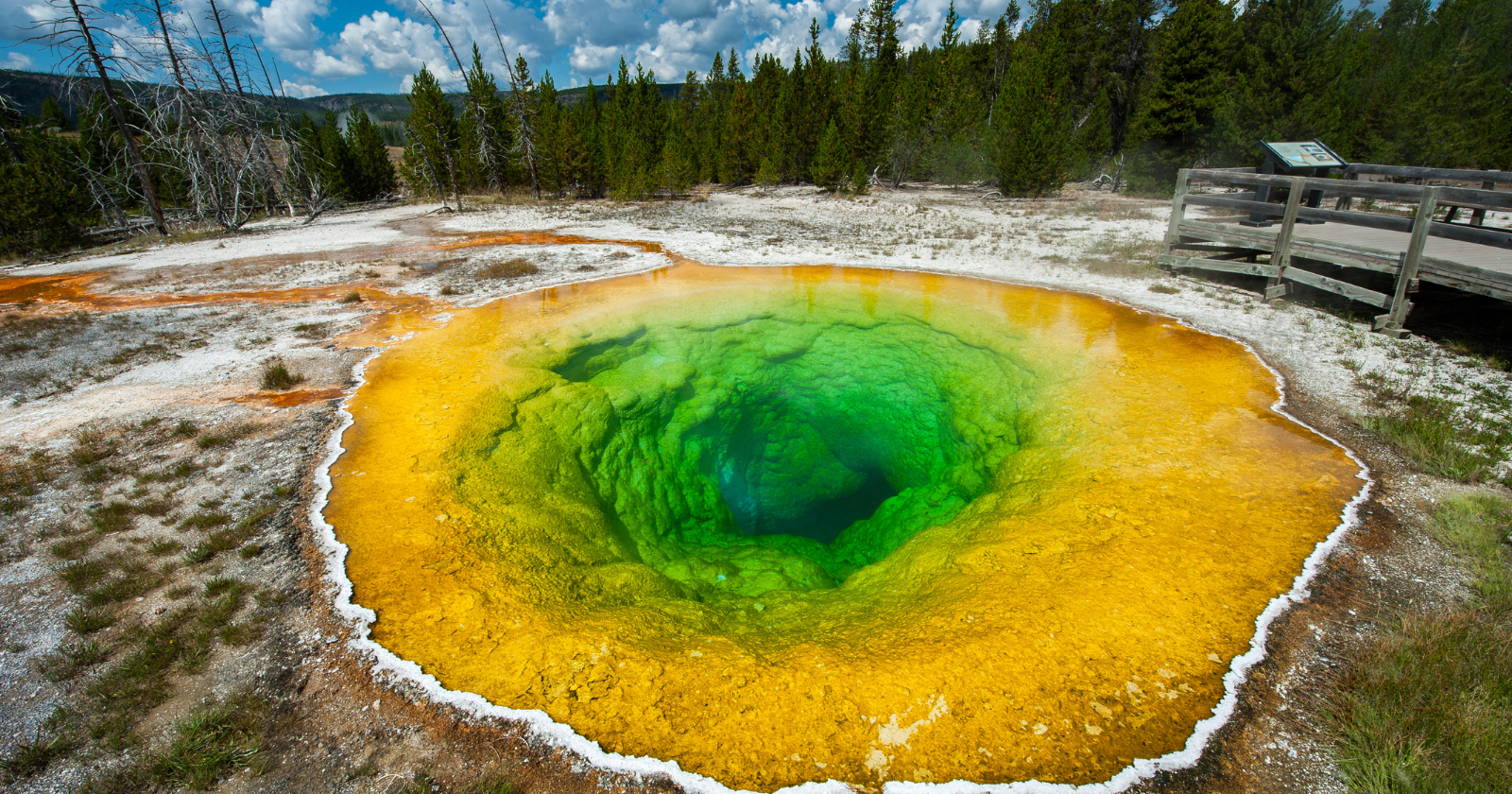
The photographs from the 1880s survive mostly as descriptions, and the descriptions all reach for the same comparison: a hot spring so purely, deeply blue that early visitors named it Morning Glory Pool, after the flower.
Stand at its rim today, a short walk from Old Faithful, and the pool is undeniably beautiful — a green center ringed in yellow and orange, one of the most photographed features in Yellowstone.
It is also a crime scene, and the colors are the evidence. Morning Glory doesn’t look like this because of nature. It looks like this because, for the better part of a century, people threw their garbage into it — and the garbage rewired the spring’s biology from the bottom up.
The wishing well era
Yellowstone’s early tourists did not arrive with modern reverence. The park’s own historian, Alicia Murphy, describes visitors tossing objects into any crevice they could find, hoping to make something interesting happen — a popular theory held that throwing things into a pool might trigger an eruption.
Morning Glory got the worst of it for a simple reason: the old park road ran directly beside the pool, making it a drive-up attraction. Coins by the thousands, bottles, rocks, logs, handkerchiefs — so much refuse accumulated that by the 1950s the spring had earned a bitter park nickname: “the garbage can.” A single cleanup in 1950 pulled out a small treasury of coins; a 1975 effort filled crates.
The debris that couldn’t be netted out did the lasting damage. It settled into the spring’s vent — the throat through which superheated water rises — and became embedded there, restricting the flow of hot water into the pool.
Color is temperature
What happened next is a chemistry lesson written fifty feet across.
A Yellowstone spring’s color is largely a thermometer. At the hottest temperatures, almost nothing can live in the water; it stays sterile and clear, and pure deep water scatters light the way the sky does — blue. That was Morning Glory’s original state: too hot for life, and blue because of it.
Choke the vent, and the pool cools. Cool it enough, and it crosses the survival thresholds of thermophiles — heat-loving microbes that grow in vast colored sheets called microbial mats, each species with its own preferred temperature band. Yellow and orange species colonize the warm shallows; green mats take the cooler zones. As Mike Poland, scientist-in-charge of the Yellowstone Volcano Observatory, put it: hotter pools tend to be brilliant blue, cooler pools grow colorful, and at Morning Glory the cooling came from people throwing objects in.
The pool’s famous rainbow, in other words, is an infection made possible by an injury. Every ring of color maps a temperature the spring was never supposed to reach — and researchers at Montana State later confirmed the sequence with optical modeling, reconstructing the blue pool of the historical record from physics alone.
The cleanup that came too late
Rangers have tried to reverse it. In the 1970s they partially drained the pool and hauled out as much embedded debris as they could reach; the famous park photos show a scientist in a climbing harness working the vent with a long-handled net. Occasional induced-eruption cleanings followed.
The efforts couldn’t reverse the change. Too much material sits too deep in the plumbing, and the U.S. Geological Survey’s own assessment is the one in this article’s title: there is a chance Morning Glory will never appear in its clear blue state again.
The park did win the behavioral war — the access road was rerouted into a walking trail decades ago, and veteran park photographers note that the coin-paved spring bottoms of the mid-century are mostly gone. But the 2018 eruption of nearby Ear Spring delivered a reminder of how long the ledger stays open: the blast ejected decades of buried tourist debris, including coins, cans and a pacifier from the 1930s.
The pretty warning
There is an uncomfortable irony in Morning Glory’s afterlife: the damage is photogenic. Millions of visitors photograph the orange-and-green pool every year, most never learning that they’re photographing a wound — that the palette exists because the spring runs tens of degrees cooler than its design temperature, with a vent full of their great-grandparents’ pocket change.
Which is what makes the pool worth writing about, and what the park’s signage now says in gentler words. A thermal spring is plumbing, alive and precise, and it has no way to digest a wish. Every coin was harmless; the hundred thousand coins were a valve, slowly closing. Morning Glory keeps its new colors as a permanent receipt — proof that a natural wonder can be vandalized not in one act but a penny at a time, by people who each believed they were leaving nothing behind but luck.
