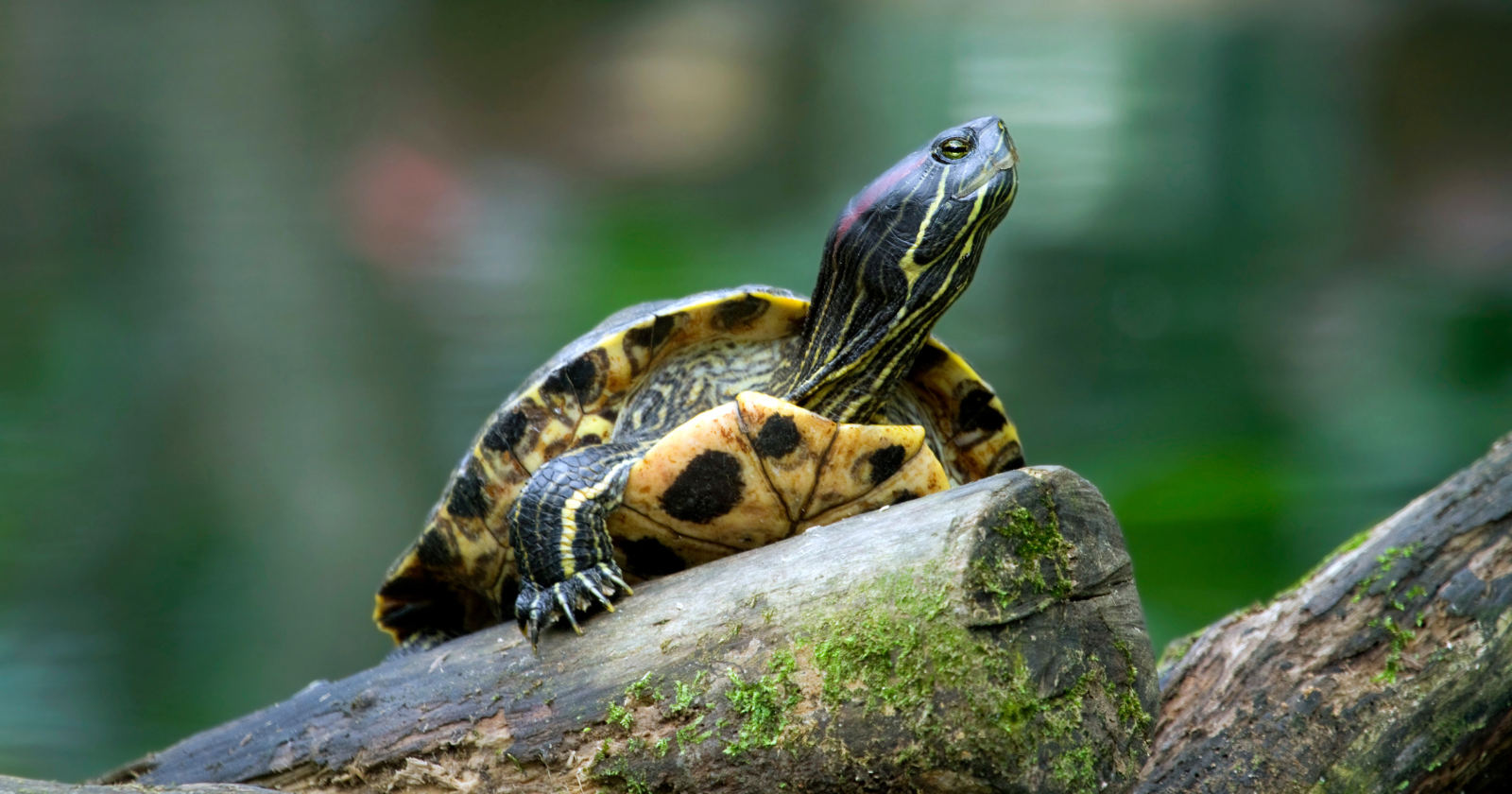
The story begins with a cartoon. In late 1987 a low-budget animated series called Teenage Mutant Ninja Turtles began airing on American children’s television, and within eighteen months it had become the most successful children’s franchise of its decade. Sales of turtle-themed toys, lunchboxes, video games, and Halloween costumes went through the roof. And so did sales of actual pet turtles. American reptile farms, most of them clustered along the Mississippi River basin where the red-eared slider is native, ramped up production to meet the demand. Hatchlings the size of a fifty-cent piece were shipped by the tens of millions to pet stores across the United States and around the world.
What almost nobody selling the turtles bothered to mention was that a hatchling red-eared slider grows into an adult red-eared slider weighing up to three kilograms, requiring a hundred-gallon tank with filtration, and living for forty years or longer. Within a few years, unwanted adult sliders started turning up in ponds, rivers, and public parks in countries where the species had never existed before.
How 52 million turtles left the country
According to the International Union for Conservation of Nature’s Global Invasive Species Database entry on Trachemys scripta elegans, compiled by the IUCN Species Survival Commission’s Invasive Species Specialist Group and citing the original Telecky 2001 tally of the United States pet turtle export trade, more than 52 million red-eared sliders were exported from American turtle farms to overseas pet markets between 1989 and 1997. The primary destination was China, though large numbers also went to Japan, Taiwan, Thailand, South Korea, and Singapore, along with substantial shipments to France, Spain, Italy, Germany, the United Kingdom, Australia, South Africa, and Brazil. The reason American farms could produce sliders at that scale was that the species is remarkably easy to breed in captivity. The reason they were so easy to ship was that a hatchling turtle weighs almost nothing and can be packed into ventilated boxes by the hundreds.
The European Union, watching this happen in real time, banned the import of Trachemys scripta elegans on 22 December 1997. That single regulatory decision effectively ended the American export trade to Europe overnight. By the time it came into effect, however, the damage across the European continent was already done. Feral populations had established themselves in France, Spain, Italy, Portugal, Slovenia, Greece, Germany, Austria, Switzerland, the Netherlands, Belgium, Poland, Latvia, and the United Kingdom. Similar populations were showing up in the wetlands of every country the trade had reached. The turtles that had already been sold were still alive. Their owners were still tiring of them. The ponds behind their houses were still available.
If our animal kingdom fascinates you, you’ll enjoy this video we made on the recorded adventure of a young elephant bull, and what his route revealed:
What happens when a tank turtle meets a lake
The red-eared slider turns out to be an unusually well-equipped invader. It reaches sexual maturity in three to four years, which is faster than most native freshwater turtles it competes with. Females can lay up to six clutches per year of up to thirty eggs each, giving the species a reproductive rate roughly two or three times higher than the European pond turtle it is now displacing across much of the continent. Adults tolerate a wide range of water conditions, from clean rural rivers to heavily polluted urban canals. They are omnivorous and will eat almost anything a freshwater environment can offer. They are aggressive at basking sites and will physically displace smaller native turtles from the sunning logs they need for thermoregulation.
The competitive dynamic has been most extensively studied in France, where researchers from the University of Paris-Sud have been documenting the interaction between introduced sliders and the native European pond turtle (Emys orbicularis) for the past two decades. What they have found is that in ponds where sliders are present, the native pond turtles are pushed to lower-quality basking sites, tend to survive at lower rates, and produce fewer offspring per breeding season. The European pond turtle is classified as Near Threatened on the IUCN Red List. Every additional slider in a European wetland adds to the pressure. Similar competitive displacement has been documented in Washington State against the Pacific pond turtle, in Australia against native short-necked turtles, and across Asia against a dozen freshwater species that had evolved in the absence of anything resembling a Mississippi-basin generalist.
According to The Nature Conservancy’s 2019 Cool Green Science article on American species invading other countries, written by staff science journalist Justine E. Hausheer, the geographic reach of the red-eared slider now covers essentially every continent where freshwater habitat and moderate temperatures exist. Established feral populations have been confirmed in the western United States, Australia, New Zealand, Europe, Great Britain, South Africa, the Caribbean, the Middle East, Southeast Asia, and several Pacific island groups. Only Antarctica remains slider-free, and even that exemption is only because Antarctica has no freshwater ponds and does not get above freezing for most of the year. If it did, and it had ponds, the sliders would probably be there too.
The IUCN Species Survival Commission’s Invasive Species Specialist Group formally listed the red-eared slider on the Global Invasive Species Database’s roster of the hundred worst invasive species anywhere in the world. The species now ranks number 93 on that list. It sits alongside brown rats, feral cats, cane toads, and the emerald ash borer as a species whose global spread has caused measurable and lasting ecological harm. Australia’s Vertebrate Pests Committee has assigned it a threat category of EXTREME. Multiple European countries have banned its sale, its keeping as a pet, or both. Illegal shipments continue anyway. Buddhist mercy ceremonies in parts of East Asia continue to release captive-bred sliders into rivers as an act of religious devotion, unaware or unbothered that the specific animal being released is an invasive species that will outcompete the native turtles the ceremony was originally designed to protect.
What the whole episode represents is one of the more improbable ecological consequences of a late-1980s children’s television programme. The Ninja Turtles cartoon ran for ten years. American reptile farms produced tens of millions of live turtles to meet the resulting demand. The turtles grew larger than their owners expected. The owners released them into the nearest available water. And forty years later, a native North American reptile that once occupied the freshwater ponds of a few states along the Gulf Coast now occupies almost every freshwater pond on the planet warm enough to support it. The turtles never asked to be there. They just weren’t given much choice. And once they arrived, they turned out to be remarkably well-suited to staying.