

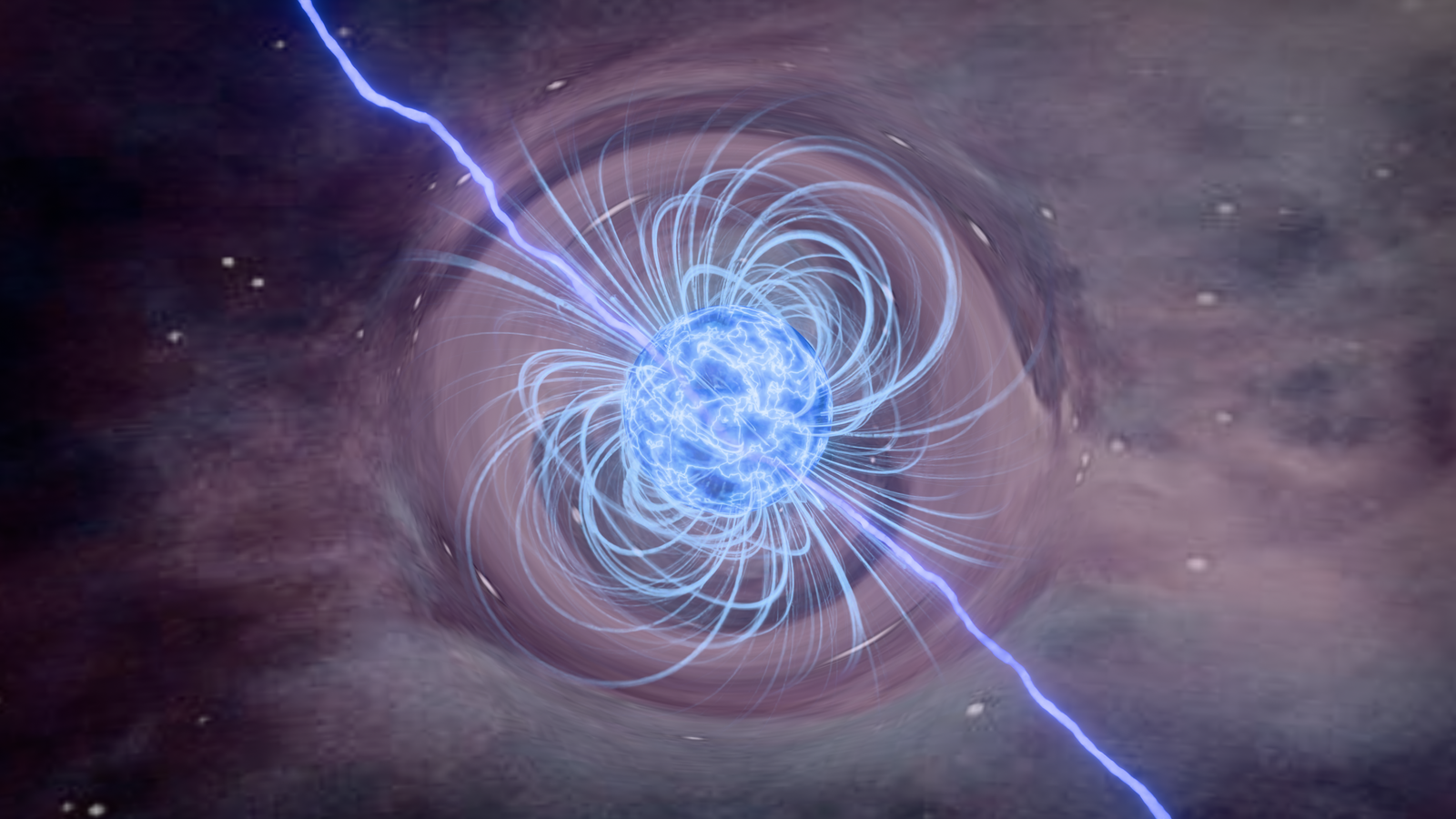
For about one second after two neutron stars collided 130 million light-years away, the wreckage they left behind was hotter than anything else in the observable universe. Bhupal Dev, a physicist at Washington University in St. Louis, and four collaborators asked what that one second would have manufactured if a hypothetical particle called an axion-like particle exists — and then went looking for the light it should have left behind.
Nothing arrived. The shape of that absence is the result.
What GW170817 actually was
On 17 August 2017, the LIGO and Virgo detectors recorded a gravitational-wave chirp lasting roughly 100 seconds, the longest signal captured to that point. About 1.7 seconds later, NASA’s Fermi Gamma-ray Burst Monitor caught a short gamma-ray burst from the same patch of sky. The coincidence is documented in the collaboration’s multi-messenger paper in The Astrophysical Journal Letters.
Less than eleven hours after the merger, the one-metre Swope Telescope in Chile pinned the source to NGC 4993, a lenticular galaxy about 40 megaparsecs — roughly 130 million light-years — away. Within a day, dozens of observatories were watching a fading point of light that astronomers had spent decades predicting and never seen: a kilonova.
Two neutron stars had spiralled into each other, each somewhere between about one and two times the mass of the Sun, each compressed into an object about the size of a mid-sized city. When they touched, the collision briefly produced conditions denser and hotter than anywhere else in the observable universe.
ESO’s telescopes in Chile tracked the afterglow across a wide range of wavelengths, and the observatory’s October 2017 announcement of the first visible counterpart to a gravitational-wave source reported spectra suggesting caesium and tellurium in the ejecta. Two years later, a separate analysis of VLT X-shooter data pinned down strontium, the first individual heavy element identified in a neutron star collision. Some of the gold in a wedding ring was made in events like this one.
Why the remnant is a particle factory
Before they merge, neutron stars are cold by particle-physics standards — thermal energies around a kilo-electron-volt. The collision changes that within milliseconds. Temperatures in the remnant climb into the tens of MeV, and the benchmark merger profile Dev’s group used exceeds 50 MeV in places, roughly 600 billion degrees. Production rates for weakly coupled particles rise steeply with temperature. Whatever exists in the right mass window gets made.
Axion-like particles, or ALPs, are among the most-hunted candidates. They are cousins of the axion — the particle implied by the Peccei-Quinn mechanism proposed in 1977 to resolve a puzzle in the strong nuclear force, and named the following year by Weinberg and Wilczek. ALPs relax the axion’s strict relationship between mass and coupling, and they appear generically in string theory and in many extensions of the standard model.
The catch is that they interact with ordinary matter so feebly that laboratory experiments struggle to reach the parameter space that matters. Which is where dead stars come in.
How the bound actually works
The property Dev’s group targeted is the ALP’s coupling to photons. In the hot, dense matter of the remnant, two processes make ALPs: the Primakoff process, in which a photon scattering off a proton converts into an ALP, and photon coalescence, in which two photons merge into one. Primakoff dominates at low masses, coalescence at high ones, with the switchover around 100 MeV.
What happens next is the whole argument. ALPs stream out of the remnant — those with enough kinetic energy to climb out of its gravitational well, at least — and then decay back into pairs of photons well outside the debris. The team required decays beyond about 1,000 kilometres, far enough that the emitted photons would not simply be reabsorbed by the ejecta. The result would be a gamma-ray signal arriving roughly along the line of sight to the merger, offset in time from the gravitational waves by the geometry of where each ALP happened to decay.
Fermi-LAT was watching. It missed the prompt burst, but it collected data in the window from 1,153 to 2,027 seconds after the gravitational-wave signal, across 0.1 to 1 GeV, and saw nothing above a flux upper limit of 4.5 × 10⁻¹⁰ erg per square centimetre per second at 95% confidence. Every combination of ALP mass and photon coupling that would have produced a brighter signal than that is excluded. The preprint sets out the full calculation, including the decay geometry and the in-medium photon physics.
That is the first constraint of its kind derived from a merger, as the university’s announcement of the work noted. Two representative points in the newly excluded region sit at masses of 200 and 398 MeV. Worth being precise about what this is not: it is not a cooling argument. The team explicitly checked that across the parameter space they constrain, ALP emission does not drain enough energy to alter how the remnant cooled.
What the bound covers, and what it does not
The GW170817 exclusion is weaker than the long-standing limit from Supernova 1987A, and the reason is geometry rather than physics. Photon flux at Earth falls off with the square of the distance to the source. A supernova in the Large Magellanic Cloud is far closer than a merger at 40 megaparsecs, so it delivers more photons even from an identical ALP population.
What the merger offers instead is timing. The arrival of the gravitational-wave signal defines a clean zero point, which supernovae generally lack — for SN 2023ixf, no neutrino signal was detected at all. Combining spectral and temporal information from a merger, the authors argue, is where this method becomes competitive, particularly for observations inside the first second.
The constraint is also more robust than the article’s underlying uncertainties might suggest. GW170817’s remnant is thought to have survived about a second before collapsing to a black hole; varying that assumed lifetime between 0.72 and 1.29 seconds barely moves the exclusion region, and the result depends only weakly on which of nine merger profiles is used.
None of this detects anything. It tells you what an ALP cannot be, given that GW170817 behaved the way it did. And the dark matter question is separate again: an ALP in this mass range could in principle be a dark matter component, but a production bound from one merger says nothing about cosmological abundance. It shrinks the box. It does not confirm anything is in it.
The source that keeps giving
The merger’s own story has kept moving independently of the particle physics. Chandra saw nothing when it first slewed to the target, then found a point source on 26 August 2017. That sequence — non-detection, then detection — was itself the clue. It indicated a narrow relativistic jet pointed away from Earth, whose emission only reached the detector once the jet slowed and widened into the line of sight.
Then the fading stopped. As the Center for Astrophysics reported in March 2022, Aprajita Hajela of Northwestern University and colleagues found that from March 2020 through the end of that year the X-ray brightness held roughly constant. Something besides the jet had taken over. The two candidates are a kilonova afterglow — a shock from the expanding debris — or matter falling onto a newly formed black hole. Either would be a first, and radio observations are the test: a kilonova afterglow should brighten in radio, accretion onto a black hole should not.
At the time of that release, Chandra was the only observatory still able to detect the source, more than four years after the collision.
Space Daily has covered other corners of the same search. A Rice University team has used a grain-of-sand-sized magnet levitated above a superconductor to hunt for ultraheavy dark matter, extending the search toward candidates approaching the mass of a living cell, according to the group’s own account of the experiment. That is the far end of the mass axis from the MeV-scale ALPs Dev’s group is bounding — a table-top instrument at millikelvin temperatures on one side, a collision 130 million light-years away on the other.
Using distant catastrophes as instruments
GW170817 remains the only confirmed binary neutron star merger with a full electromagnetic counterpart. LIGO and Virgo have caught other candidate neutron star events, but none produced the same multi-wavelength bounty, which is why the same dataset keeps being reprocessed for new physics. A 2021 review by Milton Ruiz, Stuart Shapiro and Antonios Tsokaros in Frontiers in Astronomy and Space Sciences surveys what relativistic simulations can now say about these events, including the consensus that GW170817’s remnant lasted under a second before collapsing.
A cleaner ALP constraint needs more mergers, or closer ones. The authors sketch both: a stacked analysis of several events, a hypothetical merger ten times nearer, and early observation windows starting a tenth of a second after the gravitational-wave trigger. Proposed MeV gamma-ray missions such as AMEGO-X and e-ASTROGAM would help considerably.
When that data arrives is unsettled. O4 ended on 18 November 2025, and the detectors have since been in upgrades and commissioning. According to the LIGO-Virgo-KAGRA observing plan, an interim six-month run is expected around late 2026, while the timeline for the fifth observing run remains under discussion.
The hot phase of the merger lasted about one second. The gravitational-wave chirp lasted about a hundred. Somewhere between those two numbers is a photon signal that never reached Fermi’s detectors — and the precise shape of that absence, how bright it wasn’t and how early it wasn’t, is what now fences off a corner of parameter space where a particle nobody has ever seen can no longer hide.