

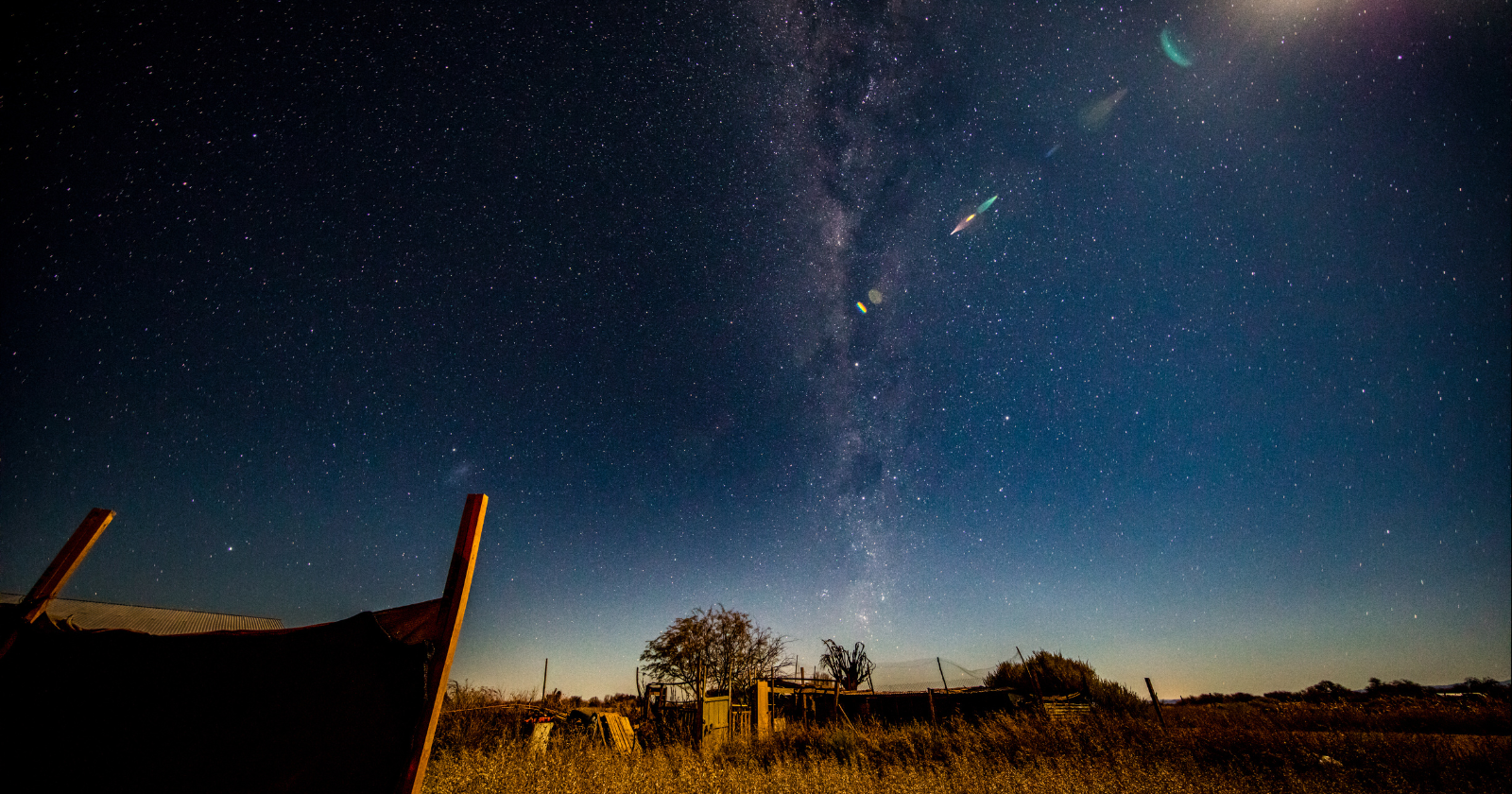
On 13 January 2026, a faint smudge showed up in a photo taken by a small telescope in the high desert of northern Chile. Not a professional survey. Four amateur astronomers running their own asteroid-hunting program.
The smudge turned out to be a comet on a loop that had last brought it near the Sun about seventeen centuries earlier.
Here is how a few people with modest gear caught a visitor no living person had ever seen, and what it says about who finds comets now.
What actually happened that night in the Atacama
The discovery came out of a program called MAPS, named for the four people running it. Alain Maury, Georges Attard, Daniel Parrott and Florian Signoret found the object using a telescope they operate remotely in San Pedro de Atacama. The instrument was not a giant. It was an 11-inch Schmidt telescope, the sort of thing you might find in a serious backyard setup.
What made this find stand out was how early it came. On his observatory blog, Maury wrote that “this is the first time such a comet has been discovered so early, allowing time to study its development as it approaches the Sun and becomes increasingly active.” We’d treat that as the discoverer’s own claim rather than a settled record. But the broader point holds: the comet was spotted a long way out, giving astronomers weeks to watch it approach.
What a Kreutz sungrazer actually is
The object, catalogued as C/2026 A1 (MAPS), belongs to a family called the Kreutz sungrazers. These are thought to be pieces of one huge comet that broke apart long ago, and they share a defining trait: they pass extremely close to the Sun. They also turn up constantly. The Sun-watching SOHO spacecraft alone has logged more than 3,500 comet discoveries in this family.
Most of those are tiny and are only ever seen in images from a solar observatory, where the Sun’s glare is blocked out. What set this one apart was how far away it was caught. Reporting describes it as the most distant an incoming Kreutz sungrazer had ever been spotted.
Why nobody alive had seen it before
The reason this comet felt like a stranger is simple once you look at its orbit. Its path around the Sun is a long, stretched-out loop running far into the outer solar system and back. The trip takes so long that its last close approach came many centuries before anyone now living was born.
However, there may even be a record of that previous pass. Recent observations suggest the comet last visited the inner solar system somewhere between 1,700 and 1,886 years ago. NASA/JPL’s Zdenek Sekanina has linked it to a comet seen in daylight in the year 363 from what is now Antakya, in Turkey. If that link holds, the last people to watch this object were living in the late Roman world.
How close?
Sungrazers earn their name, but it is worth being precise about what “close” meant here. On 4 April 2026, exactly 81 days after discovery, the comet reached its closest point to the Sun, passing just 99,400 miles (160,000 km) from the Sun’s visible surface. Extremely close by the standards of the solar system, but not a literal touch.
Chris Mihos, a professor of astronomy at Case Western Reserve University, put it plainly before the pass. As Mihos told National Geographic, “in the case of C/2026 A1, it’ll come within 100,000 miles of the Sun’s surface, which is extremely close.”
Whether anyone would get a good look at it afterward depended on whether it survived. Mihos was cautious, noting that “if we see anything of it, it won’t be until after it passes the sun on April 4th.” There was nothing to see. The comet did not survive the close pass, breaking apart near the Sun. For a Kreutz sungrazer, that is a common ending. Some fragments make it through; many do not.
What this says about who finds comets now
The detail that keeps pulling us back is not the comet itself but who caught it. The record for the earliest a Kreutz sungrazer has been found belongs to this discovery. As Nick James of the British Astronomical Association’s Comet Section wrote, “this discovery is the earliest that a Kreutz comet has been discovered with discovery occurring 81 days before the April 4 perihelion.”
None of this was done at a flagship observatory with a mountain-top dome and a research budget. It was done with a small remote telescope, wide-field cameras, and software good enough to pull a moving speck out of a crowded field of stars. That model is not new to comet hunting. Amateurs poring over SOHO’s public images have themselves accounted for more than 5,000 of that spacecraft’s comet finds. What is newer is a group running its own telescope in one of the darkest, driest skies on Earth and catching a long-orbit visitor before the professional surveys did.
The comet is gone now, scattered as dust and gas somewhere near the Sun. What remains is the fact of the catch: four people, one modest telescope in the Atacama, and a stretch of clear desert sky, finding something whose last witnesses lived in the fourth century. The tools have gotten cheap enough and capable enough that the next stranger on a long orbit may well be spotted the same way.