Rwanda’s mountain gorillas now face habitat loss as their defining problem, with CGTN Africa reporting that the work has shifted from guarding individual animals to holding onto the shrinking forest they and their neighbours both need
As Rwanda's mountain gorillas multiply, conservationists confront a harder problem than poaching: there simply isn't enough forest left.
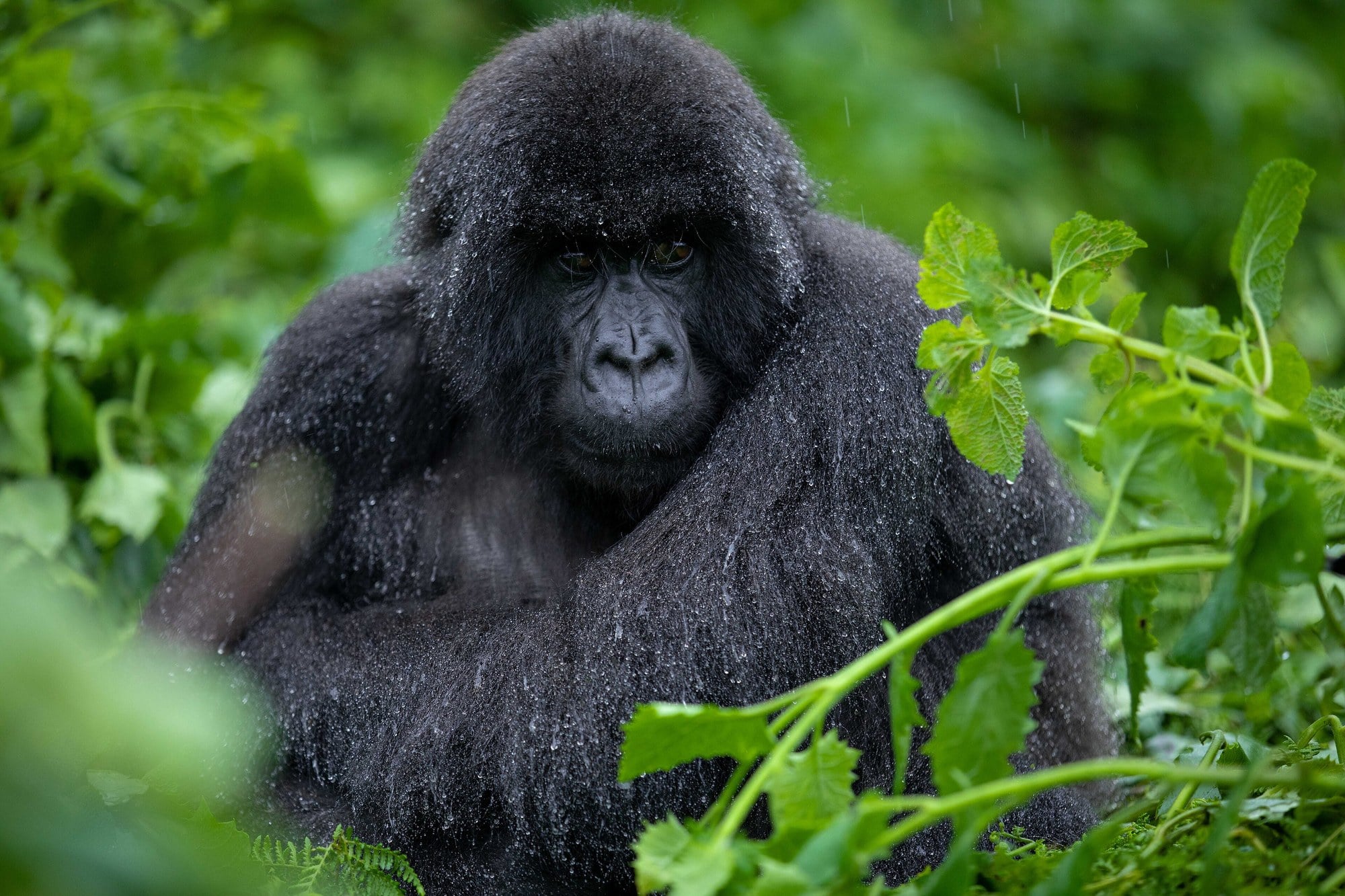
Mountain gorilla from the Susa Group in Karisimbi thicket, Volcanoes National Park, Rwanda (Emmanuel Kwizera / Wikimedia Commons, CC BY-SA 4.0).
The threat to Rwanda’s mountain gorillas is no longer best described as a hunting problem. It is a real-estate problem. In the Rwandan section of the Virunga massif — the volcanic chain that Rwanda shares with the Democratic Republic of the Congo and Uganda — the constraint on the animals’ future is the amount of forest available to them and the intensity of human use pressing against its edges. A CGTN Africa report frames the change plainly: the conservation task in and around Volcanoes National Park has moved from guarding individual gorillas against poachers to holding onto a limited forest that gorillas and the farming communities at the park boundary both depend on.
That reframing is easier to state than to see, which is why the field reporting matters. The CGTN Africa segment walks the ground where the park meets cultivated land and lays out the habitat-first argument:
When the bottleneck stops being the poacher
Anti-poaching work built the modern reputation of Virunga conservation, and the trackers, veterinary teams, and daily monitoring routines that came out of that era have not gone away. But a protection model designed around the threat of an individual animal being killed does not automatically solve the problem of a population that has recovered enough to feel the walls of its enclosure.
Volcanoes National Park is a bounded protected area on the Rwandan flank of a transboundary massif, ringed by some of the most intensively farmed land in the region. Gorilla families range within that boundary and, at times, across it. Where forest edge meets cropland, the interaction is not abstract: animals move into gardens, crops are lost, and households absorb the cost of living beside a protected area whose benefits are not automatically distributed to the people nearest to it. The same edge is where disease transmission risk between people and great apes is highest, and where the habituation that sustains gorilla tourism carries its own contact burden.
The habitat-shift thesis reported by CGTN Africa follows from that geometry. If the forest cannot grow and the pressure on its perimeter does not ease, the achievement of past decades becomes a ceiling rather than a floor. Protection then has to mean something broader than patrol coverage — it has to mean securing space, and negotiating with the people who currently occupy the space you want to secure.
The state’s answer: more park, a buffer, and a village
Rwanda’s institutional response is a park-expansion and community-resilience program that treats land, livelihoods, and habitat as one file rather than three.
According to the Rwanda Development Board and material published on Visit Rwanda, the Volcanoes Community Resilience Project is designed to enlarge Volcanoes National Park by roughly 3,740 hectares — a figure the program describes as an increase of about 23 percent — while establishing on the order of 6,620 hectares of buffer zones around the protected area. The program is presented by these official sources as a multi-year effort estimated at around USD 300 million. Those numbers are program figures as stated by Rwandan authorities and their tourism platform; they describe intent and design rather than completed restoration.
Expansion of that kind is not primarily an ecological engineering problem. It is a settlement problem, because the land in question is occupied. That is the function of the Smart Green Village at Kinigi, in Musanze District, where RDB announced a groundbreaking as the resettlement and livelihood component for households affected by the expansion footprint — housing and services intended to give relocated families a stable base rather than a displacement. RDB has tied the same policy period to the 21st Kwita Izina gorilla-naming ceremony, scheduled for 4 September 2026 under the theme “Conservation is Life: Sustaining the Future.”
The design logic is straightforward even where execution is not: buffer zones are meant to absorb the friction that currently lands directly on farmers’ fields, and expansion is meant to give the population room that patrols alone cannot create. Whether the buffer performs as a functioning transition rather than a line on a map is the kind of question that only shows up in years of monitoring data.
A forest two constituencies need
The revenue side is the other half of the argument. RDB states that Rwanda reinvests 10 percent of national-park tourism revenues into the communities surrounding those parks, funding local infrastructure and livelihood projects. It is a mechanism intended to answer the most reasonable objection a boundary household can raise — that the park generates income at national scale while the costs of proximity are paid locally.
Revenue sharing does not by itself resolve the underlying scarcity. A 10 percent allocation flows through a tourism economy that is itself dependent on a small number of habituated gorilla groups in a finite area, which means the funding stream and the habitat constraint are linked rather than independent. Nor does resettlement remove the need for the relationship to keep working after the compensation is paid and the new village is built; the boundary will still be there, and so will the crop raids, the disease-transmission risk, and the daily calculation of what proximity is worth.
What the CGTN Africa reporting captures is that Rwandan conservation now argues in those terms. The historical recovery of mountain gorillas in the Virungas — the reason there is a population large enough to press against its limits — is background here, not the story. The story is a shrinking margin of forest, an expansion program with published targets and a stated price, a village going up at Kinigi, and two constituencies with a claim on the same slope. How much of the 3,740 hectares becomes functioning habitat, and how the households moved for it fare afterward, are the measures that will settle whether the shift from guarding animals to holding ground was the right read.
About this column
Deep Field
Deep Field covers astronomy and cosmology. Telescopes and what they find, planets near and far, and the strange physics of the deep universe, traced back to the journal papers and observatory data behind the headlines.