

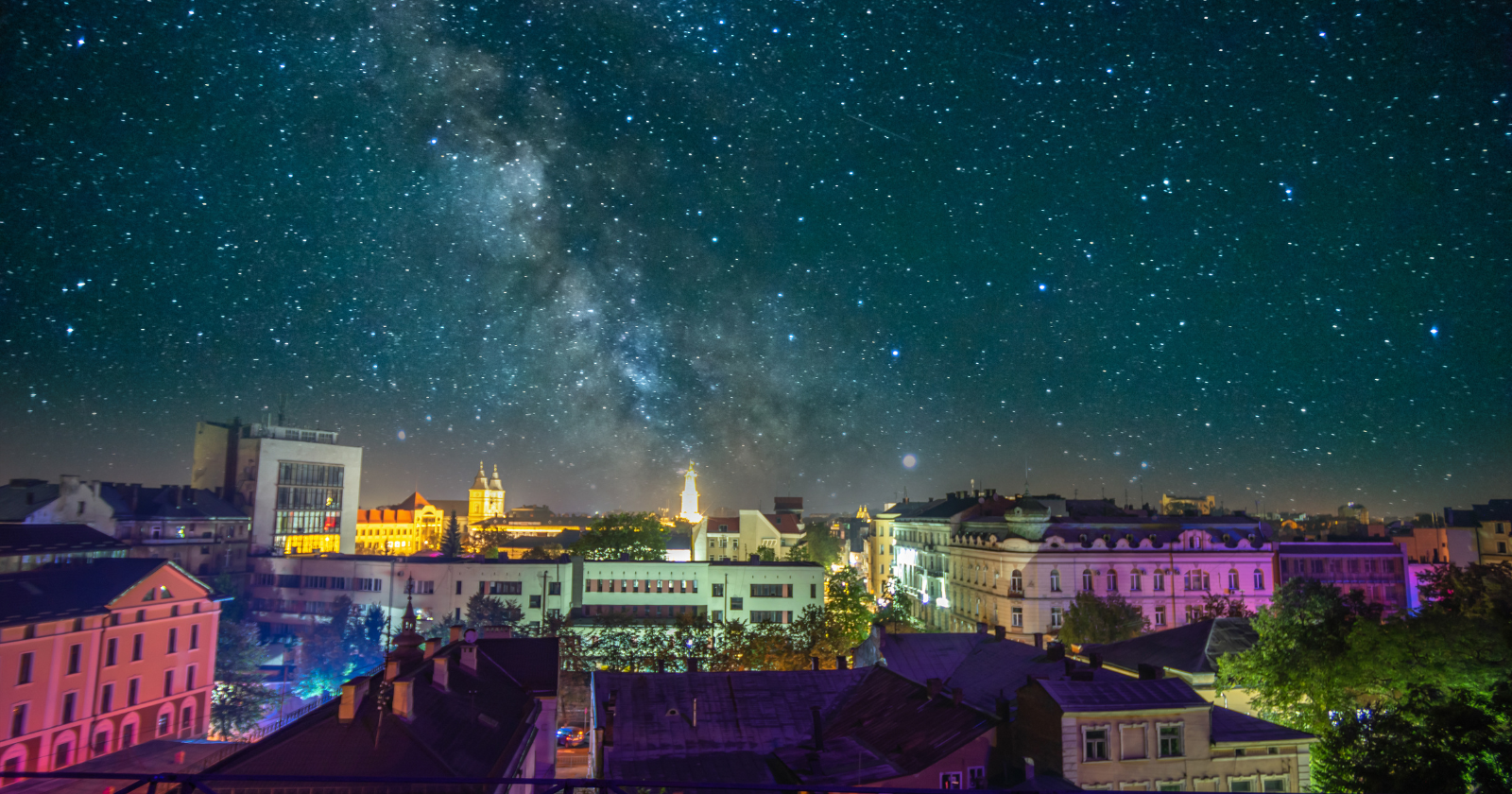
Roughly 80 percent of North Americans can no longer see the Milky Way from where they live. The galaxy that every human generation before electricity knew by heart has been washed out of the sky, city by city, without anyone voting on it.
Flagstaff, Arizona voted on it — in 1958.
Step outside on a clear night in this mountain city of about 75,000, and the arms of the home galaxy still span the darkness above the streetlights. Not from a wilderness overlook; from town. It is one of the only cities of its size on the continent where that sentence is true, and the reason traces back to a single telescope and the world’s first law against light.
A telescope with a problem
Flagstaff’s relationship with the night sky is its origin story. Percival Lowell put his observatory on a hill beside the little logging town in 1894 precisely because the high, dry air was so clear — this is where Pluto would later be discovered, in 1930, from a mesa the locals call Mars Hill.
By 1957, the town below had grown bright enough to matter. Lowell Observatory was taking delivery of a powerful 69-inch reflecting telescope from Ohio, and its astronomers realized the instrument could not reach its potential under the town’s spreading glow. They sited it on Anderson Mesa, a dozen miles out — but one hazard could ruin even that refuge: the advertising searchlights then fashionable at businesses, each one capable of spoiling the sky for miles.
So the astronomers went to city hall. One of Lowell’s own had once been mayor; the pitch, as observatory historian Kevin Schindler tells it, was modest — not to get rid of light, just to regulate how it’s used. In 1958 the council passed Ordinance 400, banning commercial searchlights: the first outdoor lighting ordinance anywhere in the world.
The law that kept compounding
One anti-searchlight rule doesn’t keep a city dark. What kept Flagstaff dark is that the 1958 law became a habit.
In 1972 the city required outdoor lights to be shielded and aimed downward — light on the ground, not the sky. In 1989, city and county capped the total amount of light permitted per acre, zone by zone, a genuinely radical idea: treating darkness as a budgeted public resource. The codes specified the kind of lighting too, favoring warm, narrow-spectrum lamps that telescopes can filter out and eyes find gentle, and the city has kept updating the rules through the LED era, choosing low-temperature streetlights when brighter, bluer ones would have been cheaper.
The result is not a dim city. Gas stations are lit, streets are lit, people walk at night — the lights are simply pointed at what they’re for. In 2001, the International Dark-Sky Association crowned the sum of all this by naming Flagstaff the world’s first International Dark Sky City, the founding member of a movement that now spans hundreds of places worldwide.
The beneficiaries nobody planned for
The law was written for one constituency: telescopes. Its accidental beneficiaries turned out to be everything else that lives at night.
Light pollution is now recognized as a genuine ecological force — it disorients migrating birds, suppresses insect populations, scrambles the schedules of bats, moths and pollinators, and rewires predator-prey rules wherever the sky glows. Flagstaff’s surrounding forests and the wildlife in them simply never underwent that experiment; the city’s ponderosa nights stayed dark enough that its nocturnal animals kept the conditions they evolved for, a century of urban growth notwithstanding. Researchers studying light and wildlife now use dark-sky cities as the rare urban control group.
The humans got their share too. Astro-tourism has become a real industry — visitors traveling specifically to stand in a parking lot and be stunned — and the astronomy economy the ordinances protected (Lowell, the U.S. Naval Observatory’s Flagstaff station, and the discoveries that flowed from them) grew into a regional identity. Schindler’s line about the payoff is the human version of the data: he has watched visitors cry at the sight.
The moral in the dark
The Flagstaff story earns retelling because it inverts the usual environmental script. There was no crisis, no reckoning, no expensive restoration — just a small law passed early, before the thing it protected was lost, renewed by each generation because the residents could step outside and see what they were saving.
Every other city made the opposite choice by default, one unshielded fixture at a time, and is now discovering what it costs to buy darkness back. Flagstaff never had to. It regulated light the way towns regulate noise — as a thing that belongs where it’s aimed — and seventy years later the dividend hangs overhead every clear night, free, ancient and intact: a city where looking up still works.
