
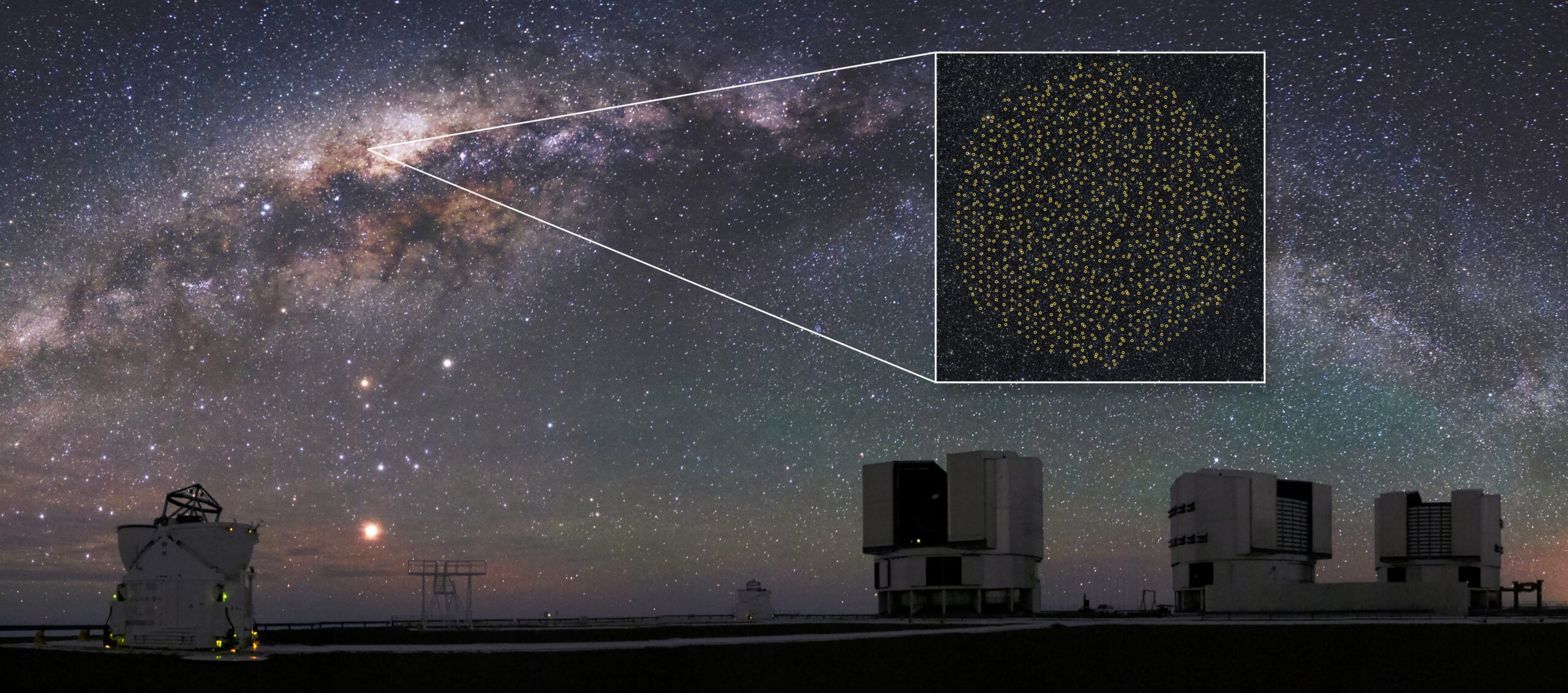
A new spectrograph on the Very Large Telescope has opened its eyes on roughly a thousand things at once. The European Southern Observatory announced on 3 September 2026 that the Multi-Object Optical and Near-infrared Spectrograph — MOONS — had successfully made its first observations from Cerro Paranal in northern Chile, splitting the light of about 1,000 astronomical targets simultaneously through about 1,000 optical fibers, each steered by its own robotic positioner. It is a first-light milestone with a long tail: over a ten-year design lifetime, ESO says the instrument is expected to observe up to ten million objects, an expectation rather than a completed census, and one that begins now with a single successful pointing.
MOONS sits on Unit Telescope 1 of the VLT, at a Nasmyth focus, which is another way of saying that an 8.2-meter mirror's worth of collected starlight now arrives at a machine designed to divide it a thousand ways rather than one. That ratio is the whole point. Spectroscopy is astronomy's slowest luxury — it takes light apart to read composition, motion, and mass — and for most of its history it has been done a handful of objects at a time. Multiplexing at this scale changes the arithmetic of what a survey can afford to ask.
One pointing, about a thousand spectra
The trick is mechanical before it is optical. Across a large field of view, roughly a thousand fibers are carried on robotic positioners that place each fiber tip on a chosen target — a star here, a faint galaxy there — so that the telescope's focal plane is reconfigured for each new patch of sky. Light captured in those fibers is then piped into two identical spectrographs, 500 fibers apiece, which do the dispersing.
Those twin spectrographs are not small instruments quietly bolted to a bigger one. MOONS stands roughly 4.5 meters tall and weighs more than 10 tonnes, and its spectrographs are held at cryogenic temperatures — in the range of about −143 to −233 °C, sustained by a large liquid-nitrogen cooling system. The reason is physics rather than fussiness: an instrument built to detect faint infrared light must be colder than the sky it is studying, or its own warmth becomes the brightest thing in the frame.
The instrument was built by an international consortium spanning Europe and Chile, led by the UK Astronomy Technology Centre, part of the UK's Science and Technology Facilities Council, with ESO participating as an associate partner and supplying detectors. MOONS principal investigator Michele Cirasuolo, who is also ESO's Instrumentation Programme Manager, has framed the achievement in terms of years of work by a distributed team converging on a working machine at Paranal; MOONS UK principal investigator Oscar Gonzalez, at UK ATC, has emphasized the consortium engineering behind the fiber-positioning system that makes the multiplex possible.
Red light, and the dust that hides the Galaxy
MOONS works in red and infrared light, and that choice does two very different jobs with the same hardware.
Close to home, it is a way through dust. The plane of the Milky Way — and above all the crowded region toward the Galactic center — is veiled by interstellar grains that scatter and absorb visible light, which is why optical surveys of our own Galaxy have a blind spot pointed at its most interesting part. Longer wavelengths slip through more of that obscuration. Astronomers have long exploited rare low-extinction sightlines such as Baade's Window to peer toward the bulge; an infrared multi-object spectrograph is a more general solution, reading stars where the dust is thick rather than only where it thins.
Far from home, the same red sensitivity is a consequence of cosmology. The expansion of the Universe stretches light from distant galaxies toward longer wavelengths, so features that would be visible in a nearby galaxy's spectrum arrive in the infrared for a remote one. An instrument optimized for red and near-infrared light is therefore an instrument optimized for the early Universe, without changing a single mirror.
For first light, the team pointed at stars in an obscured stretch of the galactic plane — a demonstration that the fibers, the positioners, and the cold spectrographs can together pull stellar spectra out of a dust-dimmed field. MOONS Project Scientist Amelia Bayo, at ESO, has underlined that the science case rests on exactly this combination of wavelength coverage and sheer number of simultaneous targets. What a spectrum yields, once it is in hand, is not a picture but a set of measurements: chemical composition, velocity along the line of sight, and constraints on mass.
Ten years, and the maps it is built to fill
ESO's stated expectation — up to ten million objects across a ten-year design lifetime — is best read as a design goal rather than a promise, and it describes the shape of the surveys MOONS was commissioned to make possible.
One is Galactic. Velocities and chemical abundances for millions of Milky Way stars, gathered including in regions shrouded by dust, are the raw material for a three-dimensional map of our own Galaxy's structure and history, reaching stars out to roughly 40,000 light-years according to ESO. Chemistry records where a star's gas came from; velocity records where the star is going. Together, at scale, they let a galaxy's assembly be reconstructed from the inside.
The other is extragalactic: spectroscopic follow-up of galaxies, including distant ones, converting imaging catalogs of dots into measured distances and compositions. Imaging surveys have supplied far more candidate galaxies than spectroscopy has been able to characterize; instruments like MOONS exist to narrow that gap.
None of that is done. What exists as of 3 September 2026 is a working machine on UT1 that has proven it can hold about a thousand fibers on about a thousand targets and bring their light, cold and dispersed, to a detector. The sky is not mapped. The window is open.