

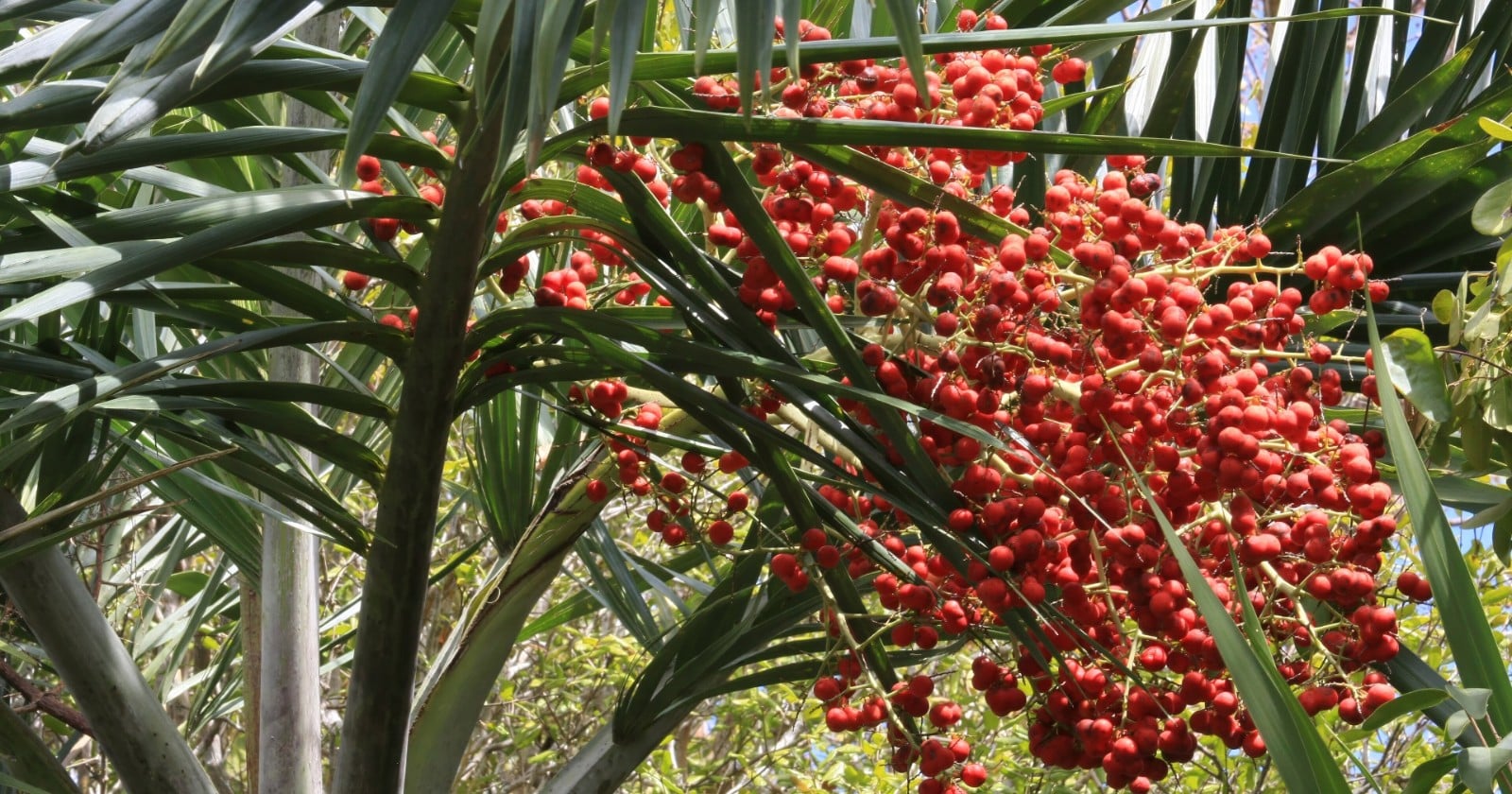
Six date seeds that spent about two thousand years in the Judean desert and decades more in storage at room temperature have germinated and grown into living palms. On inspection nothing separated them from the seeds planted alongside them that stayed dead.
The result, reported in 2020 in Science Advances by Sarah Sallon and colleagues, brings to seven the number of ancient Judean date seeds coaxed back into growth and then genetically analysed. Radiocarbon measurements on shell fragments still clinging to the seedlings’ roots place those seven between the fourth century BCE and the second century CE, once the researchers correct for modern carbon the seedlings took up while they were growing.
The excavations that turned them up
Hundreds of date seeds came out of the Judean desert in excavations and surveys between 1963 and 1991, along with other plant material. Four sites supplied the ones used here.
Masada is the fortress and palace complex built by Herod the Great above the southern end of the Dead Sea, on an earlier Hasmonean fortification. The seeds there lay under rubble close to an area the excavators identified as food storage. Qumran is the site, a settlement and the cliff caves around it, where the Dead Sea Scrolls were found in 1947; the seeds came from two of the caves. Wadi Makukh and Wadi Kelt are winter water channels cut through the desert.
Yigael Yadin of the Hebrew University dug Masada between 1963 and 1965, and that material reached Sallon by way of Mordechai Kislev of Bar Ilan University, first in 2005 and again in 2007. The Qumran and Wadi Makukh caves were surveyed between 1986 and 1989 by Joseph Patrich and B. Arubas, and the seeds from Qumran, Wadi Makukh and Wadi Kelt all reached her from Patrich in 2009. In between, they sat at room temperature.
The treatment before the soil
Thirty-four seeds were selected out of the collection because they looked whole, in good condition and free of holes. One from Qumran was set aside unplanted, to serve later as a dating control. The other thirty-three went into the preparation.
Each was soaked in water for twenty-four hours, then in gibberellic acid for six hours to encourage embryonic growth, then in a rooting solution for six hours, then in an organic fertiliser for twelve. Every bath was held at 35 degrees Celsius. A single seed was found damaged after that process and was never planted.
The remaining thirty-two were potted separately in fresh sterile soil, a centimetre below the surface, in a locked quarantine site at the Arava Institute of Environmental Sciences at Kibbutz Ketura in southern Israel. Elaine Solowey grew them on. Irrigation used desalinated water, because the team had learned from its first ancient seedling that the region’s heavily mineralised water produces tip burn, a darkening and drying of the leaves.
Adam, Jonah, Uriel, Boaz, Judith and Hannah
Six of the thirty-two came up, and the researchers gave each one a name. Adam came from Masada. Jonah, Uriel, Boaz and Judith came from Qumran. Hannah came from Wadi Makukh. Judith and Hannah are female, and the other four are male, as is Methuselah, the seedling that came out of the same team’s 2008 report on a single germinated date seed from Masada.
Nothing visible marked the six out beforehand. Setting aside the Masada seeds, which were never measured before planting, the seeds that germinated and the seeds that did not were statistically indistinguishable in weight and in length. Whatever separates a viable two-thousand-year-old seed from a dead one, it is not something the eye or the scales pick up.
Ageing a shell pulled from a growing seedling’s roots
The radiocarbon ages come from fragments of seed coat found stuck to the rootlets when the seedlings were moved into larger pots, between three and seventeen months old. But a growing seedling takes up modern carbon, and the team’s earlier work found this pulls a measured radiocarbon age down by roughly 250 to 300 years, the equivalent of two to three percent modern carbon.
So the ages the paper reports are recalculated from the direct measurements, and it prints both. The germinated seeds were set against controls from the same places. Seeds from Qumran Cave 37 were compared against an unplanted seed from that cave, the Cave 13 seed against ancient palm material found wrapping an oil juglet, and Adam against a seed from the earlier Masada work. Hannah has no control at all, because no suitable one existed and her site had been heavily disturbed, so an average deviation taken from the other samples was applied instead.
The adjustment carries real weight. Methuselah was described in the 2008 report as dating to the first century of the Common Era. In the 2020 recalculation Methuselah sits with Hannah and Adam in the paper’s oldest group, which spans the first to fourth centuries BCE. Uriel and Jonah are the youngest at the first to second centuries CE, and Judith and Boaz fall between.
The determinations themselves have been challenged. In a response published on the paper’s own page, the semi-retired archaeobotanist Charles H. Miksicek wrote that he was uncomfortable with them, and named two possible sources of stray carbon. The chemical soaks the seeds were given before planting could have introduced carbon of their own. Old carbon taken up from the region’s notoriously mineralised groundwater while the palms were originally alive could push a measurement in the opposite direction to the modern-carbon effect, making a seed look older than it is. He also proposed an easy test of the first, running a second batch of seeds through the same treatment and dating them after successive boil washes, with no need for any of them to sprout.
Measurements on the seeds that stayed dead
Twenty-one of the seeds from Qumran and the two wadis never germinated and were dug back out of the potting soil. Three had fragmented too badly to use. The remaining eighteen were rephotographed and measured against a modern reference set of more than eleven hundred date seeds, taken from cultivated varieties across eleven countries and from a group of candidate wild palms in Oman.
The ancient seeds were bigger. They averaged 27.62 millimetres long and 10.38 millimetres wide. Modern cultivars in the reference set averaged 20.60 by 8.33 millimetres, and the wild individuals 16.69 by 7.08. Pooling the cultivated and wild samples, the ancient seeds ran about 28 percent wider and 38 percent longer.
Shape was another matter. A principal components analysis of the seed outlines did not separate ancient from modern, and the ancient seeds were elongated in much the way current cultivated seeds are. Larger seeds tend to accompany larger fruit, and classical writers including Theophrastus, Strabo, Pliny the Elder and Josephus described Judean dates as unusually large. The paper reads the size result as corroborating those descriptions.
Lineages from both ends of the date palm’s range
Microsatellite genotyping placed all seven seedlings within the two known date palm gene pools. The eastern pool runs from the Middle East and Arabian Peninsula toward Pakistan; the western one covers North Africa and sub-Saharan Africa. Methuselah, Adam and Hannah, the oldest, come out most eastern. Jonah and Uriel, the youngest, come out most western. Judith and Boaz are the most admixed of the set.
Six of the seven maternal lineages are eastern, and of the five males, four carry western paternal lineages. The authors take that split as a probable sign of deliberate practice: elite female palms held steady by cloning offshoots, pollinated with genetically different males. First century texts, they point out, record that growers in Judea already had opinions about which males made the best pollinators.
Seven seedlings are a thin base for that, and the paper hedges it in the same breath: the sample size is small, and the practice is one the paper says was probably followed. The paper’s other pattern, older seeds coming out more eastern, gets a stronger caveat still, that the sample is too small to claim a trend. What the east-to-west gradient can do is sit consistently with Judea’s position between the two centres of date cultivation, and that is where the evidence stops.
Two of the seven are female and five are male. Among the things the team says it hopes to do is pollinate the ancient females with pollen from the ancient males and study the properties of the dates that result.