
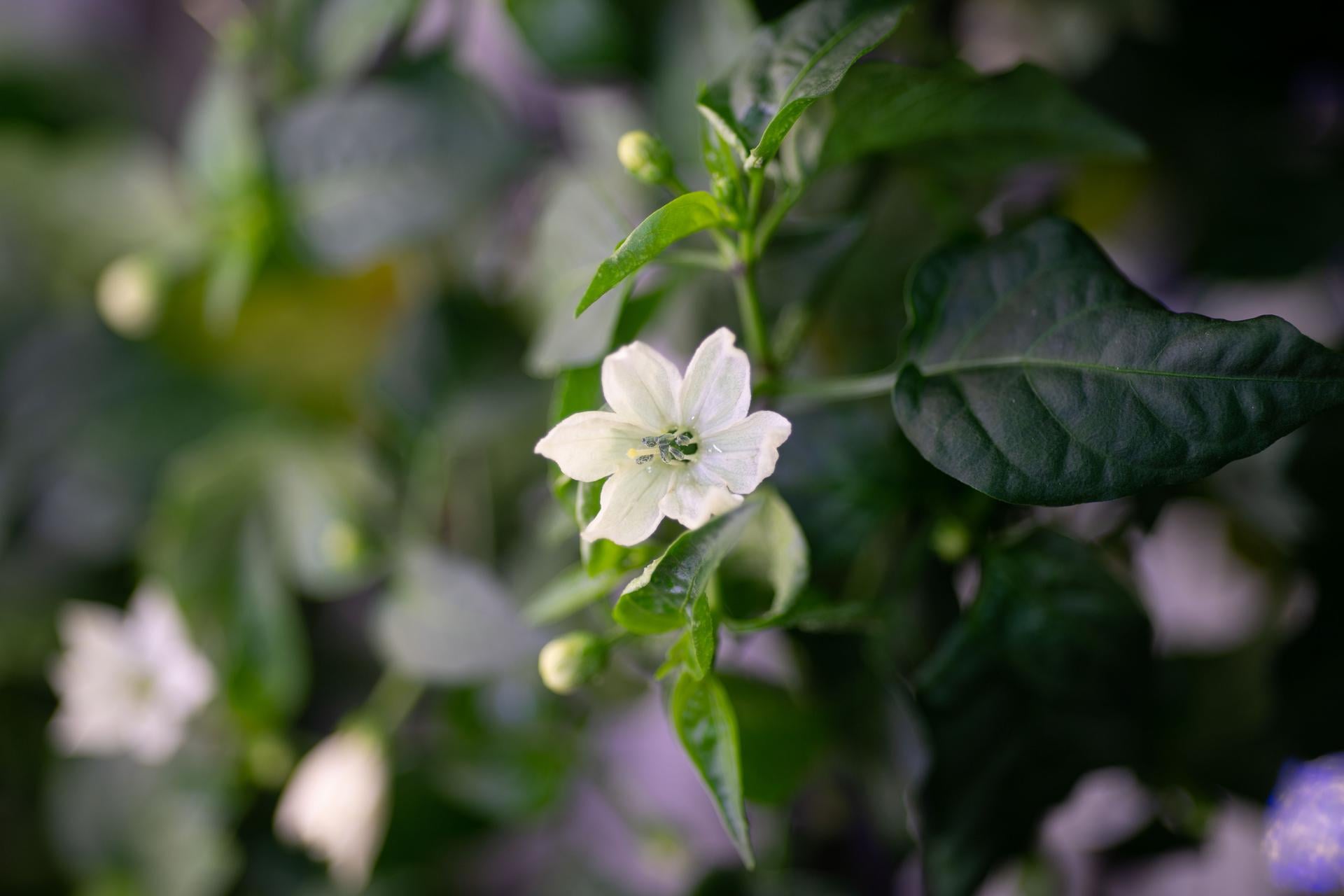
In 2021, a chile plant did something on the International Space Station that it has never done on Earth: it held its fruit out straight.
Plant Habitat-04 ran for 137 days inside the Advanced Plant Habitat (APH), the largest growth chamber aboard the station, and by the time the last peppers came off the plants it had become the longest plant experiment in ISS history, by NASA’s framing of the mission’s conclusion. Four plants. Twenty-six chile peppers. A cultivar with deep roots in New Mexico’s Rio Grande valley — a Hatch chile, described in the peer-reviewed literature as Capsicum annuum cv. NuMex Española Improved.
And in among the harvest numbers, a small structural anomaly that no one had ordered: the pedicels, the short stems that connect flower to fruit, did not curve the way they do in a field or a greenhouse. They grew completely straight.
Forty-eight seeds, four plants, two harvests
The experiment began as a science carrier — a flat cartridge of rooting medium seeded with 48 sanitised pepper seeds — launched to the station in June 2021. On 12 July, NASA astronaut Shane Kimbrough slid the carriers into the Advanced Plant Habitat and added water, which is the microgravity equivalent of pushing a seed tray onto a windowsill and turning the tap on.
The habitat itself is not large. The growth volume is roughly the size of a large microwave oven, lit and watered and monitored by an automated system that trades on sensors rather than a gardener’s eye. Into that space went a full-size field cultivar, not a dwarf variety bred for containers, which is part of what made PH-04 an unusual bet. The seedlings were thinned to four plants — the number the chamber could carry to fruiting — and left to grow under the habitat’s lights.
Peppers are self-pollinating, but self-pollination still needs movement. In the APH, the chamber’s fans supplied most of that agitation, according to NASA’s account of the harvest, with crew members also hand-pollinating to improve fruit set. It worked, but slowly: the space-grown peppers ran about two weeks behind their ground controls, a lag the mission’s principal investigator, Matt Romeyn of NASA’s Kennedy Space Center, has linked to the germination and fluid-delivery challenges of growing anything in a chamber where water does not obediently fall down.
The first harvest came on 29 October 2021 — seven peppers, some red, some green. The second came on 26 November, picked by NASA astronaut Mark Vande Hei during Expedition 66, and it pushed the mission total to 26. The peer-reviewed microbial analysis of the crop in Scientific Reports counts “over 25” peppers taken at day 109 and day 137 in a mix of red and green; NASA’s 26 remains the headline figure, and the two numbers describe the same modest, remarkable pile of fruit.
The stems that forgot to bend
On Earth, a pepper’s pedicel curves. It has to. The fruit is heavy relative to the stem holding it, and gravity does the arguing — the pedicel bends downward, the fruit hangs, and the plant’s architecture is shaped as much by load as by genetics. It is such an ordinary feature of a chile plant that nobody photographs it on purpose.
In orbit, the load went away, and the pedicels grew straight. Romeyn has described the difference as “definitely a microgravity effect” — one of the cleanest morphological signatures the mission returned, and the kind of result that only becomes visible when you have ground controls sitting beside the flight images for comparison.
It is worth being precise about what that does and does not mean. A straight pedicel is not a defect; the fruit still set, still ripened, still turned from green to red on the plant. What it shows is that a structure Earth-grown plants build in negotiation with their own weight is, in part, a response rather than a blueprint. Remove the weight and the plant builds the simpler thing.
Other differences were softer and harder to pin down. NASA has noted that the microgravity effect on capsaicin production is unknown, and that crew members found some of the fruit spicier than expected — an observation, not a measurement. No capsaicin assay accompanied the taste tests, and the flight sample size was, by any agronomic standard, tiny.
Why a fruiting crop, and what came home frozen
Leafy greens have been grown and eaten on the station for years. A chile is a different proposition: it must flower, be pollinated, set fruit and ripen, which is a longer and more failure-prone chain of events inside a sealed box. Romeyn has framed PH-04’s peppers as the first generally recognised fruiting crop grown productively in space, and NASA credits the mission with feeding the most astronauts from a single space-grown crop — the fruit turned up in crew taco nights, and the habitat’s door became an informal viewing window during the growth cycle.
The nutritional argument is straightforward. Vitamin C degrades in stored food, and chiles are dense in it; flavour matters too, on missions where taste fatigue is a real operational problem. Roughly half the fruit was eaten on orbit. The other half was frozen at –80°C and returned to Earth, which is where the Scientific Reports work picked it up: a survey of the bacterial and fungal communities on the space-grown peppers, which found low microbial counts and did not detect foodborne pathogens. For a crop intended to be eaten raw, in a closed habitat, that is the quiet result that matters most.
NASA has since pointed towards further crops in the same hardware — dwarf tomatoes, more leafy greens — on the same logic: work out which plants can be trusted to feed people a long way from a supply ship.
But the image that stays is the smallest one. Four plants in a box the size of a microwave, 137 days, 26 peppers — and every stem between flower and fruit standing straight out, because there was nothing pulling it down.