

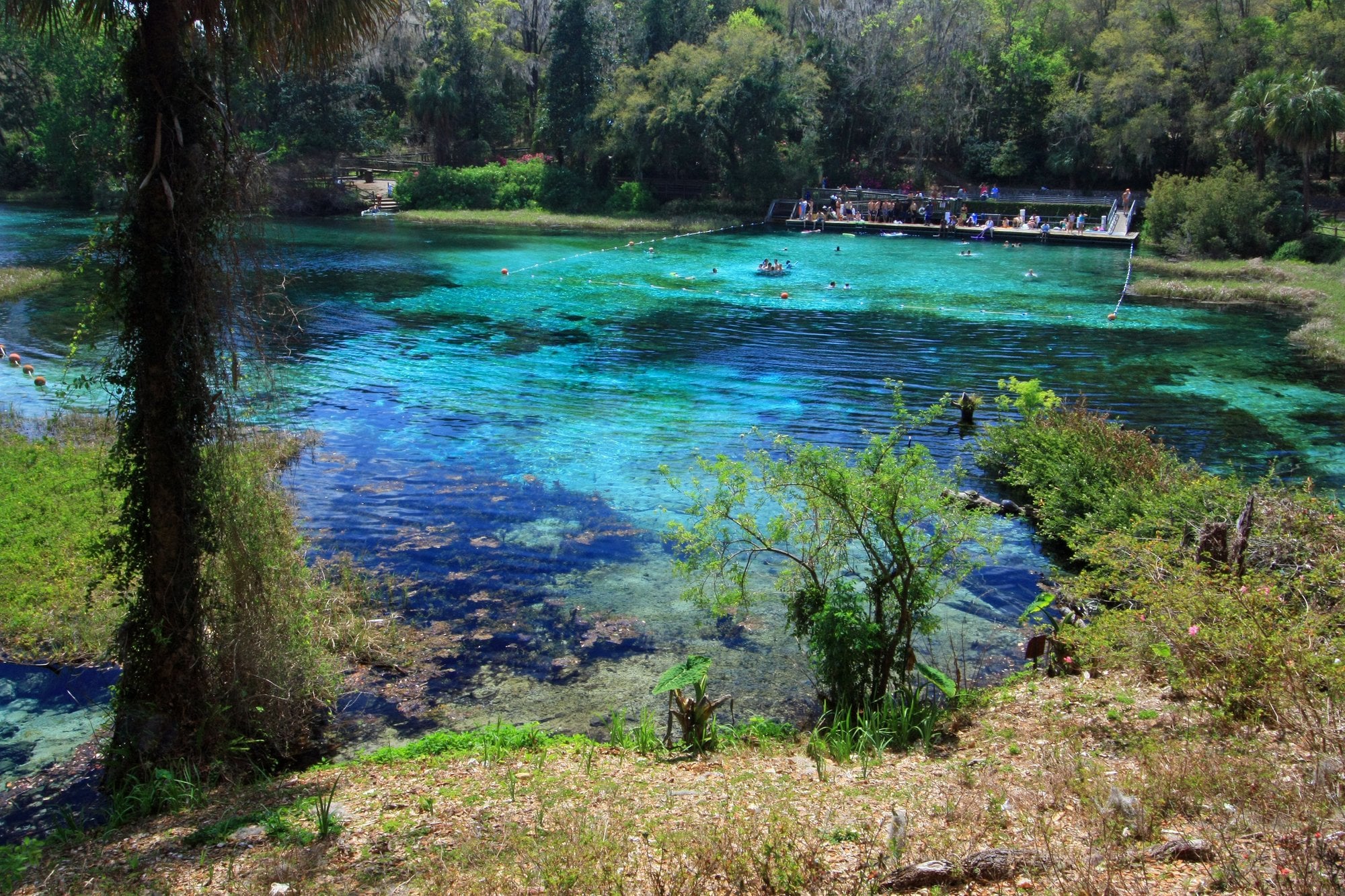
Five gallons is not much water. Poured out, it would fill a kitchen stockpot twice over, a volume a person can carry in one hand without leaning. On March 8, 2015, that much red fluorescent Rhodamine ET went into the Mammoth (Main) Spring vent at the head of Florida's Silver River, and for the next half day it behaved like a marker drawn slowly along one of the largest springs in the state — a moving stain that researchers with the Howard T. Odum Center for Wetlands at the University of Florida could measure, sample, and time.
The release was the first of four proposed dye tracer experiments in the Silver River, run by Dr. Kaplan's Watershed Ecology Lab. The larger question hanging over the day was the one Florida keeps asking about its springs: why so many of them have shifted from clear water over submerged aquatic vegetation toward algae dominance, and whether anything reverses it. The dye did not answer that. It measured how the water moves.
Why a lab pours dye into a spring
Velocity and residence time are the unglamorous numbers underneath almost every other question you can ask about a spring run. How fast does water travel from the vent to a given bend? How long does a parcel of water actually stay in the river before it leaves? Those numbers set the clock for everything biological and chemical that happens in between — how long light works on a stretch of water, how long any dissolved substance lingers in one reach rather than another. Without them, a flow-and-mixing model of the Silver River is guesswork with a scale bar.
Rhodamine ET is useful because it is visible in two senses. It is red enough to see and fluorescent enough to detect at concentrations far below what the eye registers, which means instruments can track the leading edge, the peak, and the long trailing tail of a plume through water that looks unchanged. Five gallons at the Mammoth vent is a small injection for a river that size, and that is the point: enough signal to follow for miles, not enough to turn the run into a novelty.
The work sat inside an interdisciplinary project funded at roughly $3,000,000 by the St. Johns River Water Management District, spanning three years, ten UF researchers, and four departments. The Watershed Ecology Lab's slice covered spring hydrodynamics, nutrient transformations, and algae proliferation. The March release supplied the hydrodynamics — the physical baseline that the chemistry and ecology arguments would later have to sit on top of.
Nine stations, three fluorometers, 318 bottles
Tracking a plume down a spring run is a logistics problem before it is a science problem. The team set nine fixed stations along the run: three in-stream fluorometers reading continuously, and six automated samplers pulling bottles on a schedule. Continuous instruments catch the shape of the curve — the rise, the peak, the decay. Automated samplers catch what the instruments might miss and give you something physical to carry back to a lab.
Then there was the overnight problem. A plume in a spring run does not respect business hours, and the tail of a dye curve is often the part that carries the most information about how water gets held up in slow margins and side pockets. More than 20 UF student volunteers filled the gap, collecting 318 samples through the night — an enormous manual count that turned a set of scheduled snapshots into something closer to a continuous record across the whole reach.
The day ran on borrowed access, too. The Florida Department of Environmental Protection staff at Silver River State Park, in particular Park Manager Sally Lieb, and Marion County Parks and Recreation provided the river frontage and station points. Patrick Gardner and Doug Marcinek of UF Fisheries contributed SCUBA support. A tracer study in a public spring run is, functionally, a temporary occupation of somebody's park.
What a dye release settles, and what it does not
Here is the boundary worth drawing carefully. The Silver River experiment measured transport in an open spring run: dye injected at a visible vent, tracked downstream in daylight and dark along a channel anyone can paddle. It is a different exercise from the karst sink-to-spring traces conducted elsewhere in Florida, where dye disappears underground and reappears somewhere else entirely after days of uncertainty. Nothing about the Silver River release speaks to those subsurface connections, and it should not be read as if it did.
Nor did the dye explain the algae. The green shift in Florida springs is a contested problem involving nutrients, flow, light, grazers, and land use across whole recharge basins, and no single tracer release resolves any of it. What the March 8 experiment produced was a measured record of how a parcel of water moved — nine stations, three fluorometers, six samplers, and 318 bottles carried through a Florida night — that later models of nitrogen and algal biomass would have to sit on top of. If you want to argue about what happens between the Mammoth vent and a downstream station, you first need to know how long the water was there.
Five gallons of red dye did not diagnose a river. It timed one.