

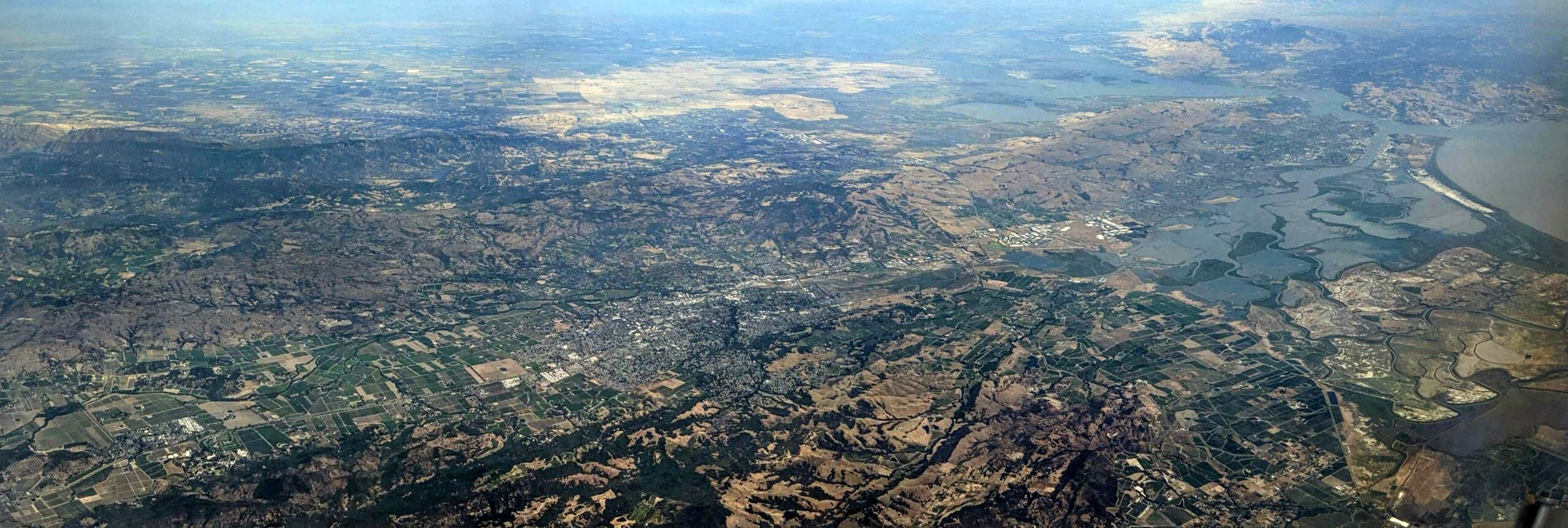
A gift of land arrived in Napa County by way of an estate, which is to say it arrived slowly, through paperwork and patience and the wishes of someone who was no longer there to see it settled. The Land Trust of Napa County announced on 7 May 2024 that it had acquired the 1,318-acre Mead Ranch near Atlas Peak, on the ridge above Yountville, donated through the estate of the poet Jane Mead, who died in 2019 at the age of 61.
The acreage matters, but so does the address. Mead Ranch sits very close to the 2,300-acre Walt Ranch, protected the year before, and to the Land Trust’s own 1,380-acre Sutro Preserve. Doug Parker, the Land Trust’s chief executive at the time of the announcement, described the property as significant both for Napa’s rare biodiversity and for that key location — three large blocks of land on the same eastern rim, now under conservation, looking out across the valley floor towards San Francisco on a clear day.
The poet who came back to manage the ranch
Jane Mead was a well-known poet with five collections published across a career of more than two decades, and she taught at universities. At one point she held a tenured position as poet-in-residence at Wake Forest University, which is the kind of post writers spend careers trying to reach. She left it to come home and manage her family’s property in Napa.
That decision is the hinge of the story, and it explains why the Land Trust’s announcement reads less like a real estate notice than a portrait. Many of Mead’s poems relate to this land — the Land Trust points to her Los Angeles Times obituary on that point — and the organisation’s announcement quotes the opening and closing lines of one of her poems published in The New Yorker, a few words about moss and about being held by a place. It is a small gesture inside a conservation press release, and an unusually apt one: the ranch was not only an asset in her estate, it was subject matter.
The Land Trust describes Mead as a long-time supporter of conservation and a friend of the organisation. After a cancer diagnosis, according to the Land Trust’s account, she decided to protect the property in perpetuity. Her reasons, as Parker relayed them, were specific rather than sentimental: the rare species that grow there, the role the ranch could play as part of a wildlife corridor, and a hope that the land might one day offer learning opportunities for children. Those are three different time horizons — botanical, ecological, generational — folded into a single decision made by someone who knew her own was closing.
Vernal pools, and a clover named for the family
The botanical case for Mead Ranch is unusually concrete, because some of it is named after the place.
Mead’s Owl’s Clover — Castilleja ambigua var. meadii — was discovered by botanist Jake Ruygt and named after the Mead family. It is found only on Mead Ranch and one nearby property. That is about as narrow as a plant’s world can get before it stops existing altogether, and it means the conservation status of a single ridge property is, functionally, the conservation status of the taxon.
It is not alone up there. The ranch also supports Few-flowered Navarretia (Navarretia leucocephala ssp. pauciflora), which is federally listed as endangered, along with Napa Bluecurls (Trichostema ruygtii). Holly-leaved Ceanothus (Ceanothus purpureus) and Narrow-anthered Brodiaea (Brodiaea leptandra) are recognised as endangered by the California Native Plant Society.
Several of those names point towards the same habitat feature: vernal pools. These are seasonal wetlands that fill with winter rain and dry out over summer, and the plants that specialise in them are adapted to a rhythm most species cannot survive — inundation, then hardpan. Ruygt describes the vernal pools on Mead Ranch as the most species-diverse remaining in the county, an assessment worth sitting with, because vernal pool systems across California have been among the most heavily reduced habitats in the state. What survives tends to survive by accident of ownership: a property that was never levelled, never drained, never subdivided.
Mead Ranch was managed, for years, by a poet who kept coming back to it in verse. That is not a conservation strategy. But it is one explanation for why the pools are still there.
A ridge, and an ambition
The larger frame the Land Trust offers is a corridor — and it is worth being precise about the tense. Parker described protecting Mead Ranch as a key step in a large-scale effort to create a continuous corridor of protected land along the ridge above the east side of Napa Valley, running from Robert Louis Stevenson State Park in the north to American Canyon in the south. That is a stated goal, not a finished map. The corridor is an ambition with several substantial pieces now in place.
Those pieces, at present, include Mead Ranch’s 1,318 acres, the 2,300 acres of Walt Ranch protected the previous year, and the Land Trust’s 1,380-acre Sutro Preserve. Contiguity, in landscape conservation, is the whole argument: species that can move between protected blocks have a materially different future to species stranded in one, and a ridge running the length of a valley is exactly the sort of geography that rewards patient assembly.
What has been secured is permanence for one 1,318-acre piece of it, along with the vernal pools, the endangered navarretia, and a clover that grows nowhere much else. What has been hoped for is softer — Parker’s mention of learning opportunities for children, some day, on a ridge with expansive views across Napa Valley towards San Francisco. Nothing about that hope is scheduled. But the land, at least, is no longer in question.