

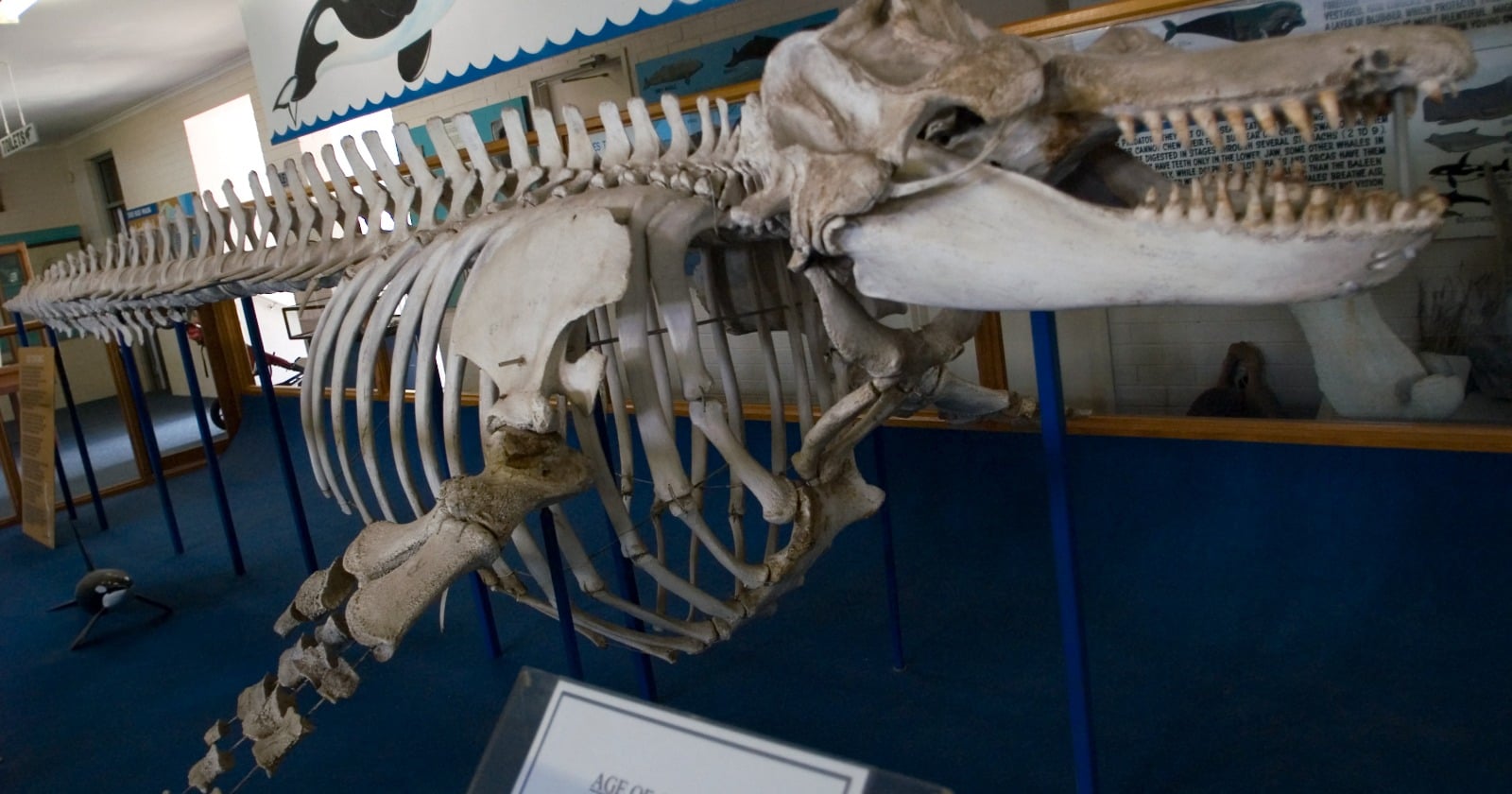
The drill was a hand-held Dremel. It took roughly half a gram of powder from a tooth on the upper jaw of a mounted killer whale skeleton on the New South Wales coast, and another half gram from inside the lower mandible. Before each cut the patch was sprayed with ten per cent bleach, left for thirty seconds and wiped down with ethanol, to remove any contaminating DNA.
The powder belonged to Old Tom, the killer whale that local accounts at Eden had pulling on the whalers’ ropes and lines during the chase in Twofold Bay. The team that sequenced it, with Isabella Reeves as first author, published its study of Tom’s ancestry in the Journal of Heredity in 2023. Their comparisons put his closest contemporary match among killer whales sampled in New Zealand, and failed to find any clear descendant of him among the animals they were able to sample.
The Thaua were working with the whales first
The paper opens with a foreword by Steven Holmes, a Thaua Traditional Custodian and a direct bloodline descendant of Budginbro and his wife Char Ree Larra. Budginbro was the Indigenous guide and good friend of Oswald Brierly, one of the managers of the Eden whaling station. Holmes writes that his people consider beowas, the killer whales, to be their brothers, and that a Thaua who dies is reincarnated as a beowa.
He records that his grandmother told him Budginbro and other Thaua swam with Old Tom holding on to his dorsal fin, and were never hurt. He records that Budginbro’s father, a blind man, walked along Aslings beach singing to the beowas, and that they followed him along the shore.
The paper treats that oral history as evidence. It has the Thaua working with the killer whales in Twofold Bay long before colonisation, sharing out a carcass with the killer whales receiving the tongue. It also describes a hunting practice in which singing encouraged the whales to herd baleen whales close inshore. Commercial whaling, which began locally in 1828, capitalised on an existing partnership rather than inventing one.
The paper says the Thaua relationship with the killer whales is thought to predate European colonisation by millennia, and was the true start of the notion that later acquired a name, the Law of the Tongue. On the Thaua account the paper publishes, the tongue was given rather than merely taken.
The arrangement in Twofold Bay
The cooperative hunting itself was recorded from 1844 and continued for almost a century. Every June, by the records the paper summarises, killer whales arrived in Twofold Bay and either herded baleen whales in or alerted the whalers by tail-slapping and splashing in front of the station. The whalers rowed out in nine-metre open boats, by day or by night.
Part of the group would help herd the adult whale, some would tear at fins and flukes and swim beneath it biting along the lip area, and others would breach over the blowhole to drown it. The whalers finished the exhausted animal with a harpoon and a lance. Local accounts have Tom taking a more direct part, pulling the tow rope at the start of a chase and seizing the harpoon line in his mouth to slow the prey.
After the kill, the whalers buoyed and anchored the carcass for twenty-four to forty-eight hours. The killer whales ate the lips and the tongue, and only then were the remains hauled in for processing.
What the paper does question is the moral attached to that at the time: that the whales took only the tongue out of respect for the arrangement. Killer whales elsewhere, including in Australian waters, are on record favouring the tongue when they kill baleen whales, so the behaviour does not need a compact to explain it.
The tongue may hold high nutritional value, the authors suggest, and the whalers may simply have disliked it or thought it worth little. With no real competition between the two hunters over the spoils, the cooperation had room to work. They also note that Tom’s tooth wear, sometimes read as physical evidence that he pulled on ropes, may instead reflect other feeding stress.
The bone had been in a shed for nine years
Tom’s skeleton has been at the Eden Killer Whale Museum for most of the time since his death, but it sat in a shed from 1930 until 1939, which the authors say potentially increased both contamination and degradation. Australia’s hotter climate and ultraviolet exposure most likely degraded his DNA, the authors say. As a positive control the team used powdered tooth from a killer whale found in the Kattegat, north of Denmark, in 1862, a specimen some seventy years older than Tom’s but kept in a cool, dark collection.
From Tom they recovered 11,464 bases of a mitochondrial genome that runs to between 16,386 and 16,392 bases in this species, at an effective coverage of 1.5 times. The Kattegat specimen, older and better preserved, came in at 115 times. Nuclear coverage for both museum animals was below one time. One sequencing read was removed from Tom’s mitogenome as likely human contamination, and three further ambiguous bases were called as unknown.
Tom’s mitogenome then went into a dataset of 490 killer whales holding 166 unique haplotypes, and his nuclear data were compared with a global panel and then with an Australasian panel of 38 animals including him. Neither panel closes the gaps in Tom’s own data, a limit the authors return to later.
Tom’s closest match is in New Zealand
His mitochondrial haplotype was new to the dataset. It fell into a clade that also holds haplotypes from the Atlantic and the Indo-Pacific, and it shares a most recent common ancestor with several Australian and New Zealand killer whales.
The nuclear comparison was relatively concordant with that, in the paper’s own phrase. Across 1,093,893 transversions in the global panel, Tom’s smallest genetic distance was to the New Zealand genome. The branch running from their shared ancestral node out to Tom is long, which is the signature of variation that is his alone, and the authors read it as ancestral gene flow rather than ongoing gene flow.
They take that branch to suggest Tom is not from the same contemporary population as the New Zealand sample. They also put his distance to the other Australian genomes in the study, from the south-west and north-west of the continent, on a par with his distance to the rest of that nuclear comparison, the Antarctic types aside.
The regional analysis says the same thing more locally. Against 1,087,094 transversions in the Australasian panel, Tom sits closest to the New Zealand genomes and a single Tasmanian one, and is otherwise made mostly of variation nobody else in the study carries.
The whales stopped coming to Eden
Around the end of the nineteenth century, twenty-five to thirty killer whales in three groups were reckoned to visit Eden, with Hooky, Cooper and Tom among the animals people could tell apart. The whales began to thin out toward 1920.
Four reasons have been offered since. The depletion of baleen whale stocks, a breach of the Law of the Tongue in which Tom fought the whalers for a whale and lost teeth, the killing of a killer whale that stranded while hunting a minke, and the Thaua leaving Twofold Bay. The paper does not choose between them, and flags that even Tom’s pod structure and age are contested.
By 1928 no more baleen whales were being processed at Eden and most of the killer whales had gone. Tom was the last of them anyone reported seeing, and he was found beach-cast in 1930.
The strongest claim the paper makes about all that is that the disappearance may have been a local extinction. The data behind that sentence are thin in several specific ways.
Tom’s mitogenome is missing about three bases in ten and his nuclear coverage is under one time, and the paper says as much about the resolution of the mitochondrial result. His position near the centre of their principal component plot is, on their own reading, likely an artefact of it: samples with heavy missing data have their variance underestimated and drift toward the middle. Reference bias is a third disclosed problem, and under one filtering scheme mapped to the more distant of their two reference assemblies the clustering pattern collapsed, though they also report that the two assemblies yielded broadly similar results and that the global distances looked similar despite the bias. The sexing check, which returned male as expected, only did so against one of the two assemblies, and they interpret it cautiously for that reason.
Most of all, the study could only compare Tom against killer whales that had been sequenced, its own 37 new Australasian genomes included. The paper states that the lack of genetic affinity between Tom and the modern genomes it held does not exclude descendants in populations nobody has sampled. What the study did not find is any clear descendant among the killer whales it could compare him against.
The mount at Eden
That is the animal the bit went into. A century of Eden’s retelling gave Tom a job, a borrowed code and a family. Worn teeth make the first possible without proving it, other killer whales’ appetites make the second less exceptional than Eden believed, and the DNA, which speaks only to the third, found him no descendant among the whales the team could sample.
He is still mounted at Eden, a gram or so lighter than he was, with two of his surfaces sprayed with bleach before the drill came down.