

Three things have been true about GRB 061201 at the same time for nineteen years, and they have never sat together comfortably.
It is a short gamma-ray burst, caught by Swift’s Burst Alert Telescope on 1 December 2006 at 15:58:36 UT, and short bursts are generally taken to be the merger of two compact objects. Its afterglow was seen and then faded, but no host galaxy was ever found underneath it in any VLT or SOAR image, which left it classified as “hostless” for nearly two decades. And the galaxy it was nonetheless assigned to sits 17 arcseconds off, and at that galaxy’s distance the burst’s beaming-corrected energy comes out below anything robustly observed in a well-studied short burst.
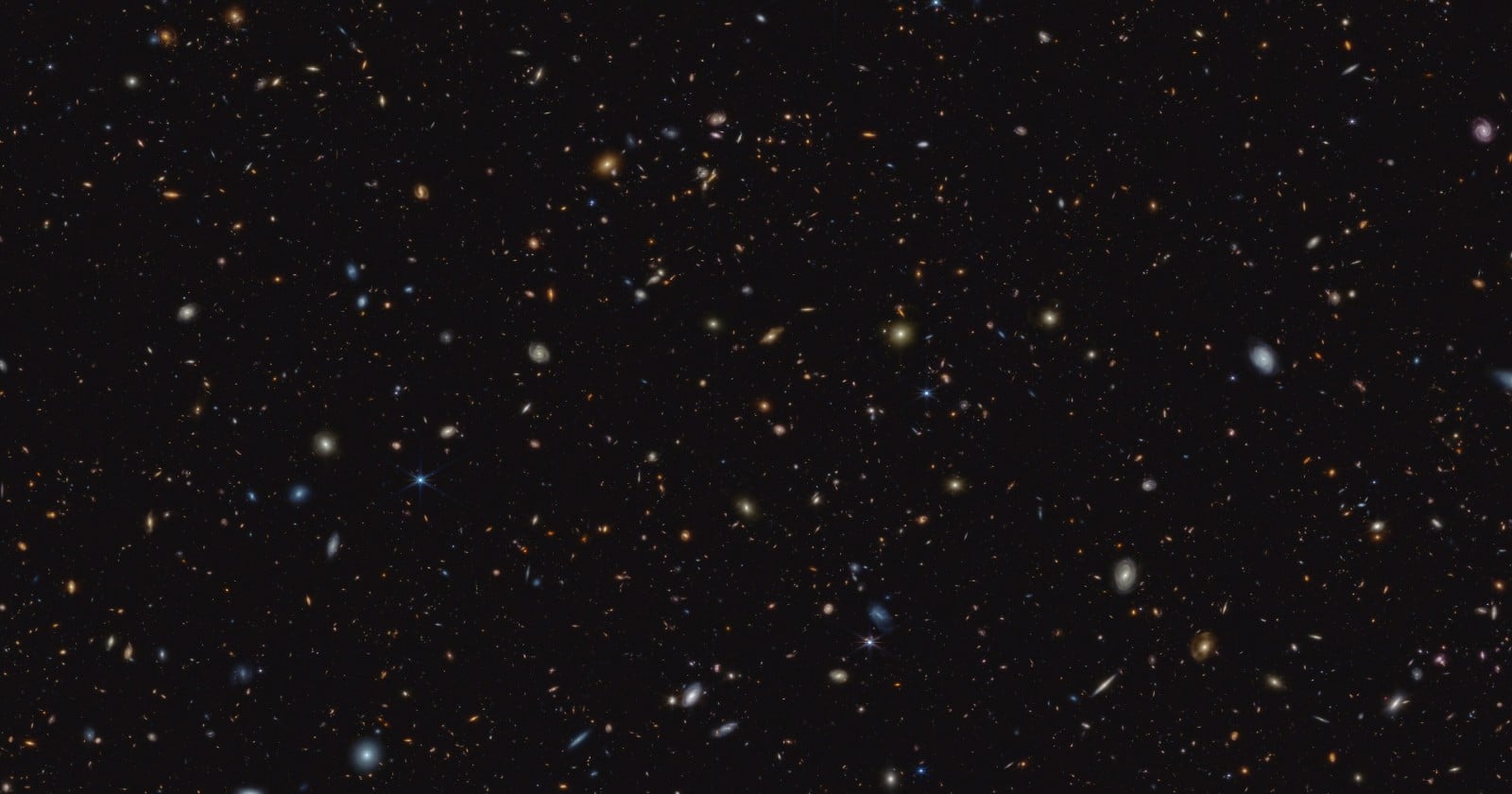
Yuhan Mao and colleagues, writing in The Astrophysical Journal, put a second candidate on the table. It is a faint galaxy, G2, picked out of archival James Webb Space Telescope images 1.97 arcseconds from the afterglow position, and the paper spends its length weighing it against the incumbent.
The two candidates, side by side
The incumbent is G1, a bright galaxy about 17 arcseconds away with a spectroscopic redshift of 0.111 measured from its [O II] and hydrogen-alpha emission. The challenger is G2, at a photometric redshift of about 1.2. Set against each other they differ on almost everything that matters:
- Distance evidence. G1’s redshift comes from spectral lines. G2’s is fitted from broadband colours, with a 95 percent interval running from 1.14 to 1.47 and a 68 percent interval that is not one range but three disconnected ones.
- Separation. G1 implies a projected offset of about 42 kiloparsecs, needing a natal kick of 10 to 400 km/s on a merger timescale of 0.1 to 3 billion years. G2 implies 16.4 to 16.9 kiloparsecs at 95 percent confidence, which is ordinary for short bursts.
- Host demographics. G2’s fitted stellar age is about 2 billion years and its stellar mass about a billion suns, both typical of the short-burst host population. G1 is older and heavier.
- Chance of being wrong by accident. G1 scores 0.108 on the standard chance-coincidence test; G2 scores 0.18. This is the other line where the incumbent wins.
That last line is one of the two the challenger loses, so it goes first rather than last.
Chance alignment favours neither cleanly
The chance-coincidence probability asks how often a galaxy at least that bright would fall that close to a random point in this field. The conventional threshold for calling a host secure is 0.1, and neither candidate clears it: G1’s 0.108 misses narrowly and G2’s 0.18 by more. For G2, both the analytic calculation and a Monte Carlo run over 10,000 random positions return 0.18.
The authors’ answer is to argue the threshold should move for images this deep, and they point to 0.2 as often warranted, which G2 clears. Their reasoning is that a longer exposure contains more faint galaxies, so the odds of a chance alignment rise mechanically with depth rather than because a particular association got weaker, and they note that several robust GRB hosts have been securely identified despite exceeding 0.1.
That is a reasonable argument and it is still an argument about where to draw a line, not a measurement that moves G2’s number. G2 is a candidate, and the paper’s own text calls it one.
G1’s better score is worth less than it looks. It rests on there being only three sources in the entire field brighter than G1, which the authors say is primarily bright-tail statistics and “does not necessarily indicate a more robust physical association”.
A third object, an ultra-faint source called G3, sits closer still at 0.49 arcseconds. The authors set it aside. It scores 0.43, and a colour break in its Webb photometry is most naturally read as a galaxy beyond redshift 3, while the afterglow spectrum shows no Lyman-alpha break above 4000 angstroms and so caps the burst below redshift 2.3.
Energy is where they separate
To match the afterglow at G1’s redshift, the jet has to be extraordinarily narrow, an opening angle of roughly one degree. Correct the burst’s energy for that beaming and it comes out around 1046 erg, against 1049 to 1051 erg for other short bursts. The paper’s phrasing is that such an extreme subenergetic nature “has not been robustly observed among well-studied sGRBs”.
Both candidates pass the Amati relation, which links peak energy to isotropic energy. It is the Ghirlanda relation, the beaming-corrected version, that splits them: at 1.2 the burst sits inside the short-burst region, and at 0.111 it falls outside by more than two sigma.
The narrow jet costs more than one burst’s plausibility. A one-degree jet means the overwhelming majority of such mergers point away from Earth and are never seen, so each detected burst stands for a very large number of unseen ones. Carried through, the neutron-star merger rate implied by the short-burst population climbs to about 1,400 per cubic gigaparsec per year, and by the paper’s own figures GRB 061201 alone accounts for roughly two thirds of that, 964 against 1,426, both carrying very wide error bars. The rate inferred from gravitational-wave detections, which the authors describe as largely free of beaming systematics, is about 165.
The kilonova that should have been visible
A merger like the one behind GW170817 leaves a fading infrared glow. The authors took AT2017gfo, the kilonova from that event, and shifted its light curve to 0.111.
It would have been bright enough to exceed the I-band and J-band upper limits actually recorded for GRB 061201. Nothing of the kind was seen. The paper runs that comparison only at 0.111, so the non-detection counts against the incumbent and says nothing about the challenger.
The afterglow fit, and one number that does not reconcile
A joint fit to the whole broadband afterglow also prefers the challenger. The high-redshift model returns a reduced chi-squared of 1.18 against 1.42 for the low-redshift fit across its 54 degrees of freedom. The low-redshift model also reproduces the observed brightness only by pushing the fraction of energy given to electrons above 0.8, which implies a radiative efficiency close to 100 percent.
The paper reports the model preference as a difference in the Akaike information criterion of 16.35, against a threshold of 10 it cites as strong evidence.
One pairing in the paper does not reconcile. Under the cosmology the paper adopts, 17 arcseconds at redshift 0.111 works out, by this article’s arithmetic, closer to 35 kiloparsecs, and 42 would need about 20.6 arcseconds. The equivalent figure at 1.2 does reconcile, which is why the 42 here is quoted as the paper’s number and nothing in this piece is derived from the angle.
The challenger has not won everything
The paper does not claim the case is closed and neither should anyone citing it. Its closing sentence says deep spectroscopy of G2 is “ultimately required to confirm its photometric redshift and secure the astrophysical framework presented here”.
On the light-curve comparison the authors state that a 0.111 origin “cannot be definitively ruled out based solely on this metric”, because a small number of intrinsically faint bursts still fall below the low-redshift track, and they name two. The merger-rate tension is described as largely mitigated at 1.2, not removed, with a mild residual discrepancy left open.
So the scoreboard is lopsided but not settled. The challenger wins on offset, on host demographics, on beaming-corrected energy and on the afterglow fit, and the kilonova limit counts against the incumbent without scoring for the challenger. The incumbent wins on the formal chance-coincidence score, and on the one criterion that is a hard measurement rather than a fit, which is the redshift itself.
What would settle it
A spectrograph, pointed at G2, long enough to pull emission lines out of it. That is a harder observation than it sounds: the galaxy sits at magnitude 26 in Hubble’s F606W band and roughly 24.4 to 24.7 in the two Webb bands, faint enough that the paper describes its own detections in two Hubble filters as marginal.
Until someone does it, GRB 061201 has a most plausible home rather than a known one, and every number that follows from the new redshift, the ordinary energy, the ordinary offset, the tidied-up merger rate, carries the same conditional as the galaxy it rests on.