

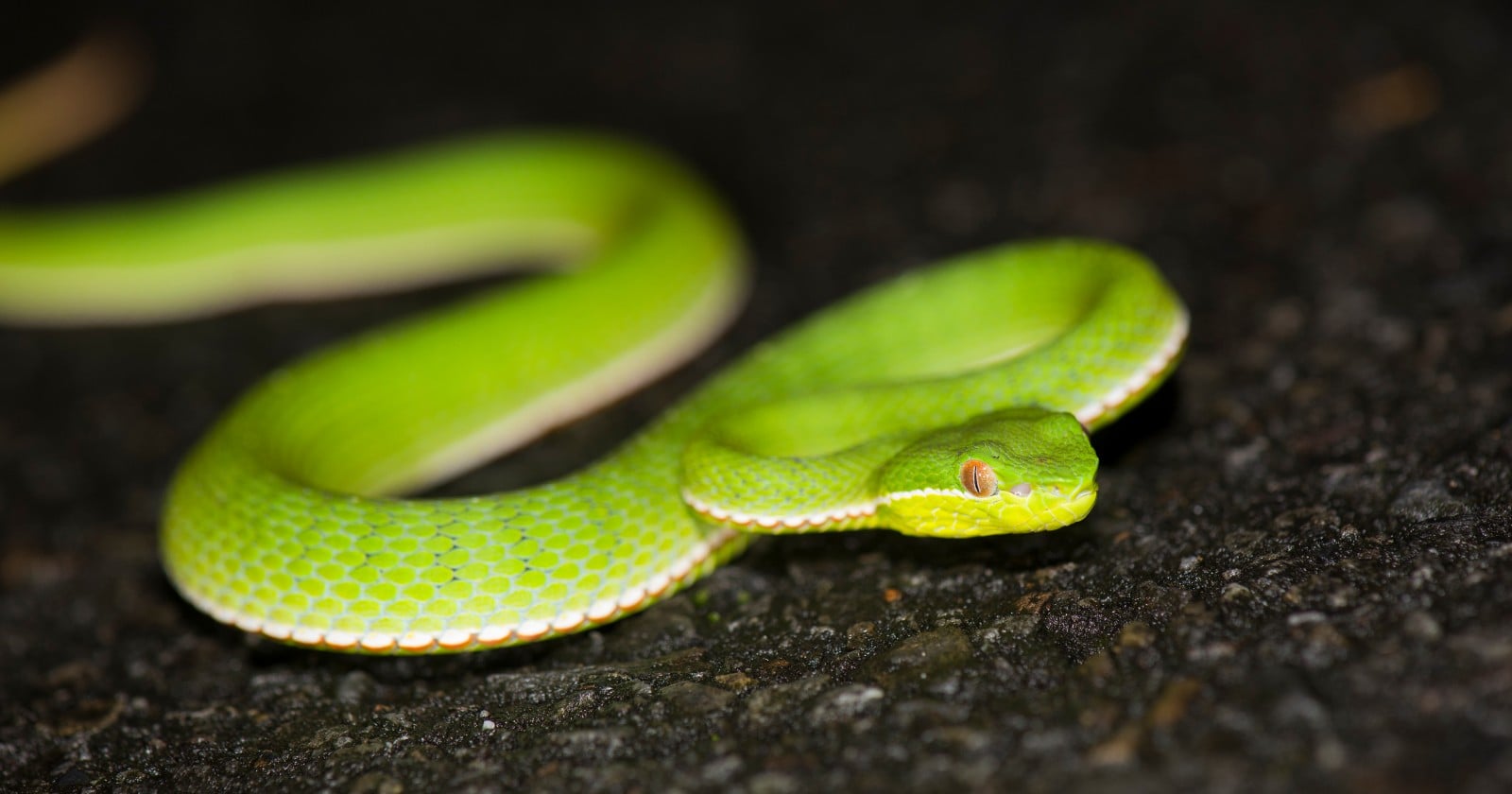
The green pitvipers of western Sichuan have all gone under one name, Trimeresurus stejnegeri, on the strength of what it looks like and nothing else. A paper published on 30 January 2026 in the open-access journal Zoosystematics and Evolution says the snakes in that corner of the province are not that species. It names them Trimeresurus lii, the Huaxi green pitviper, the 58th species of Trimeresurus recognised worldwide and the second member of the subgenus Viridovipera known from Sichuan.
One of the paper’s eleven authors was bitten by one. A grass-green pitviper from Mount Emei took Gang Wang, of Chengdu Normal University, on the ring finger of his right hand at 22:15 on 9 September 2021. By the time he reached Leshan People’s Hospital at one minute past midnight, the swelling had reached his elbow.
Four of the paratypes the species is built on are older than that bite by sixty-five years. They were collected in 1956.
The old name covered too much ground
Trimeresurus stejnegeri, described by Karl Patterson Schmidt in 1925, is the most widely distributed member of its genus in China, ranging from Taiwan across to Sichuan and south into northern Vietnam. In Sichuan it was taken to be the only representative of its subgenus, occurring in a rough ring of country around the Sichuan Basin.
The authors are blunt about how that identification was made. Populations of Trimeresurus in western Sichuan, they write, “have historically been identified as T. stejnegeri based solely on morphological characteristics”, following the standard 1998 reference on Chinese snakes. No genetic work, the authors say, had ever tested it.
That is not because nobody had tried to sort the species out genetically. A 2016 phylogeographic study by Peng Guo and colleagues sequenced 171 samples from 47 localities across China, including Taiwan, and found two well supported lineages inside T. stejnegeri, one in the southwest and one in the southeast. None of the 47 was in western Sichuan. The new paper states the consequence plainly: the taxonomic status of the western Sichuan populations “remains unverified by molecular evidence to date”.
Fieldwork between 2019 and 2025 by Bo Cai of the Chengdu Institute of Biology and his colleagues, with Wang collecting in 2021, filled the gap. The team generated 20 new mitochondrial sequences and combined them with 222 downloaded from public databases, covering 36 species of Trimeresurus and three genes: 16S, cytb and ND4. Both a Bayesian and a maximum likelihood tree put the western Sichuan animals on their own branch, paired with T. loong, a species described from Kunming in Yunnan only in 2025. The two together, the authors argue, form a clade “endemic to the eastern Hengduan Mountains”.
Everything separating the new species from its relatives at the DNA level therefore comes from three mitochondrial genes. Those are inherited down the maternal line, and they can tell a misleading story about where a population’s boundaries actually lie. The authors concede that nuclear genomic analyses “would undoubtedly refine” the assessment, and explain why they stopped there: public repositories hold scarce nuclear sequence data for this subgenus, and tissue from rare, recently collected specimens is, in their words, “severely limited”. They call for expanded genomic sampling, “especially nuclear markers”, in future work.
The separation measured in cytb and ND4 sits in the lower half of the paper’s own tables, where distances between members of the subgenus run from 4.01 to 10.43 per cent in ND4 and from 4.47 to 10.75 per cent in cytb. The closest measured gap between the new species and any named relative is 6.50 per cent in cytb and 5.77 per cent in ND4, both against T. loong. They describe that as marked genetic differentiation, and it is wider than the 4.58 per cent the same ND4 table records between T. stejnegeri and T. yunnanensis, two long-accepted species. The paper’s statement that no relative comes closer than 5.77 per cent in ND4 is slightly undercut by its own table, which records 5.72 per cent against a Sichuan population the authors label T. cf. loong.
The differences show on a living snake
Fifteen specimens, eleven males and four females, went through the morphological comparison. The diagnosis rests on a combination of characters and not on any one of them: dorsal scale rows in a 21-21-15 arrangement, 152 to 167 ventral scales in males and 160 to 168 in females, an unmarked grass-green body with no bands or markings in either sex, and smooth temporal and occipital scales where T. stejnegeri has keeled ones.
The colour differences are the ones a person in the field would notice. Male T. lii have an amber iris and a postocular streak that reaches forward to the second supralabial scale and, over the temple, splits into three bands, red above, white in the middle and red again below. Females have an orange-yellow iris and a streak that is yellow or barely there at all. The stripe running along the lowest row of body scales is white over red in males and plain yellow in females. The sexes differ in colour from the juvenile stage, though one juvenile male the authors examined also carried white dorsal spots about five millimetres apart.
The largest male measured 675 millimetres from snout to vent; the largest female, 795. Set against T. loong, its nearest relative, the new species reaches a greater maximum length in both sexes and carries more ventral scales, 152 to 167 in males against 150 to 151, and 160 to 168 in females against 157 to 158.
Those characters are checkable by anyone holding a specimen, which is the strength of the description. The tree is harder to weigh from the text alone. The paper prints bootstrap and posterior probability values above each node of its tree figure, where the new species’ own branch carries 100 and 1.0 and the node joining it to T. loong carries 92 and 0.96, but it quotes none of them in its prose, describing the genus as a whole as a strongly supported monophyletic group and saying nothing in words about the support for the new species’ own node. A distinct mitochondrial lineage plus consistent scale and colour characters is the standard this genus is currently described on, so the paper is doing what its peers do. Read strictly, the species is a hypothesis with an unusually clear set of predictions attached, and the authors name the data that would test it.
From a puncture wound to the elbow
The clinical section of the paper is a single case, and the patient, one of the paper’s authors, took the photographs that document it. The snake was a male of roughly 600 millimetres in total length. The bite left a single puncture wound that bled immediately, and within ten minutes the swelling had spread from the finger across Wang’s whole hand, accompanied by what the report calls severe aching, stabbing pain and numbness of the affected finger. Photographs timestamped that night show the ring finger swollen eleven minutes after the bite and the whole hand swollen at thirteen.
At the hospital, staff had trouble drawing blood, failing from the dorsal veins and succeeding from the femoral vein. Wang was hypotensive and mildly dizzy. He was treated with a polyvalent antivenom commercially labelled for two other snakes, Agkistrodon halys and Agkistrodon acutus, along with anti-inflammatory drugs, and was discharged at five o’clock the same morning. After discharge he had transient dizziness and mild nausea and vomiting, which cleared within twenty minutes.
Recovery then took days. Two days after the antivenom the hand was still swollen and the swelling had spread above the elbow. It began to subside on the third day, had largely cleared from the elbow by 14 September, and was gone by the 18th. Wang also records that he subjectively noticed a marked decline in his immune function over the following year, which is his own impression and not a measurement, and the paper offers no test results to support it.
Li Er’s snake
The species epithet honours Li Er, the philosopher known as Laozi, whom the paper places around the sixth or fifth century BCE and whose teachings on living in accord with nature the authors connect to the conservation purpose of the Giant Panda National Park. The holotype came from Xiling Town inside the park’s Chengdu sector, at 1,167 metres. The proposed Chinese name is 华西竹叶青蛇, Huaxi zhuyeqing she.
Confirmed sites so far are Xiling Snow Mountain, Yuping Mountain in Hongya County and Mount Emei, between roughly 1,100 and 1,500 metres, all inside the West China Rain Zone. The snakes are mostly nocturnal, often rest two to five metres off the ground in bamboo and streamside scrub, and are seen most often between July and September. Reproductive information is still thin, but one temporarily captive female gave birth to eight young in mid-August, which the authors take as confirmation that the species bears live young and does not lay eggs. Field surveys across that whole elevation band turned up no other Trimeresurus living alongside it.
The map is not finished. Photographs suggest the snake may also occur in Qingchuan County, and one of the authors, Haolong Fang, reports it from Longcanggou National Forest Park in Yingjing County, neither of them confirmed. North of all of this, green pitvipers have been recorded from Wen County in Gansu Province and areas adjacent to it, and those are exactly the records the authors say lack adequate morphological documentation and clear imagery. Settling them would take a tissue sample and the same molecular work that separated T. lii in the first place. So who is going to Wen County with a jar?