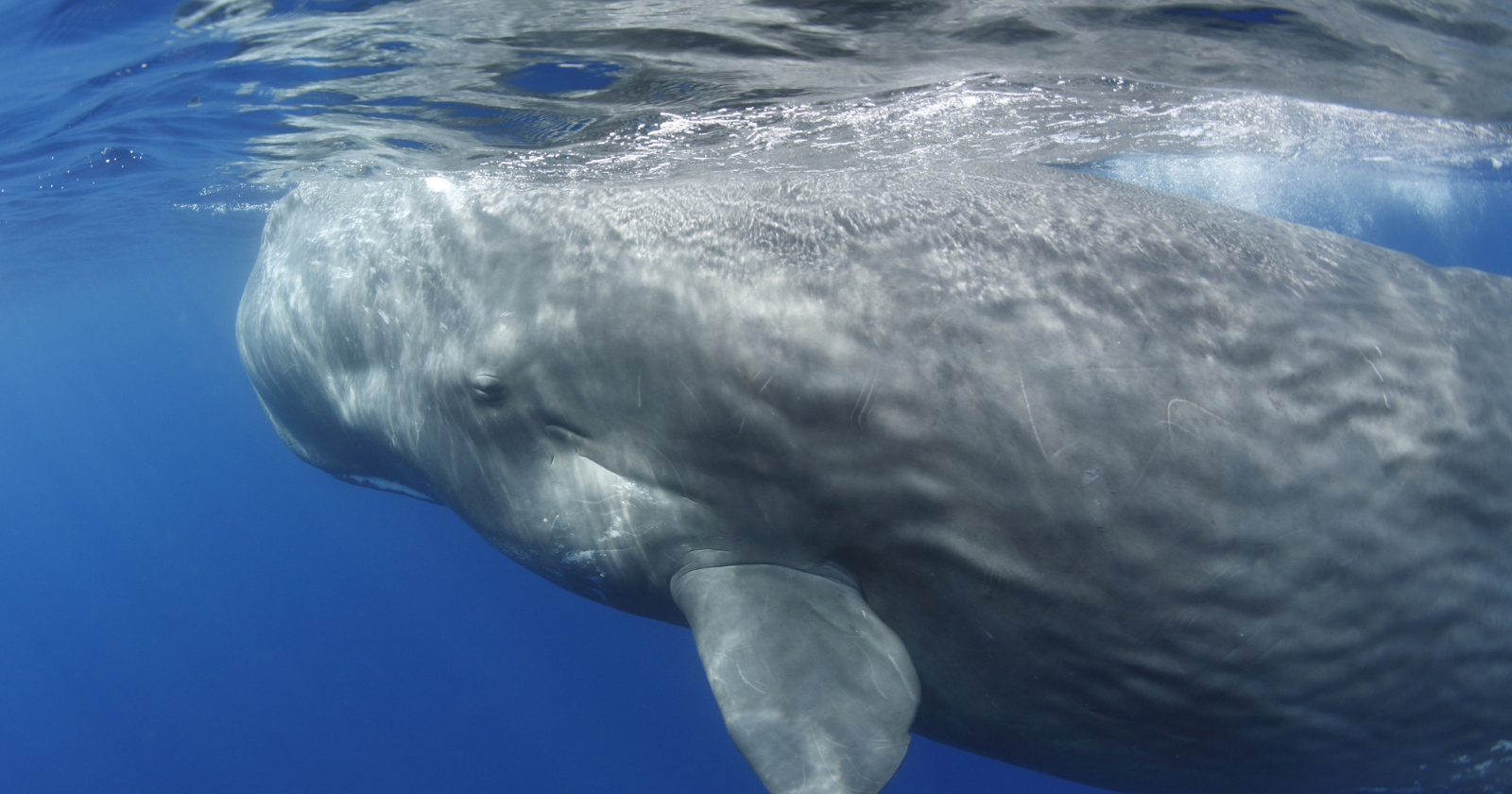
Blood clouded the water off Dominica just before noon, and eleven sperm whales pressed in closer instead of scattering.
That was 8 July 2023. A team from Project CETI, the outfit working on decoding whale communication, had gone out for an ordinary day of tracking and found a family behaving oddly: bunched at the surface, moving slowly, neither socialising nor sleeping. Two drones went up. An hour later, it became clear why.
Thirty-four minutes, tail first
At 11:12 in the morning, two small flukes appeared. Whales arrive backwards, head last, an arrangement that reduces the risk of drowning partway through delivery. By 11:45 and 45 seconds, it was over: roughly 34 minutes of active labour, captured by two drones, an underwater microphone and a pair of long lenses, and written up in Scientific Reports.
A minute later the calf surfaced beside its mother’s head and took a breath.
Everyone in the water had a name in the field records: Rounder the mother, at least 19 years old and first photographed off the island before 2005; her own mother, Lady Oracle; and her daughter Accra, born in 2017. Three generations of one family line, plus a second line that shares only a distant ancestor, were all present for the same afternoon.
Why a newborn whale sinks
Adult sperm whales float easily, thanks to a head packed with oil. A newborn has less of that oil, less body fat and proportionally smaller lungs, which makes it negatively buoyant, a polite way of saying it goes down unless something holds it up. Its tail flukes were still folded from months in the womb, curled like a leaf, and useless for swimming.
Within a minute of delivery, the adults began shoving the calf up onto their heads and backs and holding it above the surface. That went on, in bursts, for about three hours. Shane Gero, the biologist who has run the Dominica fieldwork for two decades, told NPR that individuals with no genetic link to the mother took their turn at the job.
Family lines that do not usually mix
Kinship is the standard explanation for generosity in animals. Help your relatives, and your own genes come out ahead. Which is what makes the companion study, published in Science, worth a look.
Researchers tracked every whale’s body position frame by frame using computer vision, and then ran network analysis across the result. Roughly half the group was not closely related to Rounder, and the two matrilines involved don’t normally spend much time together. All of them pitched in regardless. Giovanni Petri, who leads network science at Project CETI, described it to Northeastern Global News as a pronounced interaction between non-kin, a trait long assumed to be a human speciality.
Birth attendance had only ever been confirmed in humans and a few other primates. The Caribbean footage puts numbers on it in a whale, which the authors read as support for an old idea in the field: keeping calves alive is what pushed sperm whales towards living in groups at all.
One birth is one birth, though: a single family, a single afternoon, and no way yet to know how typical it is.
The pilot whales turn up
Twenty minutes after delivery, a school of short-finned pilot whales arrived, somewhere between 50 and 150 animals, trailed by as many as 200 Fraser’s dolphins. Over the following two hours the pilot whales pushed in again and again, sometimes diving underneath the newborn.
At least one adult female sperm whale sat between the calf and the visitors at all times, including from below. When pilot whales came in too close, the escorts opened their jaws and jerked their heads at them. At 12:10, one pilot whale rammed the nose of the female nearest the calf.
A hydrophone was running through all of it. An automated annotator pulled 5,731 codas, the patterned click sequences sperm whales use to talk, out of a few hours of audio. Vocal style shifted measurably around the delivery itself and again during the pilot whale encounters, which points to a group organising itself out loud.
A calf born into a shrinking population
Set against every published account of a wild cetacean birth, the authors argue that lifting a newborn to the surface is ancient behaviour. Harvard’s engineering school, home to several of the study’s co-authors, reports that the behaviour dates to before the split between toothed and baleen whales, more than 36 million years ago. Cooperative lifting by a whole social group, rather than by the mother alone, has so far turned up only in toothed whales: sperm whales, orcas, false killer whales and belugas.
The calf was still alive a year later, swimming with its half-sister and its young aunt.
That matters, because Gero and Hal Whitehead reported in PLOS ONE that the eastern Caribbean sperm whale population has been sliding by about 4.5 per cent a year since around 2010, with no confirmed cause. The Scientific Reports study also found that sixty years of science had produced exactly one prior observation of a sperm whale birth. So the same long-running research effort that finally caught a whale being born is also the one documenting these families thinning out, and the footage may end up recording the decline as carefully as it recorded the delivery.