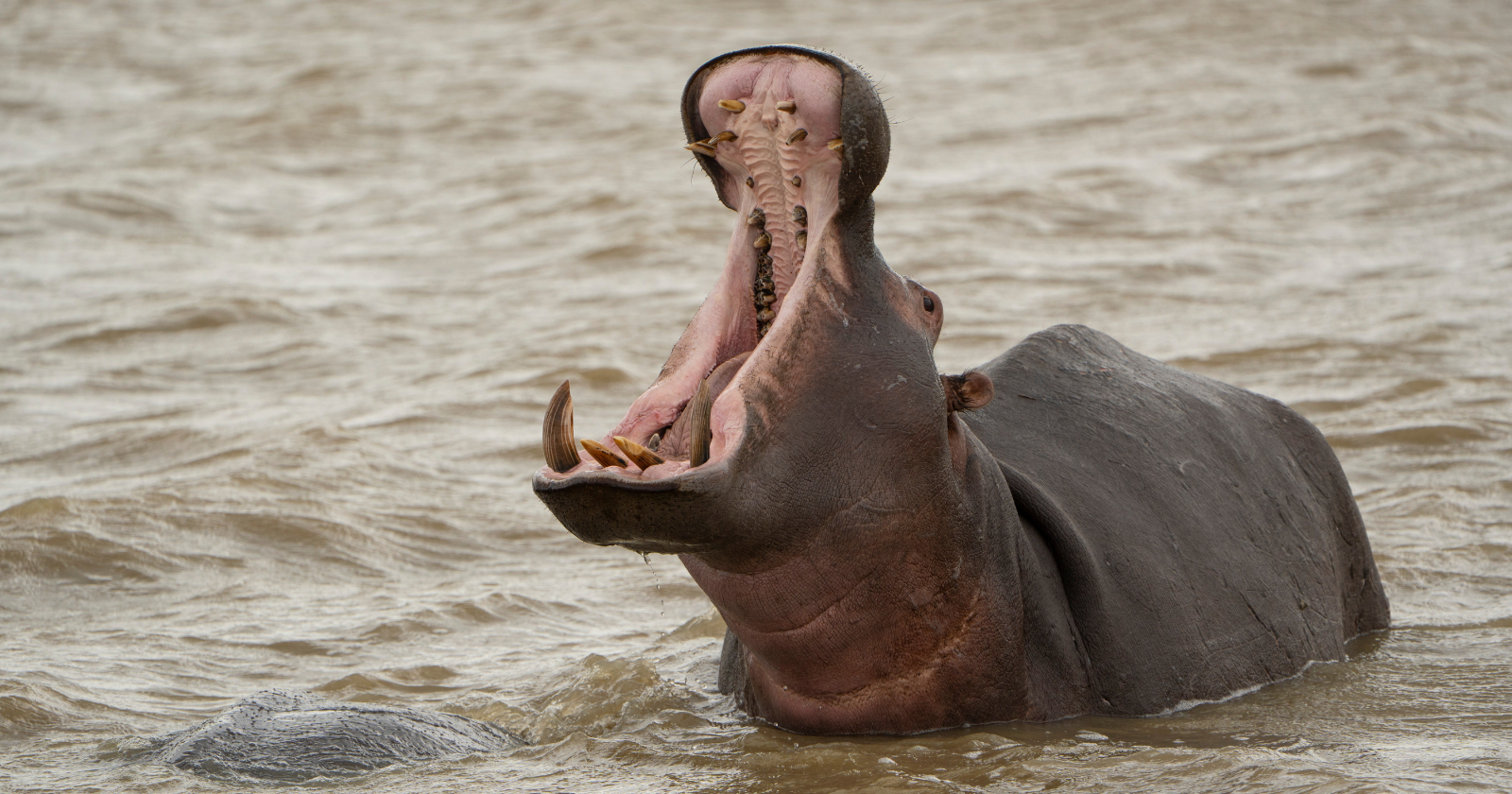
The situation currently developing along the middle Magdalena River in central Colombia is one of the more improbable ecological outcomes of any decision made by any twentieth-century individual anywhere in the world. Between the towns of Doradal and Puerto Triunfo, roughly halfway between Bogotá and Medellín, there are, on the current best estimate of the Colombian Ministry of Environment and Sustainable Development, somewhere between 170 and 220 wild African hippopotamuses living in the swamps, cattle ponds, and river tributaries of one of the most biodiverse riverine ecosystems in South America.
None of them belong there. All of them are descended from four hippos that a single Colombian drug trafficker had shipped to his private zoo in 1981. The trafficker, Pablo Escobar, is now dead. The hippos remain. And their population is doubling roughly every seven years.
How four hippos became a national problem
According to a peer-reviewed 2023 paper published in Nature’s open-access journal Scientific Reports by Amanda Subalusky of the University of Florida, together with nine co-authors from Florida International University, Yale University, Alaska Pacific University, and three Colombian institutions including the Pontificia Universidad Javeriana and CORNARE, the regional environmental authority responsible for the area where the hippos live, the introduction of the species to Colombia began with an imported group of four hippos, three females and one male, brought to Escobar’s Hacienda Nápoles estate from a zoo in the United States in 1981. Escobar was, at that point, roughly two years into building what would become one of the largest private exotic animal collections in Latin America. He kept elephants, giraffes, zebras, ostriches, camels, rhinoceroses, and kangaroos across the 10,000-acre property, which functioned equally as his personal residence, his fortified compound, and a spectacle for the region’s visitors. The hippos were housed in a lake on the property, where they were fed and cared for by staff, and where the three females and one male, having been placed together in an environment with abundant food, no predators, and no seasonal drought, did what hippos will do in such circumstances.
If you enjoy learning the weird and wonderful facts of our planet, check out this video we made on how one side of the world is quietly feeding the other…
After Escobar was killed in a rooftop shootout with Colombian police in December 1993, the Colombian state took control of the Hacienda Nápoles property. Most of the exotic animals in Escobar’s private zoo were removed to sanctuaries and zoos across Colombia and abroad. The elephants, the giraffes, the rhinoceroses, the zebras, and the ostriches were all successfully relocated within about a year of the seizure. The hippos were not. Which is a fact that turned out to matter, because the practical difficulty of capturing, sedating, transporting, and rehoming an adult African hippopotamus weighing between one and three tonnes had been substantially underestimated by everybody involved. There was no facility in Colombia equipped to hold them. There was no international zoo willing to take a founder population that had already begun to breed. The estate itself had been reassigned to local authorities and eventually converted into a theme park. And the four hippos, and their by-then-considerable number of offspring, were left in the lake because nobody could work out how to remove them.
By 2006, the population had reached sixteen animals, and hippos had begun escaping from the Hacienda Nápoles lake system into the surrounding creeks that fed into the Magdalena River. By 2009, when there were twenty-eight of them, the Colombian environmental authorities culled a single aggressive male that had been attacking livestock. The cull prompted a national and international outcry from animal rights groups, and a subsequent judicial ruling banned any further shooting of the hippos. From that point onward, the population grew essentially unmanaged. By 2020, the estimate was seventy-five. By 2022, the peer-reviewed count was ninety-one, growing at 9.6 per cent per year. And by the time of the 2022-2023 field census, which used drones, footprints, and direct observation to check the animals in remote river bends, the number had risen to somewhere between 181 and 215.
What Colombia has done about it
According to CBS News reporting from October 2025 on the current state of the Colombian government’s management strategy and the Hacienda Nápoles estate’s ongoing political reassignment under President Gustavo Petro, the Colombian government has been trying, for roughly fifteen years now, to work out what to do about the hippos. The initial approach, adopted in 2011 after the culling was legally forbidden, was surgical sterilisation of the males. The procedure requires capturing a wild adult hippo, sedating it, transporting it by helicopter to a veterinary facility, and operating on it under general anaesthesia. Which is dangerous for the veterinary staff, dangerous for the animal, and expensive. In the fifteen years since the sterilisation programme began, roughly ten males have been successfully treated.
The hippos, in the same period, have gone on producing new hippos at their species-typical reproductive rate, which is one calf per adult female every two years starting from about age three. The Colombian Ministry of Environment declared them an official invasive species in 2022, which cleared the legal path for more aggressive management. A 2024 court order has since approved veterinary-assisted euthanasia as a control method, and the environment minister has publicly discussed a plan to remove up to eighty animals from the wild by that method over the coming years. Some hippos have also been offered for transfer to overseas sanctuaries, though the international logistics of shipping a live three-tonne mammal across the Atlantic have proven to cost roughly three and a half million dollars per animal, which is not, on the government’s own accounting, a scalable solution.
In the meantime, the hippos themselves have kept spreading. Confirmed sightings have now been documented in four Colombian departments, meaning Antioquia (where the original estate is located), Santander, Boyacá, and Bolívar. Anecdotal sightings have been reported nearly four hundred kilometres downstream at Magangué in the northern part of the country. The peer-reviewed population projection published in Scientific Reports concluded that if the current growth rate continues without effective intervention, there will be more than a thousand hippos in the Magdalena River basin by 2050, and the animal will have colonised virtually the entire river system between the Colombian coast and the highlands.
The ecological consequences of that outcome are still being worked out. Hippos are what wildlife biologists call ecosystem engineers, meaning their presence physically alters the environments they inhabit. In their native African rivers, hippo activity contributes to nutrient cycling, water aeration, and sediment redistribution in ways that have coevolved with African freshwater ecosystems over millions of years. In the Magdalena, they are new. Their waste products are significantly altering the water chemistry of the tributaries they inhabit. They compete for food with native manatees. They are producing new pathways for zoonotic disease transmission. And they have already injured at least two Colombian citizens, a farmer and a fisherman, in incidents since 2019.
Which is what happens when one very wealthy individual decides, on nothing more than personal preference, to introduce a large African megaherbivore into a South American river system with no predators, no seasonal droughts, and no institutional capacity to remove it once the individual in question is dead. The four hippos Pablo Escobar imported in 1981 have already outlived him by more than three decades. Their descendants, on the current population trajectory, will probably outlive most of the Colombians currently trying to work out how to manage them. And the country’s main river, on the accumulated evidence of the past forty-five years, now belongs, in a small but rapidly growing measure, to a species that had never before set foot on the American continent.