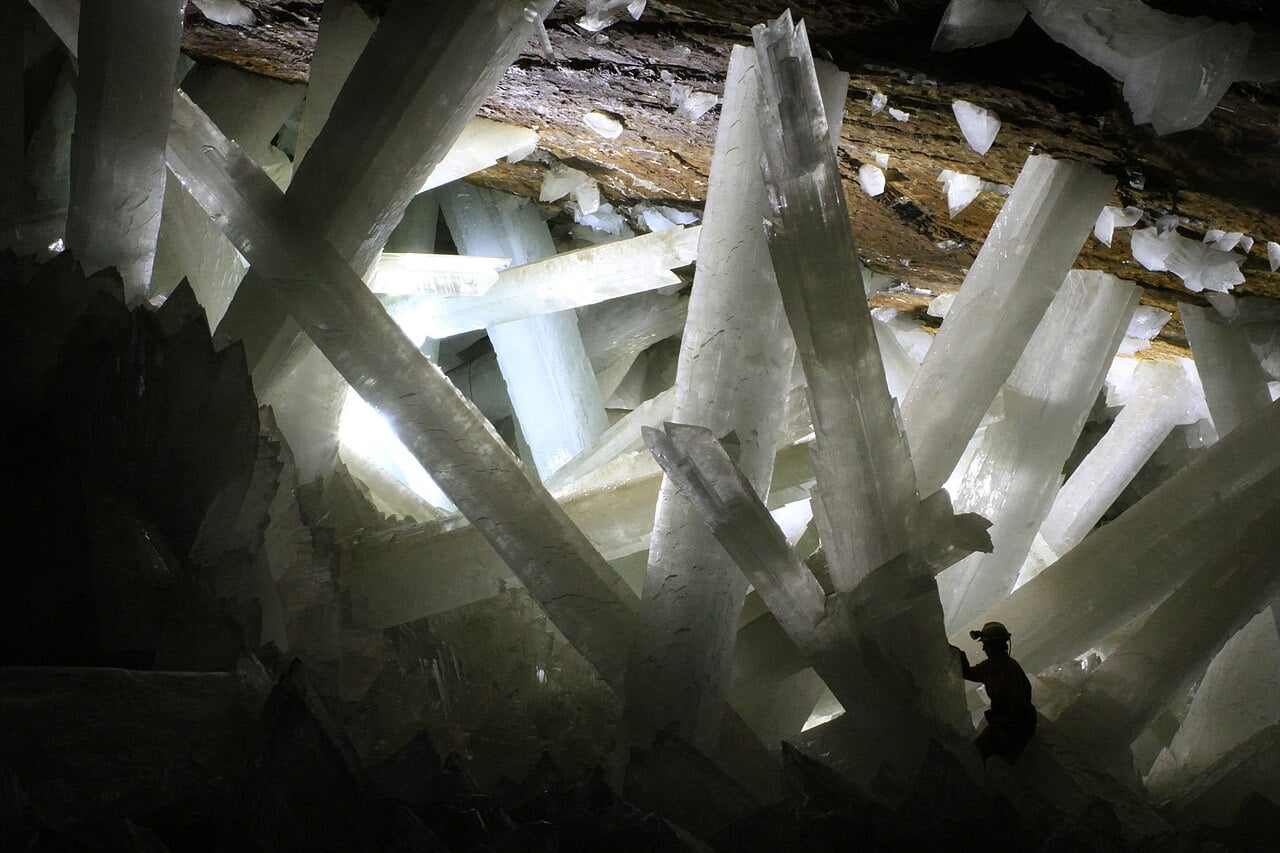
In April 2000, somewhere under the Chihuahuan Desert, a drill bit punched through solid rock and hit nothing at all.
Miners cutting a new tunnel in search of fresh ore deposits, roughly 300 metres down in the Naica lead, zinc and silver mine, broke through into a void, as researchers later recounted in ACS Central Science. Filling it, floor to ceiling, were translucent beams of crystal the size of tree trunks, jutting out at every angle, the longest of them stretching further than a city bus. As National Geographic reported, the miners had opened a chamber holding some of the largest natural crystals ever found.
What the beams are made of
Gypsum is about as ordinary as minerals get. It’s calcium sulphate with water locked into its structure, dug up by the megatonne for plaster and plasterboard. Its clear, glassy variety goes by the name selenite.
Nothing exotic in the chemistry. Size is the freakish part. Measurements from the chamber put the biggest documented beam at 11.4 metres long and about a metre thick, sitting in a horseshoe-shaped cavity around 109 metres from end to end.
Why they grew so large
So why didn’t all that mineral-rich water simply make a lot of small crystals instead?
Gypsum has a drier twin called anhydrite, the same compound without the water. Above about 58 degrees Celsius, anhydrite is the stable form; below that line, gypsum takes over. Juan Manuel García-Ruiz of the University of Granada and his co-authors analysed fluid trapped inside the crystals. In a paper published in Geology in 2007 they documented growth from low-salinity water at roughly 54 degrees, just under the switchover point.
Parked a few degrees below the line, anhydrite dissolves at a crawl and reprecipitates as gypsum, quietly feeding beams that already exist instead of seeding new ones. García-Ruiz called the process self-feeding, and hundreds of thousands of years of it produced the beams.
A hair’s width per century
Quantifying that crawl took another decade. Alexander Van Driessche and colleagues grew gypsum in water taken from the mine and tracked it with interferometry sensitive enough to register atomic-scale movement, publishing the results in the Proceedings of the National Academy of Sciences in 2011. García-Ruiz told NBC News it was the slowest growth rate ever measured, in nature or anywhere else. A beam thickens by something like the width of a human hair every hundred years. Reaching a metre across takes close to a million.
Dry only by accident
Mining is the sole reason anyone ever laid eyes on the place.
While the mine ran, Peñoles pumped groundwater out of the mountain at a rate Van Driessche compared, in coverage by ACS Central Science, to filling an Olympic swimming pool every 40 minutes. That dropped the water table and drained the chamber in 1975. Nobody got inside until the new tunnel broke through 25 years later.
Conditions in there push hard against human physiology: air near 50 degrees, humidity above 90 per cent, sweat that cannot evaporate and therefore cannot cool. Researchers went in wearing vests packed with ice. Penelope Boston, director of NASA’s Astrobiology Institute, put the recommended ceiling at half an hour, per Live Science.
Life in the fluid pockets
Sealed inside the beams are tiny bubbles of the water they grew from. Marie Ragon, Purificación López-García and colleagues surveyed the hot aquifer feeding the mine for Frontiers in Microbiology in 2013 and found thermophilic microbes living in it, organisms that draw their energy from minerals rather than sunlight. They noted the fluid pockets inside the crystals may have trapped similar life during growth.
Boston went further. At the 2017 meeting of the American Association for the Advancement of Science, she reported culturing around 40 strains from drilled inclusions, dormant for somewhere between 10,000 and 50,000 years and genetically unlike anything in the databases. Almost a decade on, that finding still hasn’t appeared in a peer-reviewed journal, and it drew caution from the start. López-García told National Geographic that trapped microbes were plausible in principle, though surviving that long was questionable and drilling can easily carry surface contamination inwards.
Older claims of far longer dormancy exist too, and they are just as contested, so this one still has convincing to do.
Nobody knows if the chamber flooded again
Groundwater rose into a large section of the mine in January 2015. Nine months of pumping failed to bring the level back down, and Peñoles suspended operations at Naica indefinitely on 13 October that year. What that flood did to the Cave of Crystals specifically, nobody has confirmed. The same ACS Central Science report, published three years after the shutdown, said it remained unclear whether the cave itself would flood again.
A 2021 review by the team that has spent the past decade analysing real Naica samples is blunter. It lists full reflooding as the best outcome for the beams, not a confirmed one, and warns that with access cut off since 2015, the risk to their surfaces is immediate, according to the journal Minerals. The clearest documented damage so far, from laboratory tests on actual crystal, traces back to the same cause: pulling the water out in the first place.
So the beams are either resting under warm mineral water again, thickening by a hair every century as before, or they are standing in dry air, slowly losing their surfaces to dehydration. Both are real possibilities, backed by real research. Nobody has been down to find out which.