

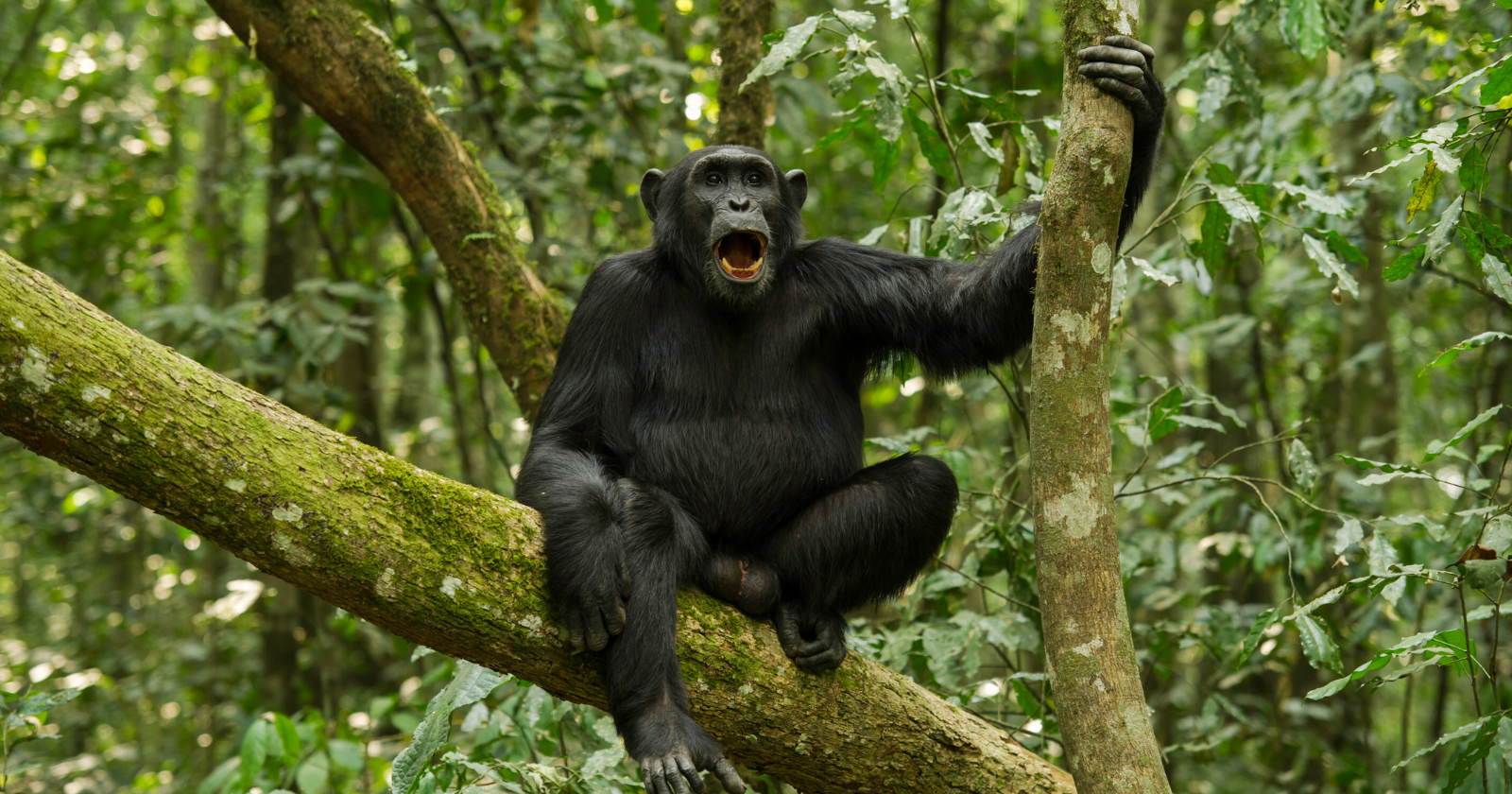
On July 14, 1960, a 26-year-old former secretary stepped off a boat onto the shore of Lake Tanganyika, in what is now Gombe National Park, Tanzania. Jane Goodall had no degree, no scientific training, and almost no equipment — a notebook, a pair of secondhand binoculars, and instructions from the paleontologist Louis Leakey to go watch chimpanzees.
The colonial authorities wouldn’t let a young woman camp alone in the forest, so her mother came along as chaperone.
That improvised expedition is now the longest-running wild chimpanzee study on Earth — 66 years of continuous observation of the same community, the same families, the same names passed down the generations. Goodall herself died last October at 91, mid-speaking-tour. The watch she started did not pause.
What the first months caught
The study nearly died in its infancy — funding covered only months, and the chimps fled from her for weeks. Then, in the fall of 1960, one male lost his fear.
Goodall had named him David Greybeard, in defiance of the scientific convention that study animals get numbers, not names. And David Greybeard, in front of her binoculars, stripped the leaves from a twig and poked it into a termite mound, fishing out insects — making and using a tool, a capacity then considered the defining boundary of humanity.
Leakey’s response by telegram became the study’s founding legend: now we must redefine tool, redefine man, or accept chimpanzees as human.
One observation, made in month four, justified everything. But the study’s real product was the decision that followed — to stay. Not a field season. Not a doctorate’s worth. Indefinitely.
What only decades can see
Time turned out to be the instrument. A short study sees what chimpanzees do; only an unbroken multigenerational watch can see who they are — and some of Gombe’s biggest findings are literally invisible on any shorter clock.
The war took four years to unfold. Between 1974 and 1978, the study community split, and the larger Kasakela faction systematically hunted down and killed the males of the breakaway Kahama group — patrols, ambushes, annihilation. The Gombe Chimpanzee War, as it became known, demolished the idea of the peaceful ape and rewrote the debate on the roots of human warfare. No expedition would have seen it. The watch did.
The adoptions took longer still. Gombe’s records show orphaned infants taken in and raised — by older siblings, and sometimes by unrelated adults, including a young male named Spindle who in 1987 adopted a sickly orphan named Mel, carrying him, sharing food, waiting for him on trails. Care with no genetic payoff, documented because observers knew every individual’s family tree going back decades.
And the family trees themselves became the data. Four generations deep, the archive — more than 300 scientific publications and counting — now answers questions Goodall couldn’t have phrased in 1960: how a chimpanzee’s mothering shapes its offspring’s success, whether personality is stable across a lifetime, how a virus related to HIV moves through a wild population.
The watch outgrew the watcher
The romantic version of Gombe stars one Englishwoman. The actual instrument is bigger, and more Tanzanian.
Goodall stopped being the study’s daily observer decades ago; the “focal follows” — selected chimpanzees shadowed dawn to dusk, 365 days a year — have been carried for most of the study’s life by generations of Tanzanian field assistants, more than 200 researchers and staff across the decades, some logging 35 years apiece with the same animals. When a 1975 kidnapping crisis forced Western researchers out, the Tanzanian staff kept the daily records going. The continuity in “continuous” is largely theirs.
The methods evolved around the unchanged core: GIS mapping, bioacoustic monitoring, a lab running hormones and pathogens from dung samples — layered onto the same practice Goodall started, a person watching a known individual and writing down what happens.
Sixty-six years, and counting whom
Goodall liked to note that the study’s greatest edge was mathematically unbeatable: we’re the longest study in the world, she said — and unless we stop, who can catch us?
Nobody can. Every year the watch continues, its lead extends, and its archive answers questions that can only be asked of a community whose every member has a recorded biography. The 26-year-old with the notebook guessed right about the only thing that mattered: that the way to understand an animal that lives 50 years is to watch it for longer than that — and to build the watching so it outlives the watcher, which, as of last October, it formally has.
