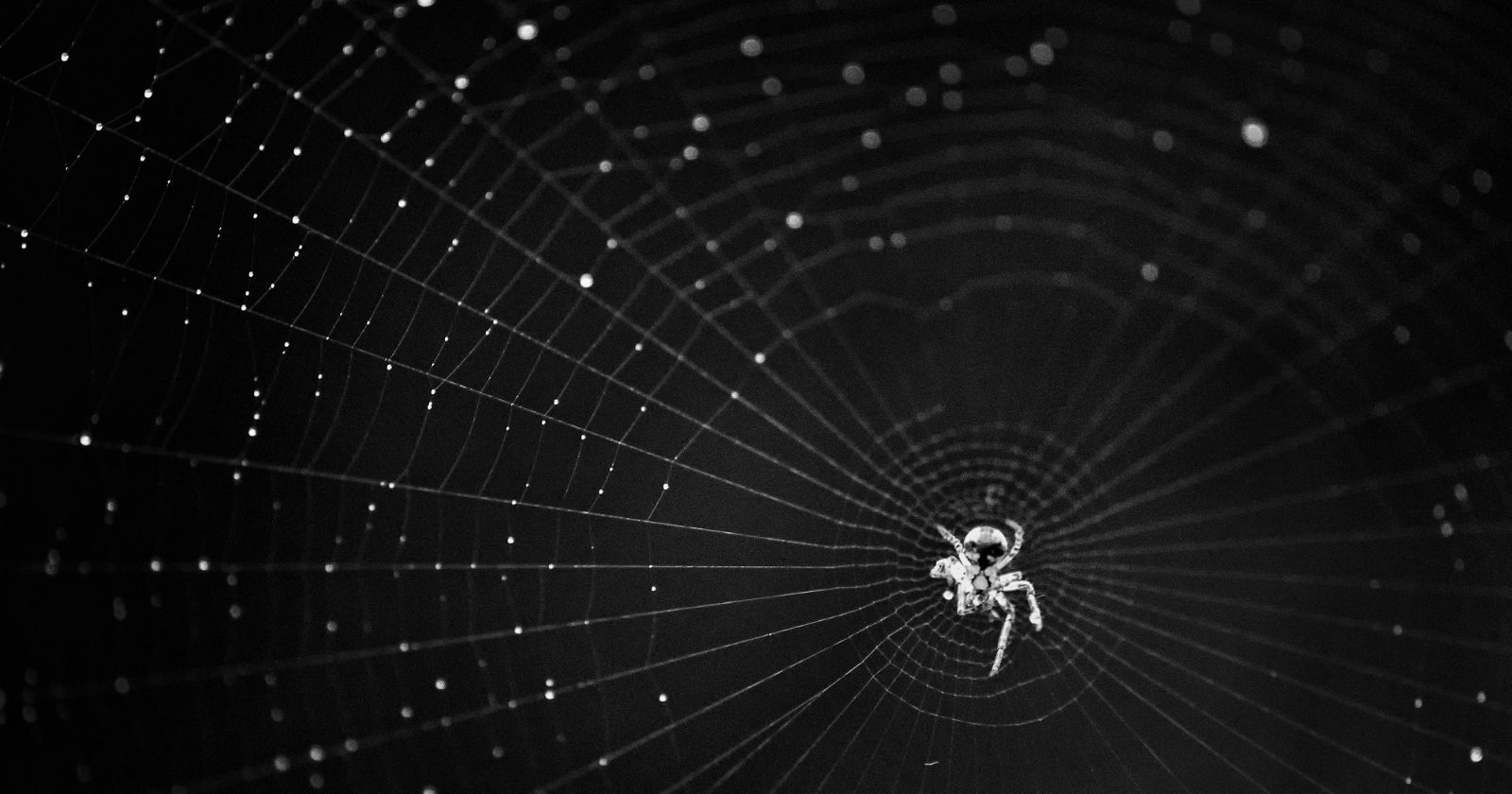
The proposal that eventually put the first spiders into orbit started with a National Geographic magazine article. The reader was a seventeen-year-old high school student in Lexington, Massachusetts, called Judith Miles. The article, published sometime around 1971, described how orb-weaver spiders build their webs, meaning the specific set of behavioural steps by which a small animal with a nervous system smaller than a grain of rice manages to produce a geometrically regular structure hundreds of times larger than its own body. What caught Miles’s attention was the observation that the spider senses its own weight during the construction process, using the weight to work out how thick each strand of silk needs to be. And that the spider also uses gravity, along with wind, to work out which way the initial anchor threads should be strung.
Which meant that a spider in orbit, on Miles’s own reasoning, would have neither of the physical cues its ordinary web-building behaviour depended on. So the question was worth asking. Could a spider still build a web in zero gravity? And if it could, what would that web look like?
How a teenager’s question ended up on Skylab
NASA had, at the time, an unusual programme running for the Skylab space station. According to NASA’s own reference material on the Judith’s Web experiment, drawing on the original mission documentation and hosted on NASA’s public image and article archive, the agency had invited high school students across the United States to propose experiments to fly aboard the station. Over 3,400 proposals came in from students nationwide. Of those, 25 were selected to actually fly. Miles’s spider experiment, given the technical designation ED52 and formally titled “Web Formation in Zero Gravity,” was one of the 25 that made it through.
She’d designed the underlying rationale carefully. Her proposal noted that the geometric structure of an orb-weaver’s web is a direct expression of the condition of the spider’s central nervous system. Drugs, stress, temperature, and other physiological factors all affect the neat regularity of a web in measurable ways, which is why spider behaviour has been used since the 1940s as a general index of neurological state. Which meant that watching how a spider’s web-building behaviour responded to weightlessness would tell researchers something not just about spiders, but about how a small nervous system copes with a completely unfamiliar physical environment.
NASA agreed. Two female European garden spiders, of the species Araneus diadematus, sometimes called cross spiders because of the marking on their abdomens, were selected for the flight. They were named Arabella and Anita. Each was given a housefly meal before launch, placed into a small vial with a water-saturated sponge and an additional housefly for the trip, and packed aboard the Apollo command module carrying the second Skylab crew of Alan Bean, Jack Lousma, and Owen Garriott.
What the spiders actually did in orbit
Skylab 3 launched on 28 July 1973 and remained in orbit for 59 days. The spider experiment began about a week into the mission. On 5 August 1973, scientist pilot Owen Garriott positioned Arabella’s vial next to the specially constructed spider habitat and waited for her to leave the vial and enter the cage. Arabella refused. After several hours of waiting, Garriott gently shook the vial to dislodge her.
What happened when she reached the cage is one of the more genuinely charming small pieces of documentation in the entire Skylab archive. Arabella, on the recorded footage, bounced back and forth across the interior of the cage in what the observers described as an erratic swimming motion, waving her legs, trying to get purchase on air that wasn’t behaving the way air was supposed to behave. Eventually she managed to fix herself to the screen covering one wall of the cage. Then she tried to build a web.
The first web she produced was, on any charitable reading, terrible. It was asymmetrical. It had missing strands. Its overall geometry was closer to a rough net than to the neat concentric orb spiders normally build. But the important observation, on the mission scientists’ analysis, was that she had built one. In an environment that removed the two physical cues her behaviour ordinarily relied on, she had still managed to string together enough silk in enough of the right places to produce a functional web.
Then, on day two, she tried again. And this second web was considerably better. By day three, she was producing webs that, on the recorded images, looked closely comparable to the ones her control spider, kept back on Earth in an identical cage as part of the experimental design, was producing under normal gravity. The spider had, in effect, learned to build webs in a completely unfamiliar physical environment across the course of a few days.
The experiment team was intrigued enough by the initial results that they extended the study and introduced the second spider, Anita, midway through the mission. Anita went through a similar adjustment period, produced a similar sequence of increasingly competent webs, and eventually settled into a routine that looked, from the outside, like ordinary spider life carried on in an ordinary spider cage. The webs the two spiders produced in orbit turned out, on later laboratory analysis of the silk itself, to be slightly different from Earth-spun webs. The silk was measurably finer. But the overall pattern, on the mission’s final report, was substantially normal for the species.
What became of the spiders and the experiment
Neither Arabella nor Anita made it home fully intact. According to the US National Archives Education Blog, which hosts the original 1973 NASA documentation of the experiment digitized from the National Archives’ holdings, Anita died during the last week of the mission. The exact cause wasn’t confirmed at the time, though dehydration and the limited food supply in her small vial were the likely factors. Arabella survived the return to Earth but died shortly after landing. Both spiders’ bodies were preserved by NASA scientists and eventually transferred, along with the flight hardware, to the Smithsonian Institution in 1974, where Anita is currently on display in the Space Science exhibit at the Steven F. Udvar-Hazy Center in Chantilly, Virginia.
The Skylab experiment holds the Guinness World Record for the first webs spun in space. The recorded footage of Arabella’s adjustments across her first three days in orbit has been used in animal behaviour classrooms for the past fifty years, and it remains one of the earlier examples in the whole of experimental biology of a small invertebrate demonstrating what looks unmistakably like learning within the span of a few days. Judith Miles graduated high school shortly after the mission concluded, went on to study biology at university, and spent her subsequent career as a scientist working on human genetics research. The experiment she had designed as a seventeen-year-old, on the back of a magazine article, ended up producing one of the most reproduced and referenced pieces of documentation in the whole history of spider behaviour research.
The webs themselves, spun by two small Massachusetts-born arachnids fifty years ago inside a purpose-built cage aboard the first American space station, remain the earliest surviving physical evidence that an ordinary Earth-evolved nervous system can, given a few days and no particular help, work out how to solve the problem of building a familiar structure in an environment its ancestors never encountered. Which is not a bad answer to a question a high school student asked after reading a magazine article. And it wouldn’t have happened if she hadn’t sat down to write the proposal.