

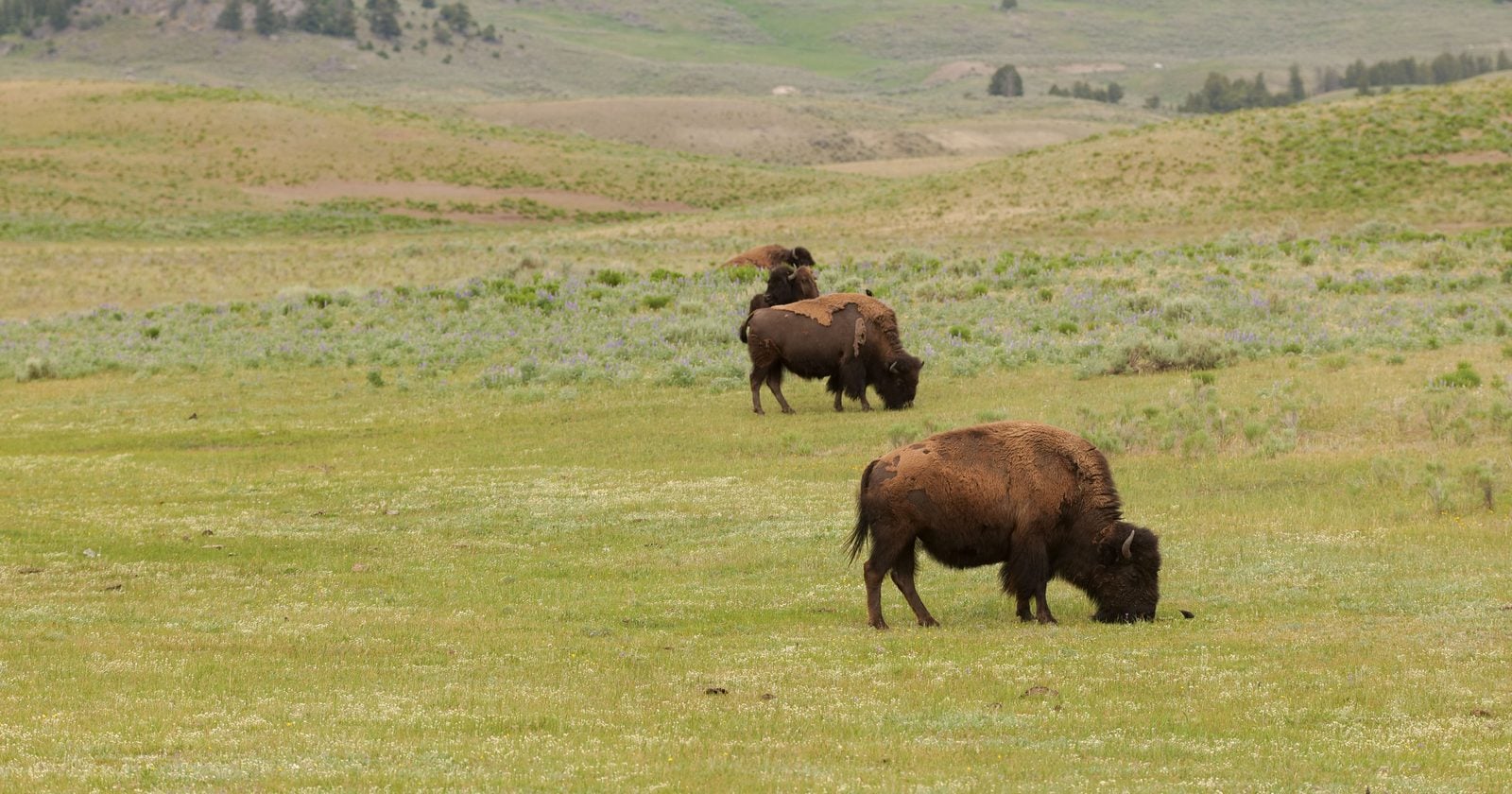
Let’s consider the same stretch of southwestern Montana ground, three decades apart. In the first version it is a working cattle ranch, cut into paddocks by wire and running thousands of cows. In the second it is open country running bison, with much of the old internal fencing gone and thousands of bison in place. The ranch now covers 113,613 acres. Almost nothing else is the same.
That is roughly what happened to the Flying D Ranch, a property between the Gallatin and Madison rivers, south of Bozeman. Ted Turner, the founder of CNN, bought it in 1989 for around $21 million. He took the cattle off, tore out much of the wire, and put bison on it instead. The switch is the whole story, and it is worth walking through what it actually changed.
We are not ecologists, range scientists, or wildlife biologists, and this is reading and reflection on the research rather than any kind of expert verdict. The grazing studies below come from particular sites, and what happens at one site doesn’t automatically hold true everywhere or settle how a single private ranch performs.
The land before: a working cattle ranch cut into pieces
Before Turner, the Flying D was a major cattle operation. At its cattle peak it supported about 7,000 to 8,000 head. A detailed history of the ranch describes decades of intensive cattle grazing, with some creek bottoms reduced to mud and vegetation depleted in parts of the riparian areas and uplands.
The wire mattered too. Cattle ranching depended on interior fencing, splitting the land into sections. Turner initially removed hundreds of miles of barbed wire so the bison could range more freely. He later described that as an early mistake: the animals overgrazed some areas and undergrazed others, so limited fencing had to be brought back. The romantic version and the practical version parted ways fast.
The land after: bison, grazing land, protected open space
What replaced the cattle is now one of the largest bison herds in North America. The Turner Institute of Ecoagriculture puts the Flying D at about 4,500 bison and says more than 5,000 acres of former cropland have been restored to grazing land. The ranch has also been protected by a conservation easement since 1989, keeping the landscape intact as open space.
The bigger difference is what bison can do differently on grassland. Bison were once a defining grazer across North American grasslands before being removed from most of their former range. Putting a large herd back on a landscape this size is, in a sense, running part of that ecological tape in reverse.
Why bison and cattle treat the same acreage differently
They are both big grazing animals, so it is fair to ask whether the swap changes anything on the ground. Some of the strongest long-term evidence comes from Konza Prairie in Kansas, where researchers compared bison-grazed, cattle-grazed and ungrazed tallgrass prairie.
Over 29 years, bison increased native plant species richness by 103 percent at local scales and 86 percent at the catchment scale compared with ungrazed areas. Cattle increased richness too, but by less than half as much as bison. The bison-grazed plant communities also remained resilient through the most extreme drought in four decades. That is one carefully studied tallgrass prairie, not a direct measurement of the Flying D, but it shows why replacing cattle with bison can matter.
One important difference is how the animals use water. A Montana study found streams in bison pastures gained perennial grass and forb cover, shrubs and woody vegetation faster than streams in seasonally grazed cattle pastures. The researchers also found cattle were detected within streams more often than bison. They note that bison tolerate heat and drought better and can forage farther from water, reducing pressure on riparian areas.
What the ranch is actually for
This is the part that complicates the tidy conservation story. The Flying D is a working business. Turner Enterprises says its herd across 13 ranches totals about 45,000 bison, the largest private herd in the world. Ted’s Montana Grill says the majority of the bison it serves comes from Turner ranches. The animals are not simply wandering a preserve; they are part of a commercial ranching system.
That does not automatically cancel out the ecological effects. The business case is that a market for bison gives private landowners an economic reason to maintain large herds and large areas of grassland. But it also means this is managed agriculture, not wilderness.
What the Flying D proves, and what it doesn’t
After 37 years, the Flying D is a real large-scale example of a cattle ranch being converted to bison production while keeping a vast landscape intact. Thousands of acres of former cropland have returned to grazing, and the ranch’s management lines up with research showing that bison can affect plant diversity and riparian habitat differently from cattle.
The limits are just as real. Turner bought the ranch in 1989 for about $21 million, a scale almost nobody can copy. Turner died on May 6, 2026, at 87. The Flying D is not truly wild: the bison are privately owned, actively managed and contained within the ranch, and some fencing had to be restored after Turner’s first attempt to let them range almost unrestricted.
Our read is narrow but genuine. The Flying D shows a landscape can be moved a long way back toward bison at scale, and that doing so lines up with field research on grassland diversity and riparian recovery. It took a private fortune to make it happen, and the result is a commercial operation with fences, not a restored wilderness.