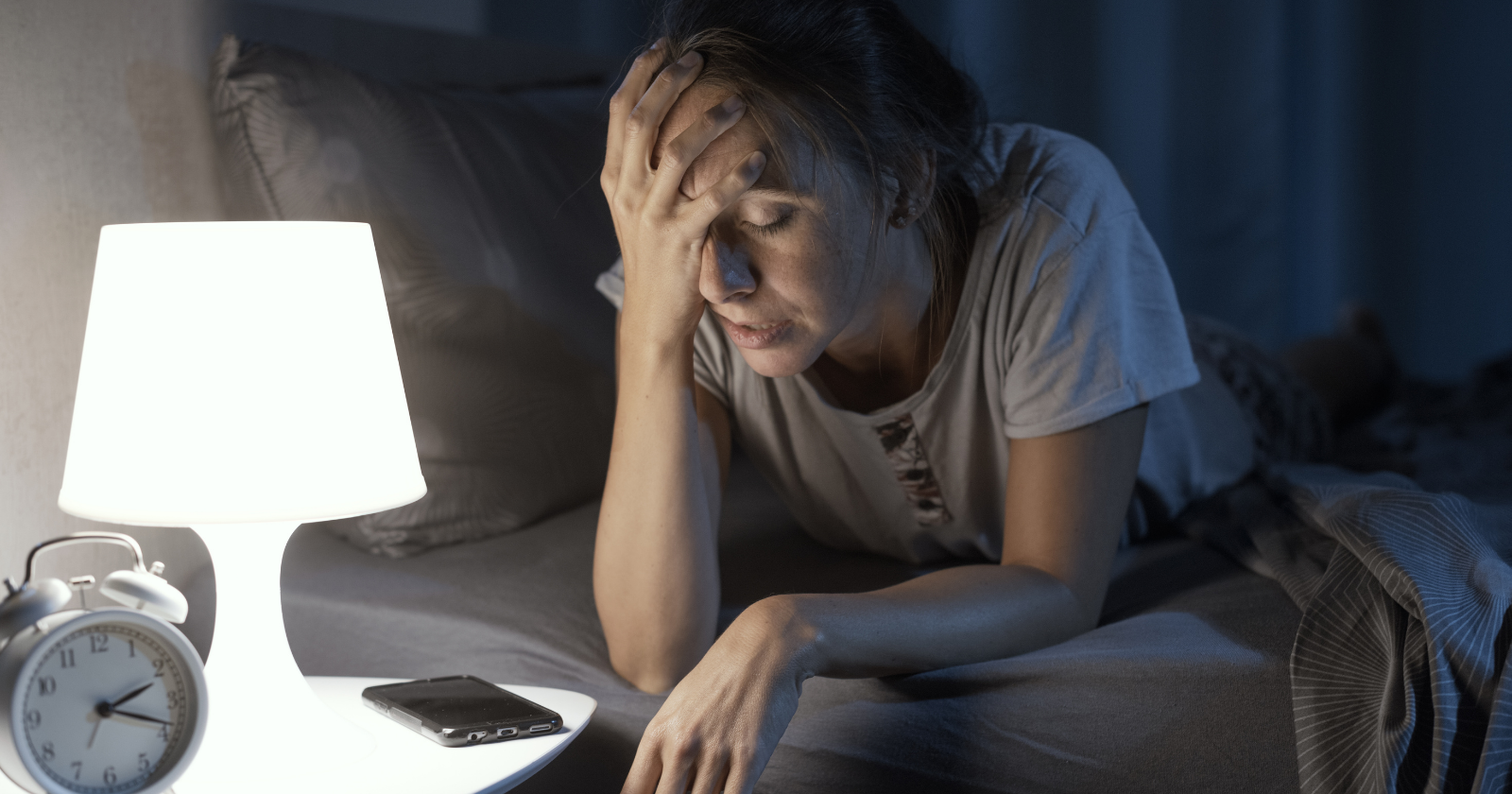
Three in the morning has a distinctive texture. Nothing has actually gone wrong; the ceiling has just become genuinely interesting, and tomorrow has quietly reclassified itself as a threat.
By mid-morning, that threat has a number attached to it.
Eighteen people, two nights, one scanner
Sleep scientists at UC Berkeley’s Center for Human Sleep Science ran a study blunt enough in design to be worth describing in full. Eighteen healthy young adults were scanned twice: once after a normal night of sleep, and once after being kept awake for 24 straight hours. Each morning they watched emotionally charged video clips inside an fMRI machine, then filled in a standard anxiety questionnaire.
Evening scores were near identical across the group. Morning scores were not. After the sleepless night, participants reported anxiety up to 30 per cent higher, a result published in Nature Human Behaviour in November 2019 by Eti Ben Simon, Aubrey Rossi, Allison Harvey and Matthew Walker. A later published correction put the in-laboratory figure more precisely at 27 per cent.
Accelerator down, brake off
Two brain regions do most of the work here, and neither is as intimidating as its name.
Sitting deep in each hemisphere is the amygdala, an almond-shaped cluster that decides, fast and without consulting anybody, whether something in the environment counts as dangerous. Above it sits the medial prefrontal cortex, roughly behind the forehead, which handles the slower job of talking the amygdala down. Yes, that shape in the dark is alarming. No, nobody is going to die because of it.
Scans taken after 24 hours awake showed the first region running hot and the second barely participating. As Walker put it, the sleep-deprived brain is “too heavy on the emotional accelerator pedal, without enough brake”.
Similar wiring showed up more than a decade earlier. Seung-Schik Yoo, Walker and colleagues documented in Current Biology in 2007 that sleep-deprived volunteers showed roughly 60 per cent greater amygdala activation to unpleasant images than rested controls.
How much weight one study can carry
Eighteen people are not a lot of people.
They were also young, healthy and studied under laboratory conditions, which is a long way from a bad week with a newborn. One striking result from a small sample tells you where to look next, and the 30 per cent figure deserves to be read in that spirit.
What holds it up is the wider literature. A review in Psychological Bulletin, summarised by the American Psychological Association, pooled 154 experimental studies covering 5,717 participants aged 7 to 79. Led by Cara Palmer at Montana State University, it found that every form of sleep loss tested, whether total deprivation, shortened nights or repeated waking, reduced positive emotions and raised anxiety symptoms. Effects on depression and on negative mood came out smaller and patchier.
Walker has cited two figures worth holding onto, raised when the Berkeley group first presented this work in 2018. Roughly one American adult in five has been diagnosed with an anxiety disorder, and as many as 80 per cent of anxiety patients report poor or disturbed sleep. Which one drives the other is beyond what a two-night experiment can settle, and the researchers make no such claim.
What the sleeping brain appears to be doing
Deep sleep did something specific in the Berkeley data. Participants who spent longer in non-REM slow-wave sleep, the heavy dreamless stretch that dominates the early part of the night, reported the lowest anxiety the next morning and reacted least to the video clips. Slow, synchronised brainwaves during that phase tracked the overnight drop in anxiety, evidence that how well someone sleeps matters as much as how long. On that basis the authors floated deep sleep as a possible non-pharmaceutical target for anxiety, a proposal rather than a therapy.
The part that applies on a normal Tuesday
Most people never pull an all-nighter. They lose an hour here, wake at four there, and file it under “unremarkable”. Ben Simon and colleagues also tracked ordinary night-to-night variation across a larger online sample and found that modest reductions in sleep predicted next-day increases in anxiety, without anyone missing a full night’s sleep on purpose.
That scales up uncomfortably. In 2024, 30.5 per cent of American adults averaged under seven hours a night, as recorded by the National Center for Health Statistics, with 18.1 per cent reporting trouble staying asleep.
Anxiety is difficult to argue with in the moment, largely because it presents itself as accurate. What this research adds is a cheap diagnostic question for the following afternoon, when everything feels slightly more dire than it did the day before: how did last night go? Some portion of the reading is coming from the sleep debt rather than the situation, and that portion fades faster than the dread suggests.