
Thirty-nine globular clusters in the inner 20,000 light-years of the Milky Way, timed by NASA’s Hubble Space Telescope and placed by ESA’s Gaia, split into three age-and-metal sequences instead of two. The middle sequence is older than the clusters brought in when Gaia-Sausage-Enceladus was swallowed about 10 billion years ago, and younger than the clusters born in the Milky Way itself, no matter how metal-rich they are. NASA and ESA reported on 17 August that those clusters came from a dwarf galaxy swallowed about 11.8 billion years ago, just two billion years after the Big Bang, and that the dwarf held roughly 500 million solar masses in stars. The team named it Low-energy-Kraken-Heracles, or LKH, after three earlier papers that had argued for a merger this early. The result, published in Nature Astronomy, pushes the documented merger history of the Galaxy 1.8 billion years farther back than Gaia-Sausage-Enceladus.
A third sequence in the inner 20,000 light-years
The Milky Way is a massive spiral with hundreds of billions of stars. It did not start that way. It grew by making stars from its own gas and by taking stars, gas and dark matter from smaller galaxies. The most recent massive merger, with the Sagittarius dwarf, began more than 6 billion years ago and is still going. Before that, Gaia-Sausage-Enceladus arrived about 10 billion years ago and left a mark on the disk. Observations and simulations had long hinted at something still earlier. The specifics were argued over. Hubble’s sample of 39 inner clusters is the evidence NASA now calls definitive.
Globular clusters are roughly spherical collections of tens of thousands to a few million stars, among the oldest in the Galaxy, and they keep the chemistry of the systems that made them. Davide Massari, of the Astrophysics and Space Science Observatory of Bologna and lead author of the paper, put it as a house: “Our home is the Milky Way galaxy, but we do not know how our house was built. In this paper we discover where the first significant batch of bricks came from: a dwarf galaxy that we call LKH.”
The team looked where the oldest debris should still sit, inside 20,000 light-years of the centre. They expected two families: clusters born in the young Milky Way, and clusters collected from Gaia-Sausage-Enceladus. Hubble’s ages and metallicities, the abundances of elements heavier than helium, turned up a third family. Those clusters are older than the Gaia-Sausage-Enceladus group and younger than the in-situ group, at every metal content the team measured. That is the signature of a separate, earlier merger.
How Hubble timed the clusters
Chiara Zerbinati, of the University of Bologna, said the ages and metals only became usable because of Hubble’s resolution and depth. “Coupled with measurements from Gaia, this made it possible to distinguish a population of globular clusters that are different from the others. These are the clusters that were born in LKH, and they tell us when that galaxy was devoured by ours, and how massive it was.”
Gaia maps positions and motions across the sky. Hubble times the stars. Together they separate clusters that look mixed on a sky map. The farther back the history goes, the harder that split becomes. When the Galaxy was young it was smaller, closer in size to the systems it hit, and more chaotic. Merger scars can be erased. The 39-cluster sample is what survived in the inner Galaxy long enough to be timed.
From the imported clusters the team inferred a dwarf of roughly 500 million solar masses in stars, a significant fraction of the Milky Way’s mass at the time. NASA dates the swallowing to about 11.8 billion years ago. Gaia-Sausage-Enceladus is the 10-billion-year mark. The 1.8 billion years in the title is that gap, the same interval NASA says the new work adds to the documented history.
A dwarf that was a significant fraction of the house
The name Low-energy-Kraken-Heracles is not a new object on the sky. It is a label for three earlier claims that something this early, and this large, had already been eaten. Hubble’s third sequence is the measurement those papers did not have.
A merger that large, that early, changes how the first stars of the Galaxy are counted. “Some past studies have argued that the earliest phases of our galaxy’s evolution were defined by stars born only in our galaxy,” Massari said. “Here, we have shown that stars born in external galaxies also need to be considered.”
Fernando Aguado-Agelet, of the University of Vigo and the University of La Laguna, said Hubble is still taking clusters that have never been studied this way, with the aim of listing every massive merger the Galaxy has been through. NASA Goddard manages the telescope. The Space Telescope Science Institute in Baltimore runs the science. Hubble is a NASA–ESA project, more than three decades on, still doing the kind of inner-Galaxy photometry that Gaia cannot do alone.
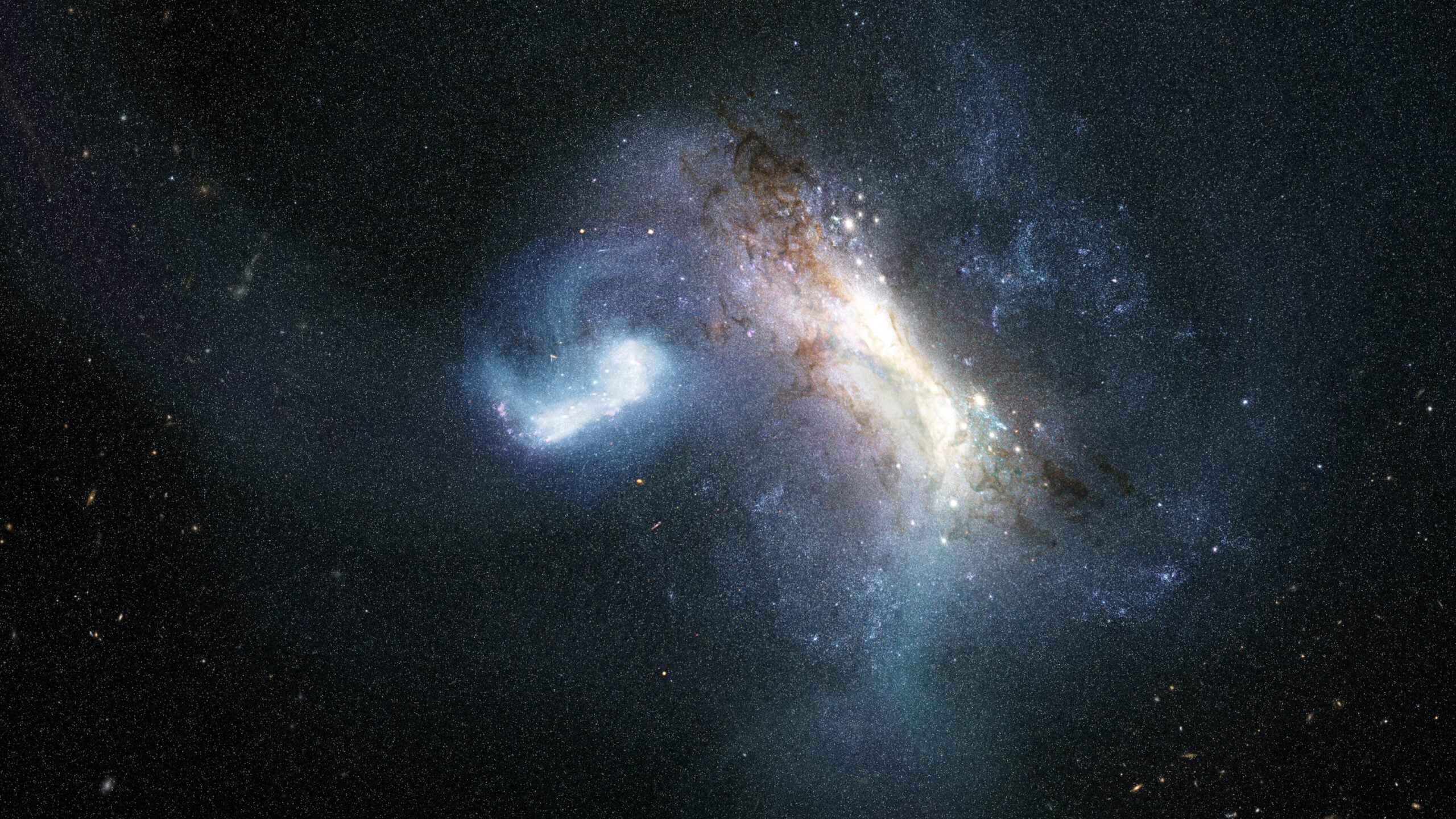
The illustration NASA released with the story, by Joseph Olmsted at STScI, shows a dwarf hitting a Milky Way that had not yet settled into a spiral. That is the scene the 39 clusters date. Not Hubble tension. Not a new telescope. A count, a place, and a time: 39 clusters, 20,000 light-years in, 11.8 billion years ago.