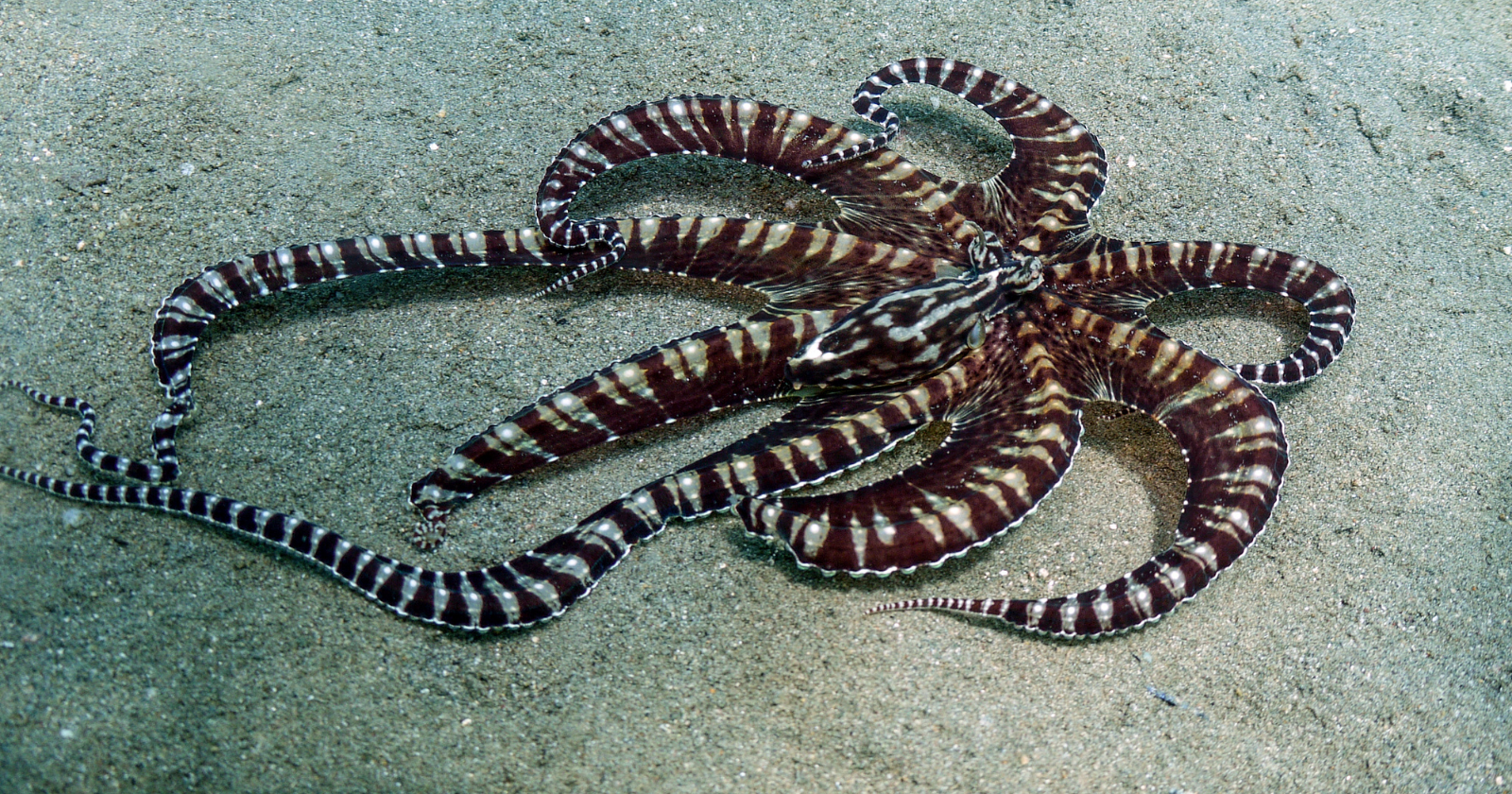
Out on the open sand flats off Sulawesi there is nothing to hide behind, which is an awkward situation if you happen to be soft, boneless and roughly the size of somebody’s lunch.
One octopus there solved the problem by refusing to be an octopus.
Divers spotted the animal in 1998, and it took another three years for the behaviour to reach the scientific literature. Mark Norman, Julian Finn and Tom Tregenza published the foundational account in Proceedings of the Royal Society B in 2001, drawing on nine individuals filmed over repeated dives in Sulawesi and Bali. Norman and F. G. Hochberg gave the species a formal name four years later in Molluscan Research, settling on Thaumoctopus mimicus, which translates to something close to wonderful mimicking octopus.
The strangeness starts with timing, not with any of the costumes to come. Norman’s team found the species foraging in broad daylight on open sand, in full view of hunting fish, at hours when most octopuses are wedged into a crevice waiting for dark. It has no shell and nothing built into its body for defence. Its long arms can detach near the base if something grabs one, an escape route Norman and Hochberg set out in the naming paper, and losing an arm is the outcome the impersonations exist to avoid.
Three impersonations, three different animals
Start with the everyday costume, the flatfish. All eight arms draw together into a flat leaf shape. The animal jets forward and undulates along the bottom at the speed and rhythm of a swimming sole, several local species of which carry toxins in their skin.
Lionfish is the showier option. Arms spread wide and trail out from the body in stiff radiating spokes, doing a passable impression of venomous spines while the octopus hovers just above the sand.
Sea snake is the strangest of the three. Six arms go down a burrow, two come out in opposite directions, striped black and white, waving with the slow deliberate movement of a banded sea snake. From the front, the effect is a pair of snakes guarding a hole.
What the damselfish saw
A damselfish the length of a finger will charge almost anything that enters its patch of sand, including an octopus many times its size. Norman’s team logged what happened next, and the behaviour went further than a simple costume change. The sea snake routine appeared only when territorial damselfish harassed the octopus, never in the other situations they filmed. That detail matters, because banded sea snakes eat damselfish.
The threat picked the disguise.
That observation has done a lot of work since. A 2019 analysis in Biosemiotics treats the damselfish encounters as evidence of goal-directed deception, noting that the octopus reserves the snake performance for that one aggressor while deploying flatfish and lionfish far more broadly.
Nine animals is not an experiment
Norman and his co-authors were careful with their own claim, writing that their observations suggest the octopus makes decisions about which form of mimicry suits the moment. Suggest is doing real work in that sentence. Nobody has run the controlled version, presenting the same octopus with different predators in sequence and recording what it picks, so the context-switching sits as a strong field observation rather than a settled result.
It is one paper, built on a handful of animals, describing behaviour nobody had documented before.
A colourblind quick-change artist
How does an animal that cannot see colour run a con built on colour? Octopus eyes run on a single photoreceptor type, one channel for brightness and nothing for hue, and yet this one produces high-contrast banding aimed squarely at colour-sensitive fish.
Skin may be part of the answer. Writing in the Journal of Experimental Biology in 2015, Desmond Ramirez and Todd Oakley showed that isolated patches of octopus skin, cut off from eyes and brain entirely, expanded their pigment cells when light struck them, responding fastest to blue. Those patches carry the same light-sensitive proteins as the retina. Skin cannot form an image, but it registers light exactly where it sits.
Other oceans, same idea
Flatfish mimicry shows up well outside Indonesia. Roger Hanlon, Anya Watson and Alexandra Barbosa documented the Atlantic longarm octopus copying the peacock flounder across five Caribbean sites, reported in The Biological Bulletin in 2010 and announced by the Marine Biological Laboratory as only the fourth convincing case of mimicry in cephalopods. Both species vanish completely when they hold still, since movement is the one thing a soft-bodied animal cannot hide.
That is the real trick behind the sea snake routine. A costume is only as good as the fear it borrows, and this one is not staged for divers with cameras. The audience is a single aggressive fish the size of a business card, and the only review that counts is whether it swims off.