

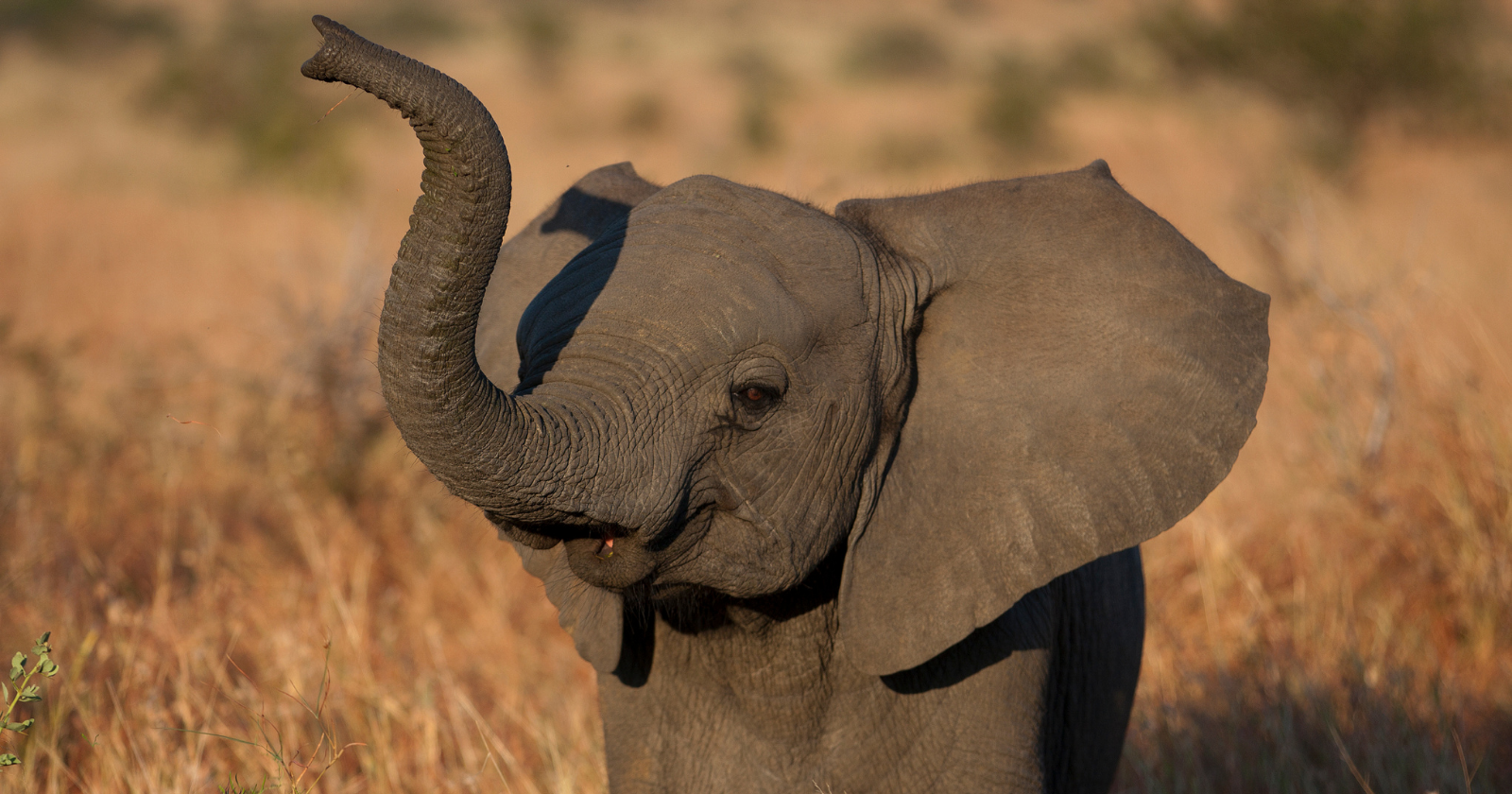
How does one boneless organ uproot a tree one minute and pick up a single blade of grass the next? An elephant does both with the same trunk, and there is no skeleton inside it doing the work. No bones, no joints, no cartilage. The answer is muscle, and a lot of it.
That mix of raw force and fine control in a single soft limb is what keeps drawing anatomists and engineers back to the trunk. The trunk is built entirely out of muscle arranged in a particular way, and a 2023 scan of a young elephant’s trunk finally put a firmer number on just how much.
What the trunk actually is
Biologists call the trunk a muscular hydrostat. That is a technical way of saying an organ that holds its shape and moves using muscle alone, with nothing rigid inside it. Your tongue works the same way. So does an octopus arm. The elephant trunk is made almost entirely of muscle, nerves, and connective tissue. It attaches to the skull at a bony opening, but no bone of its own holds it up.
The trick that makes it work: muscle tissue cannot really be squashed smaller. Squeeze it in one direction and it bulges out in another, because the volume has to go somewhere. Contract the muscles running the length of the trunk and it shortens and stiffens. Contract the ones wrapped around it and it narrows and stretches out. There is no lever, no hinge, no rigid arm being swung. The change in shape is the movement.
That is why a trunk can curl, twist, reach, and stiffen without a single joint. It is closer to a tongue than to an arm, just far larger and with much more going on inside.
Why the old muscle count gave way to a bigger one
For a long time nobody could say with confidence how many muscle units a trunk held.
The most careful answer so far comes from a study published in Current Biology in 2023, led by researchers at Humboldt University of Berlin. Instead of dissecting by hand, they used detailed 3D scanning to reconstruct the muscle bundles inside the trunk of a young Asian elephant. From that they estimate the whole trunk holds roughly 90,000 muscle bundles, the individual units the researchers treat as the trunk’s basic muscles. That “estimate” matters. It is one carefully measured animal, not a final count.
What surprised the team most was not the total but how tiny the muscles at the tip turned out to be. Michael Brecht, the senior author, put it plainly: “We knew elephant trunks have many muscles, but the microscopic size of trunk tip muscles was a big surprise.”
How muscle running three ways does both jobs
The reason one organ can be both strong and delicate comes down to how the muscle is laid out.
Inside the trunk the fibres run in three directions at once: lengthwise along the trunk, across it like the spokes of a wheel, and in a helical twist. Each direction pulls the trunk into a different kind of shape change, and because they can work in almost any combination, the trunk can make a huge range of movements.
Force and finesse come from different parts of this system. The long muscles down the trunk deliver the power to lift and haul. The fine control lives near the tip, packed with those thousands of tiny cross-wise bundles. In the nimble finger at the end, the study found the muscle is made up largely of these microscopic bundles, which is why the authors point to the muscles getting smaller and more numerous toward the tip as a likely reason the trunk handles small objects so precisely.
Skin matters too. A Georgia Tech team studying how the trunk stretches found that its folds and wrinkles let different parts of the trunk stretch by different amounts, so the skin itself adds to the trunk’s flexibility rather than just wrapping the muscle underneath. The whole organ works as a package: muscle, nerves, and skin all contributing.
Why engineers keep coming back to it
A boneless limb that is both strong and precise is close to a wish list for anyone building soft robots, which is why the trunk keeps turning up in engineering labs.
Andrew Schulz, who has studied the trunk’s mechanics, puts the appeal directly: Schulz says that “soft robotics created with biologically inspired design are always based on muscle movement.” Get the muscle logic right and a machine can be strong without being rigid.
The trunk gives engineers a working example of that balance already solved. One team built a soft-and-rigid robotic arm that copies the trunk’s bending and twisting to pull off nine different ways of grasping, pointing to the real trunk’s many coordinated muscle bundles as the reason for its versatility. The 2023 anatomy study is the kind of work that could feed directly into those designs, since the fine muscle map it lays out may help explain where the dexterity comes from.
What the trunk ultimately shows is that a skeleton is not the only route to a capable limb. Nature built a strong, precise, endlessly maneuverable organ out of nothing but carefully arranged muscle, and our own soft machines are still trying to match it.