

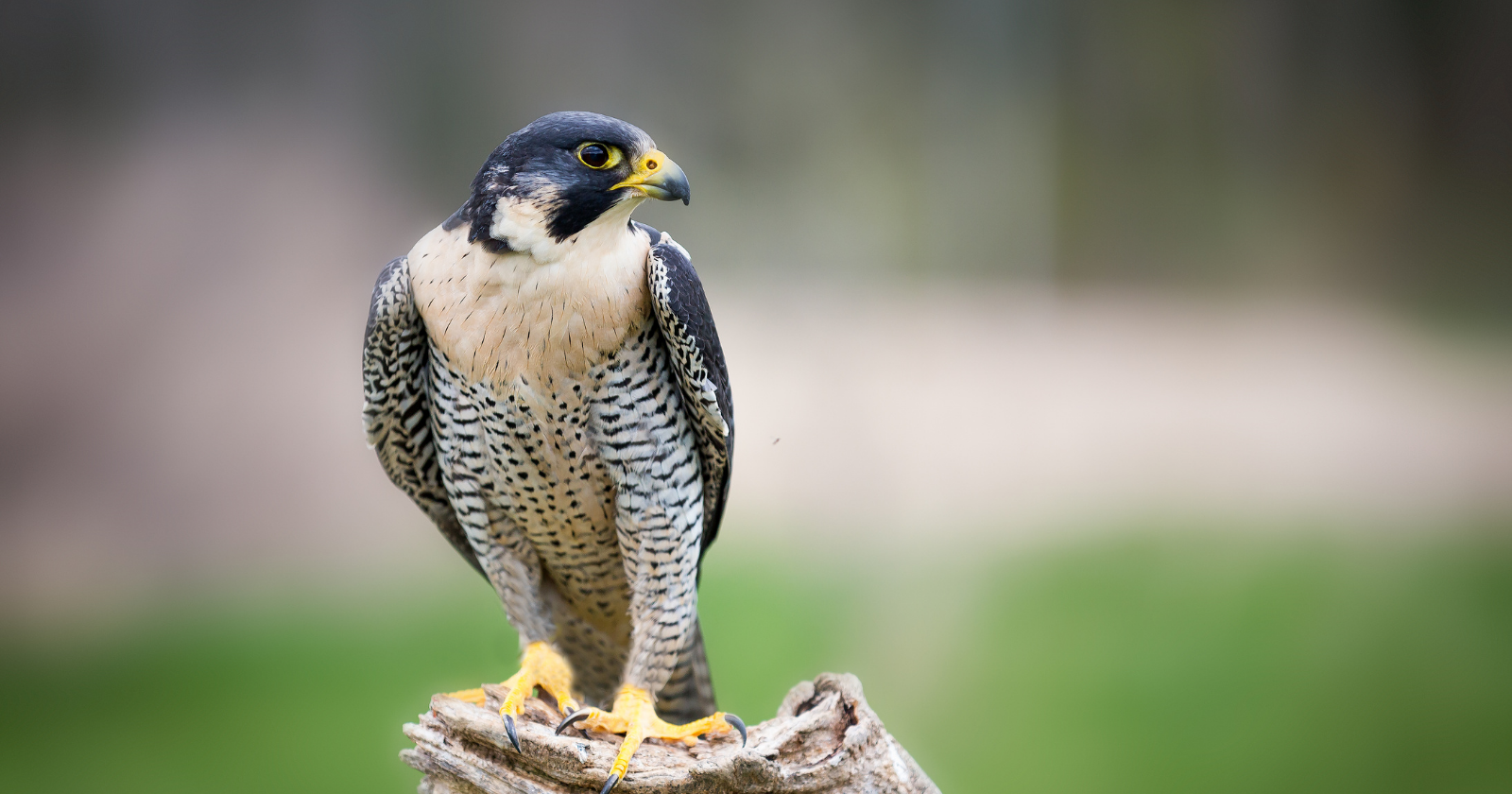
Every spring, spokespeople for two Wisconsin power companies issue press releases about their newest employees. The releases include names, chosen by public vote, and hatch dates, and links to live cameras. This year the roster includes Sheldon at the Weston Power Plant near Wausau, back for a third season, Joel and Essity at Oak Creek, and Barney at the Valley Power Plant in Milwaukee.
They are peregrine falcons, the fastest animals on Earth, and they are nesting where they now nest across Wisconsin: on power plants. By the utilities’ own running tally, 465 peregrines have hatched at We Energies and Wisconsin Public Service facilities since the program began, and about 22 percent of all wild-born peregrine falcons in Wisconsin came into the world in a box bolted to a generating station.
The bird that fell out of the sky
To understand why a falcon would want a smokestack, start with why there were almost no falcons at all. The peregrine hunts by climbing high and diving onto other birds at speeds past 200 miles per hour, a lifestyle that requires one piece of fixed infrastructure: a high, sheer ledge, safe from raccoons and foxes, with commanding airspace. For thousands of years that meant cliffs, and the Midwest’s peregrines nested on the river bluffs of the Mississippi and the rock faces of the Great Lakes shores.
Then DDT moved through the food chain. The pesticide concentrated in the falcons’ prey and thinned the falcons’ eggshells until incubating parents crushed their own clutches, and by the mid-1960s the peregrine was gone from the entire eastern United States, every historic cliff in Wisconsin empty. The species went onto the endangered list, DDT was banned in 1972, and biologists began releasing captive-bred chicks. But the recovery hit a problem the pesticide ban could not fix: many of the old cliffs now belonged to great horned owls, which eat young peregrines, and a released bird had few safe ledges to come home to.
A cliff with a boiler attached
The solution had already been discovered by the falcons themselves. Peregrines, city dwellers noticed, would happily treat architecture as geology; a skyscraper ledge or a bridge tower reads, to a falcon, as a cliff with unusual right angles. In the early 1990s, We Energies and Wisconsin Public Service took the logic to its conclusion and began installing nest boxes high on their power plants, gravel-floored shelters fixed to smokestacks and boiler houses hundreds of feet up.
Run the falcon’s requirements down the list and the smokestack scores like a dream cliff. Height, far beyond anything an owl or raccoon bothers with. An unclimbable face. Open sightlines across lake or river country, since power plants sit on water for cooling, which also puts them on the flyways where prey traffic is thickest. A structure that never erodes, guarded around the clock, on fenced industrial land where no hiker will ever peer into the nest. The falcons approved immediately, and the boxes have run at high occupancy for three decades, with utility crews and state biologists banding each year’s chicks and streaming the nests to a devoted public.
The numbers compound quietly. A few boxes, a few chicks a year each, sustained for thirty-plus years, and the industrial share of the state’s falcon production climbed until roughly one wild Wisconsin peregrine in five, by the utilities’ count now trending toward one in four or five, hatched on a power plant. The birds themselves close the loop: chicks banded on one plant’s stack turn up years later breeding on another’s, an industrial population that knows no other kind of cliff.
The species that ran out of rock
It is worth being precise about what the smokestacks replaced, because the falcons were not being decorative. Wisconsin’s natural cliff supply was always finite, and the usable portion shrank further with owls, disturbance and development. The peregrine’s comeback, here and across the country, has been overwhelmingly an artificial-ledge phenomenon: bridges, high-rises, cathedrals, grain elevators, and power plants, with the state’s falcon population still listed as endangered by Wisconsin even as the boxes keep it growing. The federal government declared the species recovered in 1999, one of the Endangered Species Act’s showcase successes, and the urban-industrial ledge is a large part of why.
There is an easy joke available about falcons and fossil fuel PR, and the utilities do enjoy their falcon cams. But the biology underneath is real and slightly humbling. A species that evolved for rock faces was audited to the edge of extinction by one human chemical, then rebuilt, ledge by ledge, on human structures, because what a peregrine needs was never the rock. It was the geometry: height, sheerness, sightlines, and safety. The cliffs of the Mississippi bluffs supplied that for ten thousand years. When the birds came back and found the old rock occupied and the world changed, the tallest, sheerest, best-guarded ledges left in Wisconsin turned out to have turbines humming at the bottom, and the fastest animal on the planet moved in without sentiment. A smokestack is not like a cliff, to a falcon. It is one.
