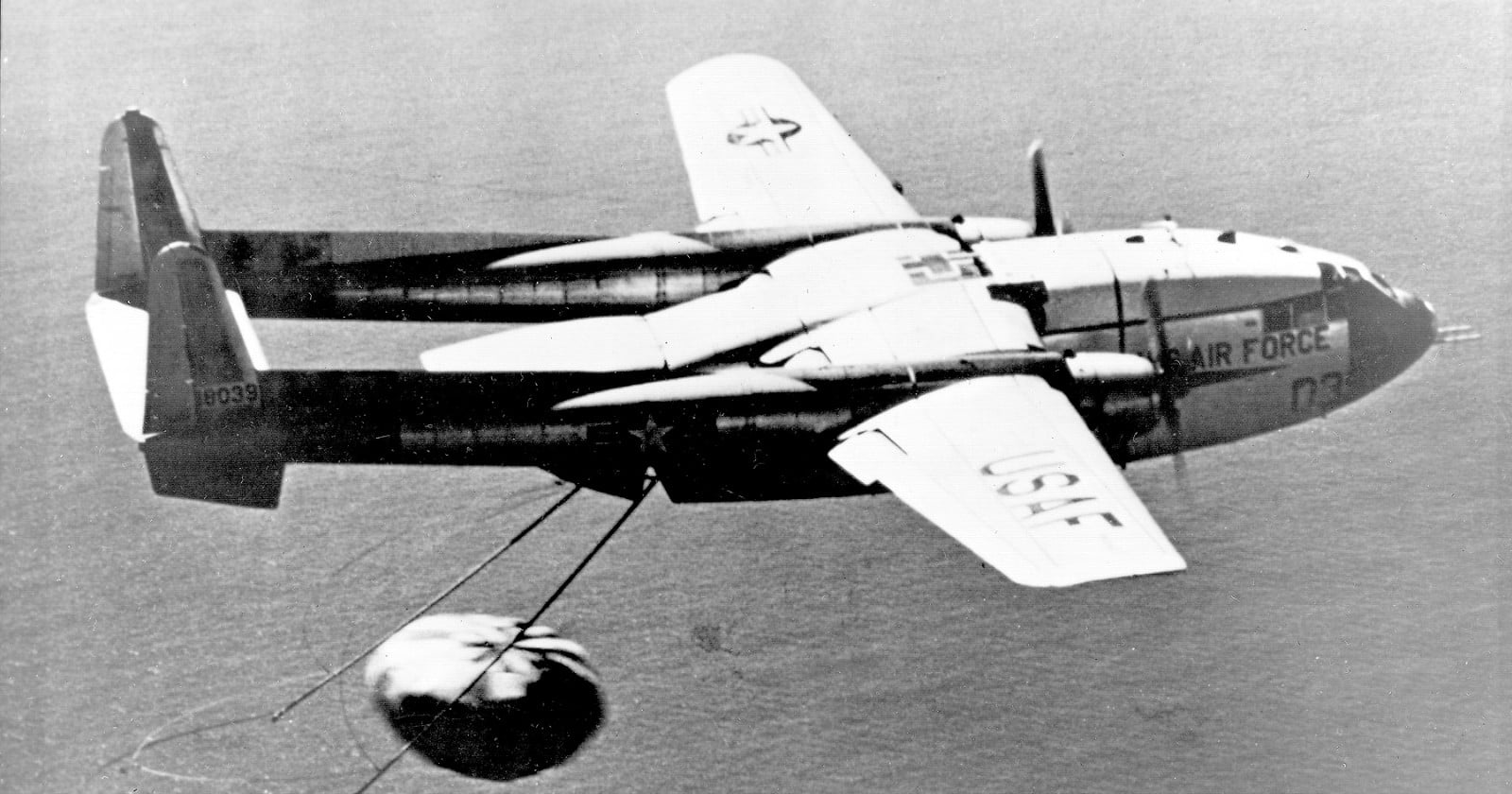
The Air Force missed it. On 11 August 1960 the return capsule from Discoverer 13 became the first man-made object recovered from orbit, and the aircraft holding the number one slot to catch it in mid-air got back over the splashdown point only as it hit the water.
It went into the sea about 330 miles northwest of Honolulu on Volume IV’s account, and a cargo ship in the recovery area sent aircraft out to lift it off the surface. The United States got its space first, and the wrong service made it.
Most of this is declassified now. CORONA Program History, Volume IV: Recovery from Orbit, a declassified CIA history of the programme, records that “a USAF C-119 aircraft received the radio signal from the descending SRV but could not get a bearing.”
The bearing that never came
Discoverer 13 launched from Vandenberg Air Force Base on 10 August 1960. Twenty-seven hours later, after seventeen orbits, the satellite ejected its recovery vehicle toward a staked-out patch of ocean northwest of Hawaii.
Captain Harold E. Mitchell had the number one slot in the primary recovery zone. His account survives in Star Catchers, the National Reconnaissance Office’s history of the aircrews who flew these missions.
“My navigator picked up the signal, but the receiver was so saturated that we couldn’t tell where Discoverer 13 was,” Mitchell told the NRO’s historians. A controlling aircraft, an RC-121 from the 552d Airborne Early Warning and Control Wing, offered a target and put him on a heading of 285 degrees.
His navigator, Bob Counts, asked him to fly a 360 degree turn, and he did. “Bob said, ‘The target is behind us.’ The RC-121 came on the air and agreed with Bob. The RC-121 had given us a reciprocal heading when he sent us off on the run at 285 degrees.”
A reciprocal heading is the exact opposite of the correct one. The three surviving accounts do not agree on why the catch failed, though, and the difference matters.
Volume IV blames only the lost bearing, and Mitchell blames the saturated receiver and the reversed heading. Kenneth Greer’s internal CIA history of the programme records something that would make both moot: the capsule came down “well away from the planned impact point” and was “beyond the range of the airborne recovery aircraft,” near enough to the zone for a water pickup but not an air catch. On Greer’s account no heading would have helped, and his section heading for the flight calls it a partial success.
What came back with the capsule
The ship was Haiti Victory, a cargo vessel run for the Navy by the Military Sea Transportation Service. The Navy’s own ship history records the moment briskly: on 11 August 1960 “her helicopter retrieved a 300-pound capsule that was launched into orbit the previous day by a Thor-Agena rocket,” making her the first ship to recover a space vehicle from orbit.
The capsule was still floating because it was built to. Volume IV’s design section says one “is designed to descend and remain afloat for a minimum of 48 hours,” and that “in 48 to 85 hours the capsule will sink due to the action of an electrolytic sink valve located in the bottom of the capsule.”
The window existed so American crews could get there, and the timer so that nobody else could. Volume IV says the capsule “may be retrieved by ‘frogmen’ from the tracking vessel,” and only “if the conditions of the sea permit.” Greer, writing of the later capsules, says the valve was set “to minimize the chance that a capsule might be retrieved by persons other than the American recovery crew.”
Then the capsule reached Honolulu for shipment home. The Navy, Volume IV says, “had taken advantage of the situation by painting in bold letters ‘Compliments of the US Navy’ on the shipping can.”
That sentence is the whole of the evidence. Volume IV, Greer’s article, Star Catchers and the Navy’s ship entry were each searched for a photograph of the can and for the names of the men who painted it, and none of the four carries either. The painting is placed at the point of shipment, not with the helicopter crew.
Histories written in-house
Almost all of this comes from histories written inside the organisations that ran the programme and released decades later. They are candid documents but not neutral ones, and both carry passages where words are still missing.
They also diverge on small points. Volume IV calls the ship USS Haiti Victory, while the Navy’s register lists her without a prefix as Haiti Victory, T-AK-238. Volume IV says “Helicopters” went out; the Navy’s entry says “her helicopter.”
Greer puts the same splashdown 330 miles northwest of Hawaii, where Volume IV says Honolulu. Volume IV also puts the capsule on display at General Electric, while Greer sends it to the Smithsonian, which is where the museum records it today.
The claim in the first line needs its qualifier kept whole. The Smithsonian’s wording is the first man-made object recovered from orbit, which is not the same as the first object returned from space. Discoverer II’s capsule had already come down in April 1959, in Greer’s words “probably somewhere in the near-vicinity of the Spitsbergen Islands north of Norway,” where “nothing was found, however, and the search was abandoned on the 23rd.”
Mice and a primate that ARPA would not pay for
Discoverer was a cover story, the public face of CORONA, America’s first successful photographic reconnaissance satellite programme. Greer’s history, declassified and reprinted in CORONA: America’s First Satellite Program, records a press release of 3 December 1958 announcing the series as tests of the vehicle itself, with later flights framed as explorations of conditions in space, carrying biological specimens “including live animals.”
The cover plan called for five biomedical vehicles. Three were committed to the schedule, the first two to carry mice and the third a primate, and the remaining two were to be held in reserve in case the heavier primate flight failed.
Only one animal mission was ever attempted, as Discoverer III, and it failed. Nor did the cover come free. Greer records that three extra launch vehicles were needed for biomedical flights “in support of the CORONA cover story,” and that ARPA “could not see its way clear to making Defense Department funds available merely for testing or for cover support,” which sent the programme’s managers back to the President.
The cover was thinner than it looks in hindsight. Greer notes that the predecessor reconnaissance effort had already “become the subject of fairly widespread public speculation identifying it as a military reconnaissance program,” with the press calling it a spy in the sky.
A switch that stayed on paper
Discoverer 13 carried nothing to photograph with. Volume IV is direct: “The DISCOVERER XIII was a diagnostic flight without camera and film.” On Discoverers XII and XIII, it says, the entire payload weight allowance “was transformed into a diagnostic payload.” The Smithsonian’s record agrees, giving the object as 136.1 kilograms in total, a gold-plated aluminium capsule with instrumentation of “magnesium, other metals” inside, built by General Electric.
Because the recovery worked, the programme wanted the publicity, and Greer says so plainly: extensive coverage was arranged, in large measure to support the cover story. Photographs went out of the launch, of the capsule in the water, and of Haiti Victory, and President Eisenhower displayed the capsule, and the flag it had carried, to the press.
Something else had been prepared for a different outcome. Greer records a plan under which the capsule would be switched in transit through Sunnyvale, in case the first successful recovery turned out to be a camera flight. Because Discoverer 13 was diagnostic, the project office “was spared the necessity of executing a clandestine switch,” and the President and the Smithsonian received the actual hardware.
The switch was only ever a plan on paper. Greer describes no substitute capsule and no swap performed, and nothing in either history says one was.
The method the programme was building toward
Mitchell felt the blame. “It felt like we were blamed for not recovering Discoverer 13, to begin with,” he told the NRO, and Greer’s history carries a footnote saying the Air Force, “pride stung,” assigned him “to the boondocks some 500 miles downrange” for the next flight. Mitchell calls the same move routine: the flights rotated positions, so A Flight, having held the primary area for Discoverer 13, drew the secondary area for Discoverer 14.
Discoverer 14 launched on 18 August 1960, in Greer’s words “one week after the successful water recovery of the DISCOVERER XIII capsule,” and this one carried film. Its capsule was caught the following day. Mitchell, in a C-119J under the callsign Pelican 9, missed on his first pass by six inches and on his second by two feet, and snagged the parachute on his third.
The two histories give slightly different heights for that catch. Volume IV says 8,500 feet, Greer says 8,506, and this piece uses Volume IV’s figure. Mitchell was awarded the Distinguished Flying Cross and his crew the Air Medal.
Air catch became the normal method for the rest of the programme, the aircraft snagging the chute or its shroud lines in what Greer calls “a trapeze-like hook suspended beneath the airplane” and winching the vehicle aboard. Greer’s tally for the later MURAL series runs to twenty successes out of twenty-six tries, nineteen of them taken out of the air, a count he says “appeared to be a remarkable record when viewed against the difficulties experienced only two years earlier.”
The sea kept its share regardless. Greer records three later capsules that came down in the ocean and sank before anyone reached them, and notes that they were “not supposed to sink so quickly.” One floated for less than three minutes.