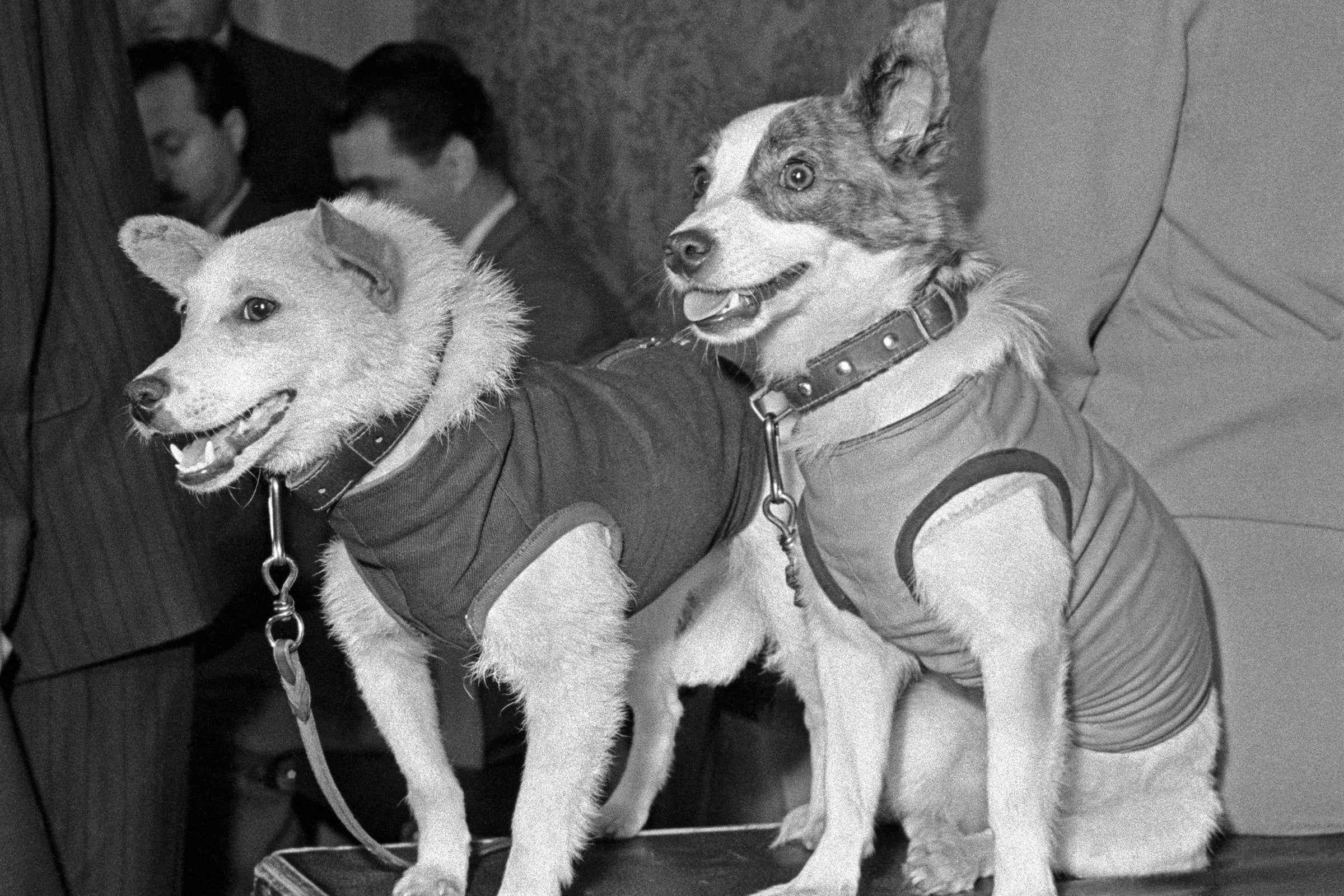
The mission had a technical name that hardly anyone outside the Soviet space programme ever used. It was called Korabl-Sputnik 2, or Ship-Sputnik 2, which in Russian was the second in a series of test flights of the Vostok spacecraft that would eventually carry Yuri Gagarin into orbit. In the West, the same mission became known simply as Sputnik 5. What it carried, when it lifted off from the Baikonur Cosmodrome in Kazakhstan on 19 August 1960, was almost certainly the most unusual passenger manifest of any spacecraft in history.
There were two dogs, a small terrier-mix mongrel called Belka, meaning squirrel or whitey in Russian, and a slightly larger dog called Strelka, meaning little arrow. Both were strays picked up from the streets of Moscow by Soviet space program researchers, who preferred mongrels because they were tougher and more resistant to stress than pedigreed animals. There were 42 mice. Two rats. One grey rabbit. Several containers of flies. A number of plants and fungi. And an assortment of scientific instruments designed to monitor the biological effects of orbital flight on everything alive inside the capsule.
What happened over the next day
According to NASA’s StarChild educational reference material on the first living creatures to enter space and return alive, maintained by NASA’s Goddard Space Flight Center, the Sputnik 5 mission was the point at which the Soviet space programme demonstrated something the American programme had not yet managed. They could put something alive into orbit around the Earth, keep it alive through the extreme conditions of launch, weightlessness, and reentry, and bring it home in a condition to be walked out of the capsule under its own power.
The spacecraft completed 17 revolutions around the Earth over roughly 25 hours. The dogs, whose vital signs were being transmitted back to ground stations across the Soviet Union, both showed elevated heart rates during launch, at up to four or five times normal in Belka’s case, but stabilised into what the flight surgeons described as calm orbital resting behaviour once the capsule reached its stable orbit. The mice and rats and rabbit, from the limited data available, appeared to have handled the flight without visible distress. Even the flies and plants and fungi came home in serviceable condition.
If you love learning about space, check out this video we made on what happens to astronauts when they return to Earth:
On 20 August 1960, roughly 25 hours after launch, the Sputnik 5 capsule fired its retrorockets, dropped out of orbit, and descended by parachute to a landing site in Kazakhstan. The recovery team opened the hatch and found every passenger alive. Belka and Strelka were walked out of the capsule for the assembled cameras. The mice, rats, rabbit, flies, plants, and fungi were catalogued. All of them, on the mission’s official record, had survived the whole flight in good health.
The two dogs became international celebrities within days. Photographs of them appeared in newspapers around the world. Belka and Strelka toured television studios and press conferences across the Soviet Union. They were reportedly visited backstage by the American classical pianist Van Cliburn, who was on a concert tour of Moscow at the time and asked to pet them when they wandered into his interview room. And within weeks of the flight, the Soviet space programme published detailed medical data on what a day in orbit had done to their bodies, which turned out to be, on the current examination, very little. The dogs were healthy. They had recovered normally from weightlessness. Which meant, on the Soviet planning documents that came to light later, that the programme had cleared its final biological milestone before attempting to launch a human being.
Eight months later, Yuri Gagarin flew into orbit and back. He came home alive largely because Belka and Strelka had done it first.
What happened to Strelka afterwards
Some time after her return to Earth, Strelka had a litter of puppies. There were six of them. One of the six, a small fluffy female born on 30 November 1960, was named Pushinka, which is Russian for Fluffy. She was, at the point of her birth, an entirely ordinary Moscow-born mongrel puppy of an entirely ordinary Moscow-born mongrel mother, who happened to be the most famous dog on Earth.
What happened to Pushinka next depended on a small piece of diplomatic small talk at a state dinner. According to reporting by Russia Beyond, drawing on interviews with Caroline Kennedy and with Ada Kotovskaya, the Soviet space physiologist who had trained Strelka for the mission and who was involved in Pushinka’s transportation to the United States, at a state dinner during the Vienna Summit in June 1961, Jacqueline Kennedy was seated next to Nikita Khrushchev. Between courses, she ran out of things to say to him. The Cold War tensions in Vienna were, by every diplomatic account, considerable. Khrushchev had that morning delivered a hard-line ultimatum on Berlin. Kennedy and Khrushchev’s own meetings had gone poorly. Jackie Kennedy, faced with a conversational silence at the dinner, decided to ask the Soviet Premier about the space dogs. Specifically about Strelka. And about whether she had, since coming home, had any puppies.
Khrushchev, on the account Caroline Kennedy has given in later interviews, took the question at face value. He said he’d look into it. And several weeks later, a Soviet delegation arrived at the American embassy in Washington with a small white fluffy puppy, complete with her own Soviet-issued passport identifying her mother as Strelka.
According to the John F. Kennedy Presidential Library’s own reference material on the animals that lived at the White House during the Kennedy administration, Pushinka arrived at the White House in June 1961 as a gift from Khrushchev to Caroline Kennedy. President Kennedy wrote a formal letter of thanks. His wording, on the letter’s preserved text, has become one of the more quietly charming pieces of Cold War correspondence in the entire archive. He wrote that his wife and he had been particularly pleased to receive Pushinka, that the puppy’s flight from the Soviet Union to the United States had not been as dramatic as the flight of her mother, but that it had been a long voyage nonetheless, and that she had stood it well.
Before Pushinka was allowed to settle into the White House, she was taken to the Walter Reed Army Medical Center and thoroughly examined for hidden microphones, listening devices, and biological agents. None were found. She was returned to the White House and joined the Kennedy family’s existing pets, which included a Welsh terrier called Charlie. Pushinka and Charlie eventually mated, and in June 1963 produced a litter of four puppies. Kennedy called them the pupniks, which was a small private Cold War joke on the Sputnik programme that had produced their grandmother.
Two of the four pupniks were given away to American children whose families had written to the White House asking for one. The other two went to family friends. In late 1963, roughly five months after the puppies were born, John F. Kennedy was assassinated in Dallas. Pushinka, on the surviving photographic record, continued to live in and around the White House through the transition, and eventually accompanied Caroline Kennedy and her