

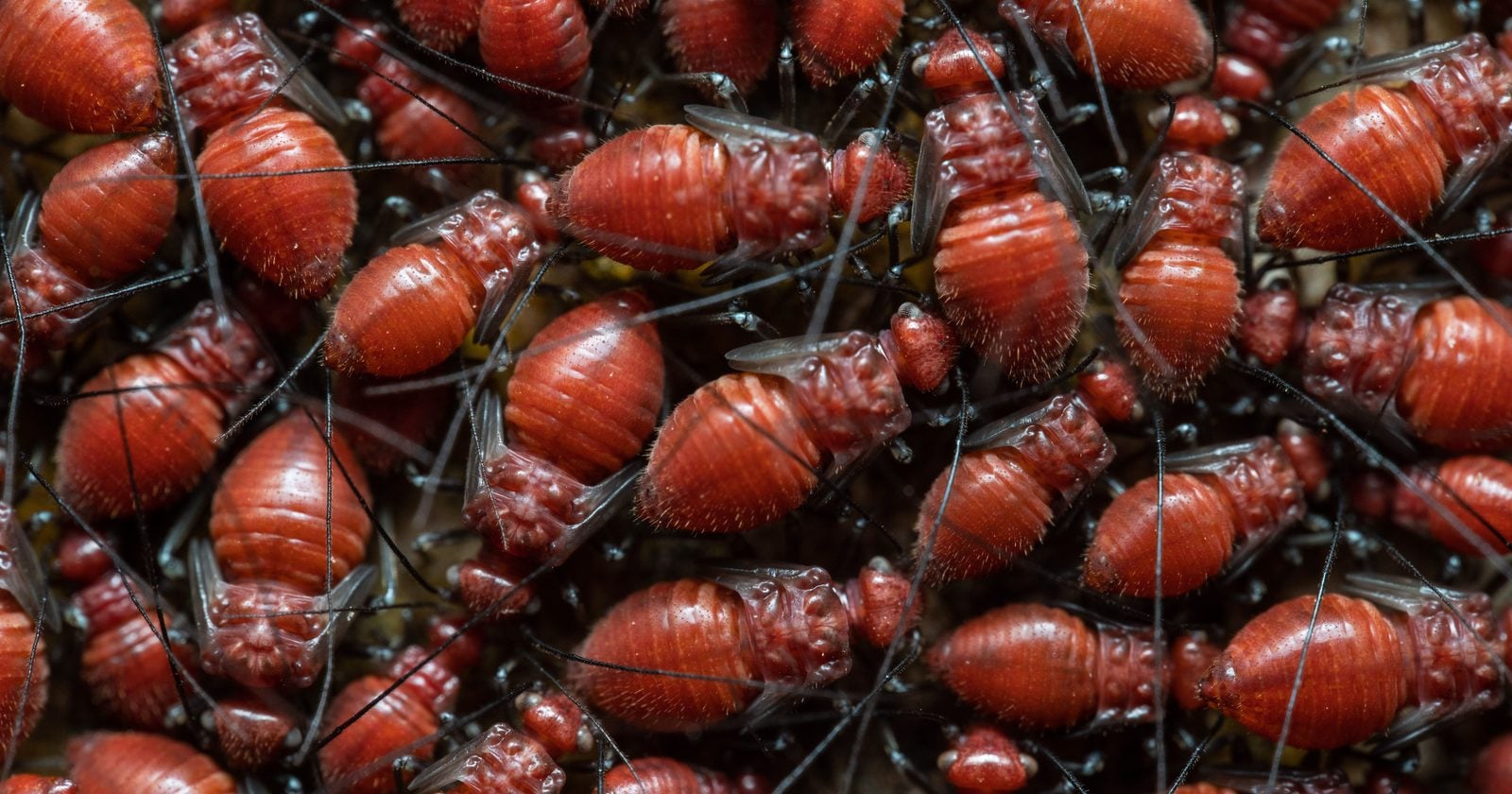
Stand still in a field for a minute and picture the insects sharing that patch of ground with you. Now stretch the picture out to the whole planet, every soil crumb, tree canopy, rotting log and puddle at once.
The Smithsonian’s tally for that scene is a number most of us have no way to feel: “At any time, it is estimated that there are some 10 quintillion” individual insects alive, per the Smithsonian’s own figure. Split that across the roughly 8.3 billion people alive now and you get about 1.2 billion insects each!
Where the 10 quintillion figure actually comes from
The short answer is a single Smithsonian information sheet, prepared by the National Museum of Natural History’s entomology section, which notes that insects probably have the largest biomass of any terrestrial animals. It is an estimate offered as an estimate, which is worth keeping in mind. The page itself uses “estimated,” and the figure long predates the kind of large global surveys that could actually test it.
How rough is rough? Rough enough that the sensible way to read it is “somewhere in the ballpark of ten billion billion,” not “exactly this many.” The true count could plausibly sit far above or below the headline, because nobody has ever counted anything close to the world’s insects directly.
That doesn’t make 10 quintillion wrong. It just means the number is a scaled-up estimate, not a census.
Why counting insects is close to impossible
The reason for that wide window isn’t laziness. Nobody can survey the whole planet’s soil and air, so estimates get built by sampling small plots, measuring what’s there, and scaling up across habitat types.
Every step in that chain compounds the uncertainty. And the ground keeps shifting under the researchers: a June 2026 study put the number of insect species at somewhere between 14 and 30 million, more than three times the roughly six million long treated as the working figure.
If we can’t pin down how many kinds of insect exist to within a factor of three, counting the individuals is harder still. Brian Fisher, an entomologist at the California Academy of Sciences who wasn’t part of that study, framed the new species estimate as a floor rather than a ceiling. “Even though it’s a crazy large number, I believe their approach gives us the lower bounds of what insect diversity is in the world,” he said. The totals keep going up as we look harder.
Most of that number lives underground
When you picture 1.2 billion personal insects, you probably imagine flies, mosquitoes, the odd wasp. But the overwhelming bulk of the total is invisible to us. A 2023 synthesis in Science Advances from Ron Milo’s lab, drawing on roughly 500 sites, estimated about 1 x 10^19 soil arthropods on Earth, and around 95% of them are mites and springtails, tiny creatures most people have never knowingly seen.
Ants alone are staggering. A 2022 study in PNAS integrating data from all continents put the global ant population at about 20 quadrillion, with a combined mass that beats all wild birds and mammals put together.
A huge total is not a stable one
It would be easy to read 10 quintillion as reassurance. Surely nothing that abundant could be in trouble. But abundance and stability are different things, and this is where the number needs handling with care.
A 2020 meta-analysis in Science, compiling long-term surveys across 1,676 sites, found land-dwelling insects declining at just under 1% a year, more than a quarter over three decades, though the picture varied a lot by region and freshwater insects actually rose. A broader assessment by dozens of scientists put typical reported declines around 1 to 2% a year, while noting that not every group is falling.
Reacting to the 2020 findings, Michigan State’s Nick Haddad, who wasn’t involved in that study, called the pattern “jaw dropping,” and warned that continued “decline on land at this rate will be catastrophic for ecological systems and for humans.”
How to hold a number this big
Perhaps the tidiest fact about insect populations is how little we actually know. Roughly 99% of insect species have essentially no monitored population trend at all. Rob Cooke, an ecological modeller who co-led that work at the UK Centre for Ecology & Hydrology, put the task plainly: “We need to find out whether insect declines are widespread and what’s causing them.”
The 10-quintillion figure is best held as two things at once. It is a genuinely vast number, a reminder that insects underpin ecosystems by pollinating, decomposing and feeding other animals. It is also a rough, ageing estimate applied to populations that in many places are declining while most species remain unmonitored. A large global total is not evidence that every insect population is stable.