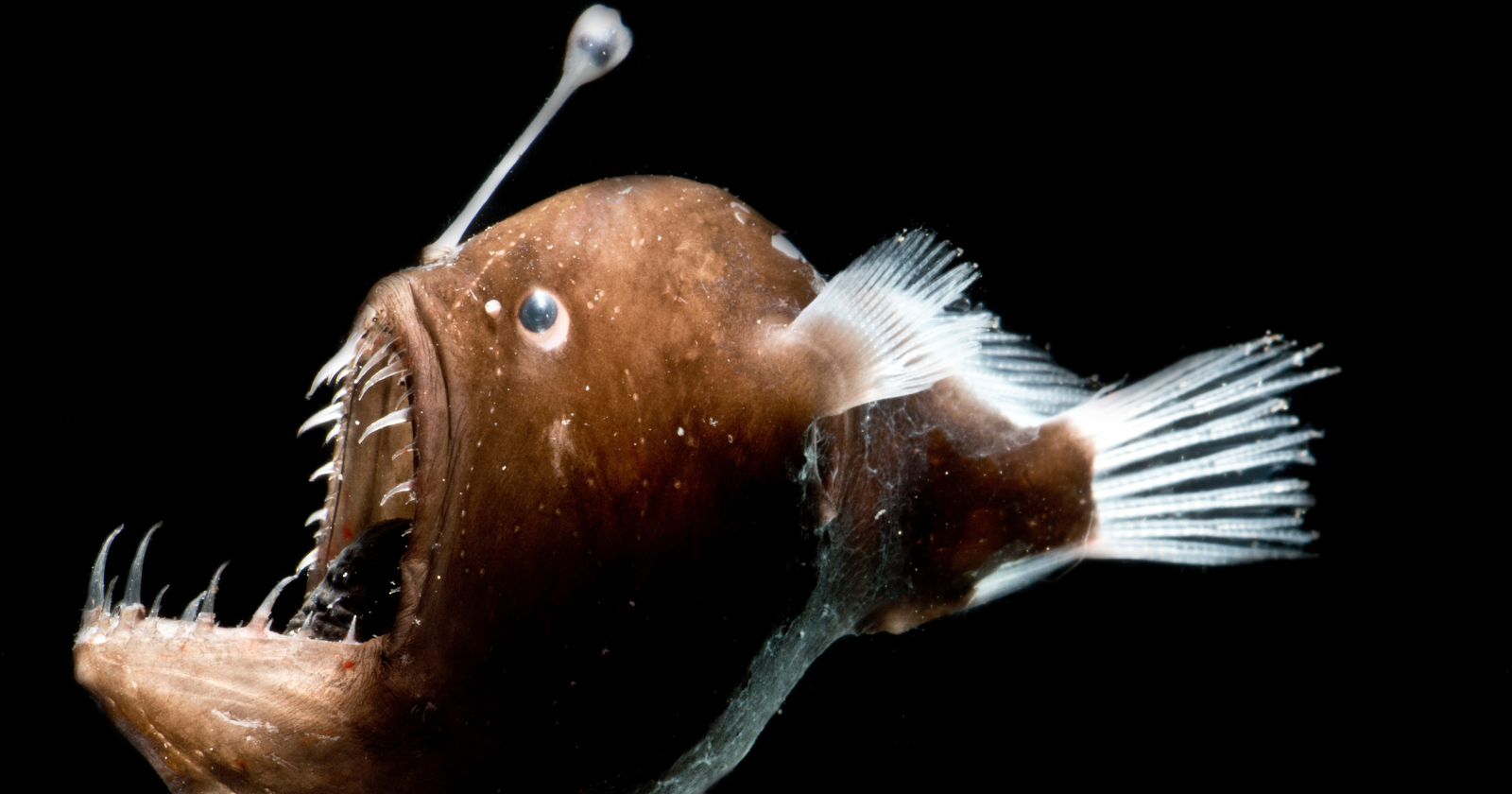
The team from a Spanish marine research NGO called Condrik Tenerife had spent the day two kilometres off the west coast of the island, on their research vessel the Glaucus, studying pelagic sharks in the waters off Playa San Juan. It was 26 January 2025. The expedition had gone well. They were on their way back to port when the marine biologist Laia Valor, looking at the water beside the boat, saw something small and black moving in the sunlit surface layer.
Her first thought was that it might be plastic. Something drifting. Something dead. But it was moving in the wrong way for either of those, and something about the shape didn’t fit any surface animal she recognised. She flagged it to the rest of the team. They circled the boat back around, cut the engine, and drifted alongside whatever it was to have a closer look.
What was looking back at them was one of the least-seen large animals on Earth.
The fish and the darkness it lives in
The species is called Melanocetus johnsonii. Its English name is the humpback anglerfish, though it’s more often known by the popular label black seadevil. It’s the same species Pixar based the terrifying anglerfish scene in Finding Nemo on. And, until the moment Laia Valor spotted one drifting alongside a research boat off Tenerife on a January afternoon, no living adult had ever been documented at the surface of the sea in daylight.
According to an analysis by Dr Prema Arasu, a postdoctoral research fellow at the Minderoo-UWA Deep-Sea Research Centre at the University of Western Australia, originally published in The Conversation and republished on the university’s news channel in March 2025, Melanocetus johnsonii ordinarily lives in the deep midwater column between roughly 200 and 2,000 metres below the surface. The upper end of that range is called the twilight zone. The lower end is the bathypelagic layer, sometimes called the midnight zone, where no sunlight of any wavelength has ever penetrated on any day in the planet’s history. Water temperature at the depths where this fish typically hunts sits at about 4 degrees Celsius. Water pressure runs to hundreds of times atmospheric. And the only light available is the light the animals themselves produce.
If stuff like this fascinates you, you’ll enjoy this video below:
Which is what the anglerfish is famous for. On the head of every adult female of the species sits a modified spine called the illicium, tipped with a bioluminescent lure called the esca, which glows in the dark through a symbiotic relationship with light-producing bacteria that colonise the tip. Prey animals in the pitch-black water column are drawn toward the small greenish glow, and when they get close enough, the anglerfish, which is otherwise almost invisible in the dark and covered in matte black skin that absorbs any incidental light, extends its enormous mouth and swallows them whole. The teeth are curved backwards. Anything that goes in doesn’t come back out. It’s one of the more efficient predator designs the deep ocean has ever evolved, and it works precisely because the whole system is optimised for a world without sunlight.
Which is why seeing one at the surface, in broad daylight, in the middle of a sunny afternoon, was the kind of observation that made the team on the Glaucus struggle at first to believe what they were looking at. The fish that was drifting beside their boat had spent its entire life in a habitat where there had been no light, no warmth, no significant motion of the water, and no possibility of encountering any surface predator. And now it was here, in the light, in warm water, in the middle of the world it had spent its whole existence in the absence of.
Why it might have appeared, and why nobody’s sure
According to reporting by National Geographic on the incident, drawing on direct interviews with the Condrik team including David Jara Boguñá, the marine wildlife photographer who filmed the animal, the researchers spent about an hour and a half with the fish before it died. Jara described the encounter as feeling like a dream come true, which is what marine biologists tend to say when something happens that they’ve spent their careers hoping to witness but had never seriously expected to see. The fish was small, about the size of a fist, with the huge mouth and the illicium and the lure and the small malevolent eyes all exactly where the specimens preserved in jars in natural-history museums said they would be. The team filmed it. They photographed it from multiple angles. They followed it as it moved slowly through the surface layer, sometimes rising toward the light, sometimes drifting downward. And they watched it die.
What killed it, most likely, was the same thing that had brought it up. According to reporting by Discover Wildlife, quoting the Condrik team’s own official statement on the sighting, the researchers acknowledged that they had no confident explanation for what had happened. Their published statement listed the possibilities they thought worth considering. Some kind of pathology, meaning an illness or internal injury that had affected the animal’s ability to remain at depth. An upwelling current, meaning a mass of cold deep water forced to the surface by wind or tidal action, which could have carried the fish along without giving it any chance to swim back down. An attempted escape from a predator further down the water column, which would have driven the fish into an emergency ascent it wasn’t built to survive. Or other unknown factors, which is the phrasing marine biologists use when they mean they cannot rule out possibilities they haven’t yet thought of.
None of these explanations has since been confirmed. The specimen was recovered after it died, and preserved at the Museum of Nature and Archaeology in Santa Cruz de Tenerife, where researchers have been examining the body for signs of any of the candidate causes. The examination is ongoing. And the underlying question the sighting raised, which is why a member of one of the most exclusively deep-water fish species on Earth ended up in warm surface water in the middle of a bright afternoon, remains open.
What the encounter did settle, on the surviving film footage and the preserved specimen, is that live adult Melanocetus johnsonii exist. Which sounds like a strange thing to note, given that plenty of dead ones have been recovered from fishing nets and deep-sea trawls over the past century, but the fact of an adult of this species alive and moving on its own in an environment where it could be observed directly was, until January 2025, something no human had ever documented. Every image of a living anglerfish anyone had ever seen had come from either a submersible descending into water most humans will never enter, or from a preserved specimen sitting behind glass in a natural history museum. The Condrik team’s footage was the first time the rest of the world got to see one of these animals doing what it does, in real time, with its lure lit and its enormous mouth working slowly in the light, before it drifted downward and died in front of the camera.
Which is why the video has been watched, on the last count anyone bothered to keep, several hundred million times. The fish was small. It was dying. It should not have been where it was. But it was, briefly, exactly what it had always been, in a place where nobody had ever seen it before. And whatever it was that dragged it up out of the darkness has, on the current state of the evidence, still not been named.