

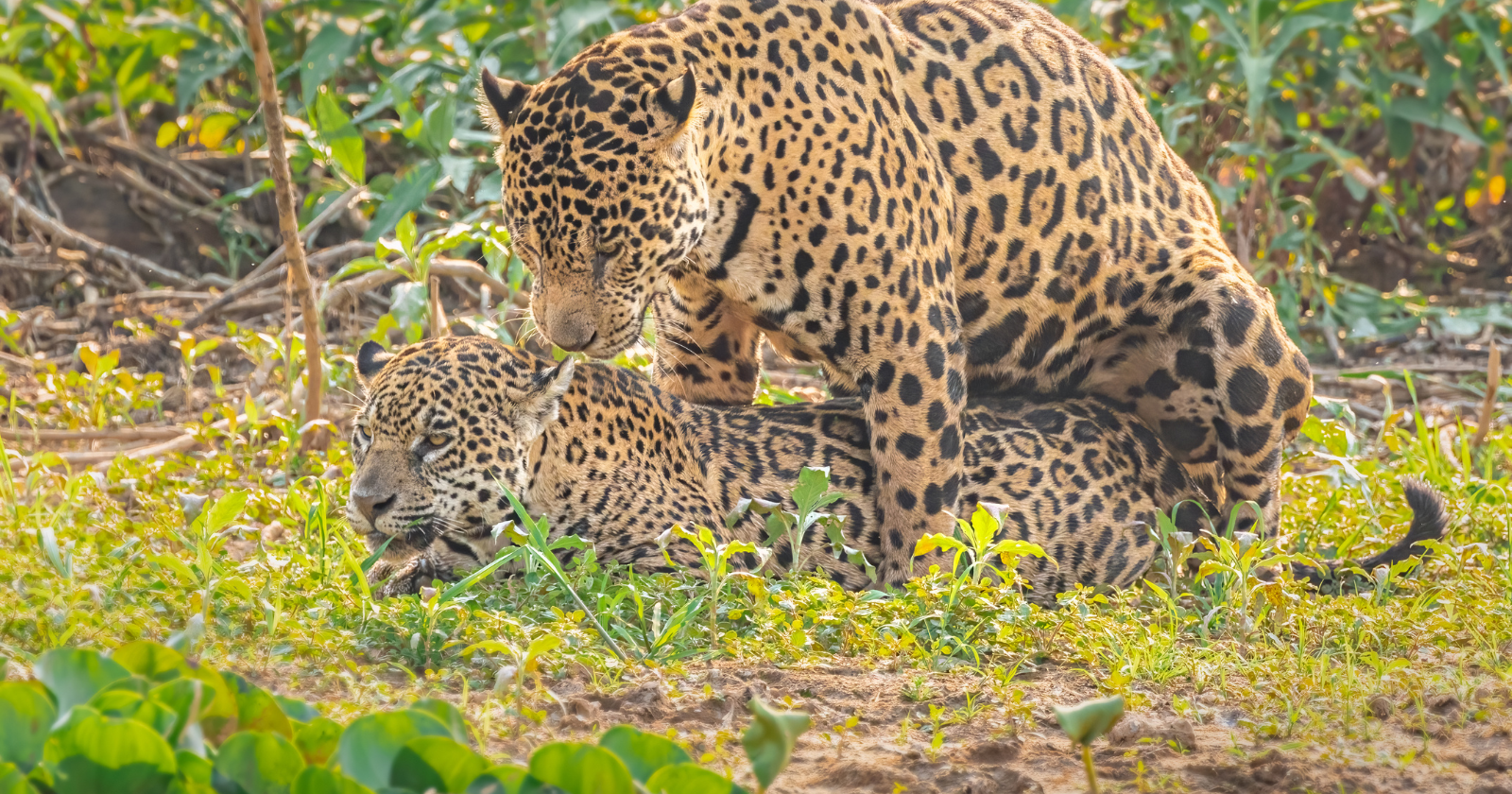
A camera trap set deep in Serra do Pardo National Park, in the Brazilian Amazon, was recording biodiversity surveys, not courtship. On 6 September 2023, over six minutes, it caught something researchers say had never been filmed before: a black-coated female jaguar and a spotted male circling one another, courting, and mating twice.
What the footage shows
The clip, captured along the Xingu River, records nine of the twelve behavioural phases researchers recognise in jaguar mating: courtship circling, mounting, vocalisations, the female rolling, and copulation itself, twice within the sequence. The male also appeared to attempt a nape-bite, though the paper notes this specific action couldn’t be conclusively confirmed from the footage. The research team, led by Thomas Luypaert of the Norwegian University of Life Sciences with colleagues from the University of East Anglia and Brazilian collaborators, published the observation in Ecology and Evolution in August 2025.
“We hit the proverbial jackpot and captured the first ever video trap footage of a black jaguar mating with a spotted male in the wild,” said Carlos Peres of the University of East Anglia, a senior author on the paper. “The six-minute sequence reveals courtship and copulation, and if they’d moved a few metres we would have missed everything.”
One detail stood out enough to make it into the paper itself rather than just the footage: the female appeared to have swollen nipples, consistent with recent lactation. The researchers raise, cautiously, the possibility that this points to a “hide-and-flirt” mating strategy rather than a straightforward oestrus cycle, a female already caring for young re-engaging in mating behaviour, something documented in a handful of other solitary cat species when opportunities to mate are scarce. They’re careful to flag this as speculation drawn from a single observation, not a conclusion the footage can support on its own; confirming it would need evidence of an actual litter nearby, which the camera trap didn’t capture.
What the black coat actually is
Melanism in jaguars comes from a recessive gene affecting pigment production, not a separate subspecies or population. Estimates of how common it is vary sharply by region, from rare in some parts of the jaguar’s range across Central and South America to closer to one in ten individuals in parts of the Amazon, where dense forest cover may make the darker coat less of a hunting disadvantage than it would be in open terrain. Despite that, black jaguars remain difficult to study specifically, since standard camera-trap identification methods rely partly on reading each individual’s unique spot pattern, which is far harder to make out against dark fur. Under close infrared or flash lighting the faint rosette pattern is sometimes still visible against the black coat, which is how researchers reviewing this footage were able to confirm the female’s identity and coloration with confidence rather than guessing from silhouette alone.
Wild versus captive, and how closely they matched
Melanism, the black colouring, in jaguars comes from a recessive gene and shows up in an estimated one in ten individuals across parts of their range, more in some Amazonian populations than others. Most of what’s been documented about how melanistic jaguars behave during mating has come from captive breeding programmes and zoos, not wild sightings. That’s what made this recording useful beyond its novelty value.
“What surprised us most was how closely the wild behaviour mirrored what’s been observed in zoos,” said Luypaert. “The behaviours we observed looked very similar to what’s been described for spotted pairs in captivity.” He added a broader point about why that comparison matters: “Understanding how jaguars behave in their natural environment is essential, not just for science, but for improving conservation and breeding programmes worldwide.”
A qualified first
The “first ever” framing doesn’t hold up on close reading. The paper’s own claim is narrower and more defensible than the phrase suggests on its face: this is the first such event captured on camera and published in a peer-reviewed journal, not necessarily the first time it has ever happened or even the first time anyone has recorded it. Edu Fragoso, a researcher with the Brazilian conservation group Onçafari who wasn’t involved in this study, has said his own camera traps recorded a melanistic jaguar mating back in 2022, a sighting that, as far as available reporting shows, was never written up for publication. That doesn’t diminish what Luypaert’s team documented. It’s a reminder that “first published” and “first ever” are different claims, and camera-trap networks across the Amazon are large enough, and thinly enough analysed, that the true history of what’s been seen out there almost certainly runs ahead of what’s made it into a journal. Thousands of camera-trap hours accumulate across the region every year for various conservation projects, and only a small fraction of that footage ever gets reviewed closely enough, or by someone positioned to recognise what they’re looking at, to end up written up anywhere at all.
The authors themselves are careful not to overreach from one recording. They describe it explicitly as a single data point, useful for showing that wild melanistic jaguars behave broadly like their spotted counterparts during mating, but not enough on its own to draw firm conclusions about how colour morph might shape mating strategy more broadly. Jaguars are listed as Near Threatened by the International Union for Conservation of Nature, with populations fragmented across their range by deforestation and habitat loss, which is part of why basic behavioural documentation like this, rather than anything more dramatic, still counts as a genuine addition to what’s known about the species.
Serra do Pardo covers more than four thousand square kilometres of largely unstudied Amazon forest along the Xingu River, part of a broader mosaic of protected land in the region that also includes Indigenous territories where jaguars are rarely disturbed. The camera trap that recorded this sequence was one of many placed for general biodiversity monitoring, not aimed at capturing mating behaviour specifically. What it happened to catch, in six minutes, is as much a reminder of how much of what happens in that forest simply isn’t being watched as it is a finding about jaguars themselves.