

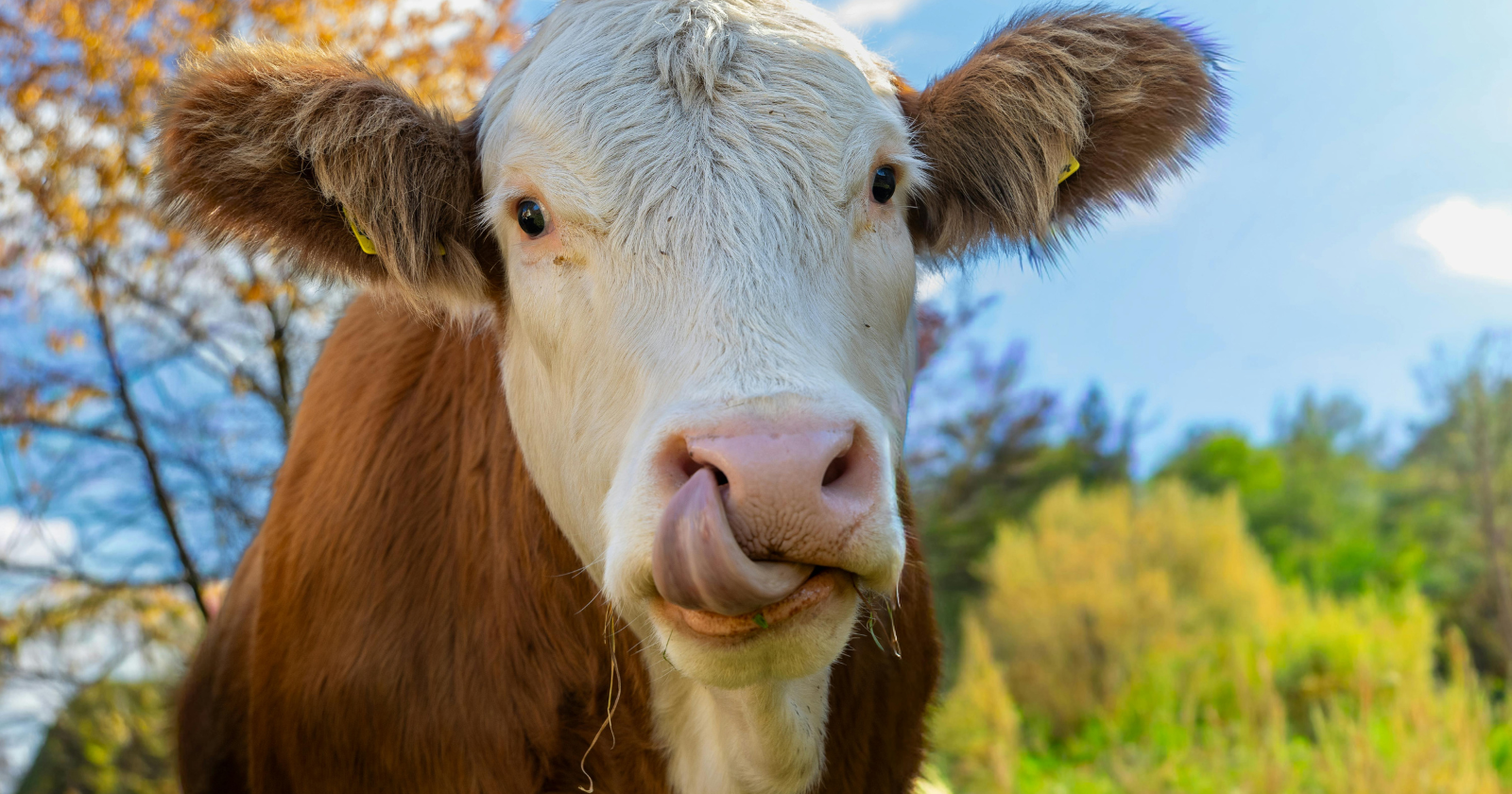
Veronika, a thirteen-year-old Swiss Brown cow living on a small organic farm in Nötsch im Gailtal, Austria, picks up a long-handled brush in her mouth. Working it across her own back and rump, she keeps the bristled end pressed to her hide, dragging it in wide, forceful strokes over the thick skin there. Then she reaches the soft skin around her udder, and flips the brush around. The smooth handle end goes against her body now, moved slowly and carefully. She switches back when she moves to a different patch of hide. According to the researchers who filmed her, this wasn’t a one-off. It was a pattern, repeated and adjusted by body region, and they say it’s the first time this kind of flexible tool use has been documented in cattle.
An unusual cow, in an unusual position to show this
The study, by Antonio Osuna-Mascaró and Alice Auersperg of the University of Veterinary Medicine, Vienna, was published in Current Biology in January 2026. Veronika is owned by Witgar Wiegele, an organic farmer and baker, and unlike most farm cattle she has long had loose access to sticks, rakes and other handheld objects lying around the property. The researchers are upfront that this matters: it’s the kind of environment that plausibly makes tool manipulation more likely to emerge and be noticed, compared with a conventional dairy or beef operation where cattle rarely encounter loose implements at all.
Working with Veronika directly, the researchers presented the brush in different starting orientations across repeated sessions and recorded which end she used, and where. She favoured the bristled end more often overall, roughly two and a half times as often as the smooth handle, but that preference wasn’t fixed. When grooming sensitive areas, her udder, belly, navel or legs, she reliably switched to the smooth end and used slower, more controlled movements. On thicker-skinned areas like her back and loin, she went back to the bristles and applied more force.
Flexible tool use of this kind, adjusting which part of an object to use and how forcefully, based on the job at hand, has a short list of documented non-human examples. Chimpanzees select and modify different plant stems for termite fishing versus nut cracking. Sea otters choose particular rocks and reuse favoured ones to crack shellfish. Some crow species bend wire into hooks shaped for a specific task. Cattle have not previously been part of that list. Auersperg’s own earlier work with Goffin’s cockatoos, which showed the birds selecting and even manufacturing tools suited to particular problems, gives her a useful point of comparison: cockatoos and cattle diverge sharply in brain organisation — birds and mammals arrived at cognitive complexity via different neural architectures entirely — which is part of why a result like Veronika’s draws attention. It suggests flexible tool manipulation doesn’t require the specific neural architecture birds or primates have for it.
What “tool use” means here, and what it doesn’t
Osuna-Mascaró described the significance plainly: “Veronika is not just using an object to scratch herself. She uses different parts of the same tool for different purposes, and she applies different techniques depending on the function of the tool and the body region.” Auersperg, whose earlier work documented tool use in Goffin’s cockatoos, called it “a meaningful example of tool use in a species that is rarely considered from a cognitive perspective,” adding to Science that “it’s totally unexpected to see this in cattle.” Josep Call, a comparative psychologist at the University of St Andrews, who wasn’t involved in the study, put it plainly: “I have absolutely no doubt that this is tool use.”
Two categories of tool use are being blurred together here, and they’re not equally impressive. Scratching your own body with an object, technically self-directed tool use, is generally considered a cognitively simpler category than using a tool to act on something external, like cracking a nut or extracting insects from a log. Cattle themselves already do a version of self-grooming without tools, rubbing against fence posts and tree trunks to relieve itching, so the baseline behaviour Veronika is building on isn’t itself unusual. The flexibility is the notable part here: adjusting grip and technique by body region and skin sensitivity, rather than using an object, or a fence post, the same way regardless of the job.
One cow, not yet a finding about cattle
Cattle cognition is a thinner research literature than most people would guess, given how long humans have kept them. What exists mostly concerns learning speed, social recognition and stress responses relevant to welfare and farming practice, not tool manipulation; cows have not traditionally been considered candidates for this kind of study, partly because commercial cattle rarely encounter loose objects worth manipulating in the first place. That gap in opportunity, rather than a gap in ability, is exactly what Veronika’s living situation removes. It’s a pattern that has shown up before in comparative cognition: an ability goes undocumented for a long time not because a species lacks it, but because nobody happened to put an animal with that capacity in a position where using it would be noticed.
This is a single case study, one cow, observed by one research team, and the paper doesn’t claim otherwise. Veronika’s atypical upbringing, with years of casual access to tools most cattle never encounter, is a real limitation on how far the result generalises. The researchers are explicit that they’d want to see similar behaviour documented in other cattle, ideally animals with different backgrounds and environments, before treating this as evidence that flexible tool use is a latent capacity across the species rather than something closer to an individual quirk that unusually favourable conditions allowed to surface.
For now, what’s been documented is narrower and still fairly remarkable on its own terms: a cow that knows which end of a brush belongs where, and appears to have worked that out entirely on her own, with nobody training her to do it. Whether that turns out to be something latent in cattle generally, waiting for the right combination of curiosity and opportunity, or something closer to one animal’s individual habit, is exactly the kind of question a single case study raises without being built to answer.