

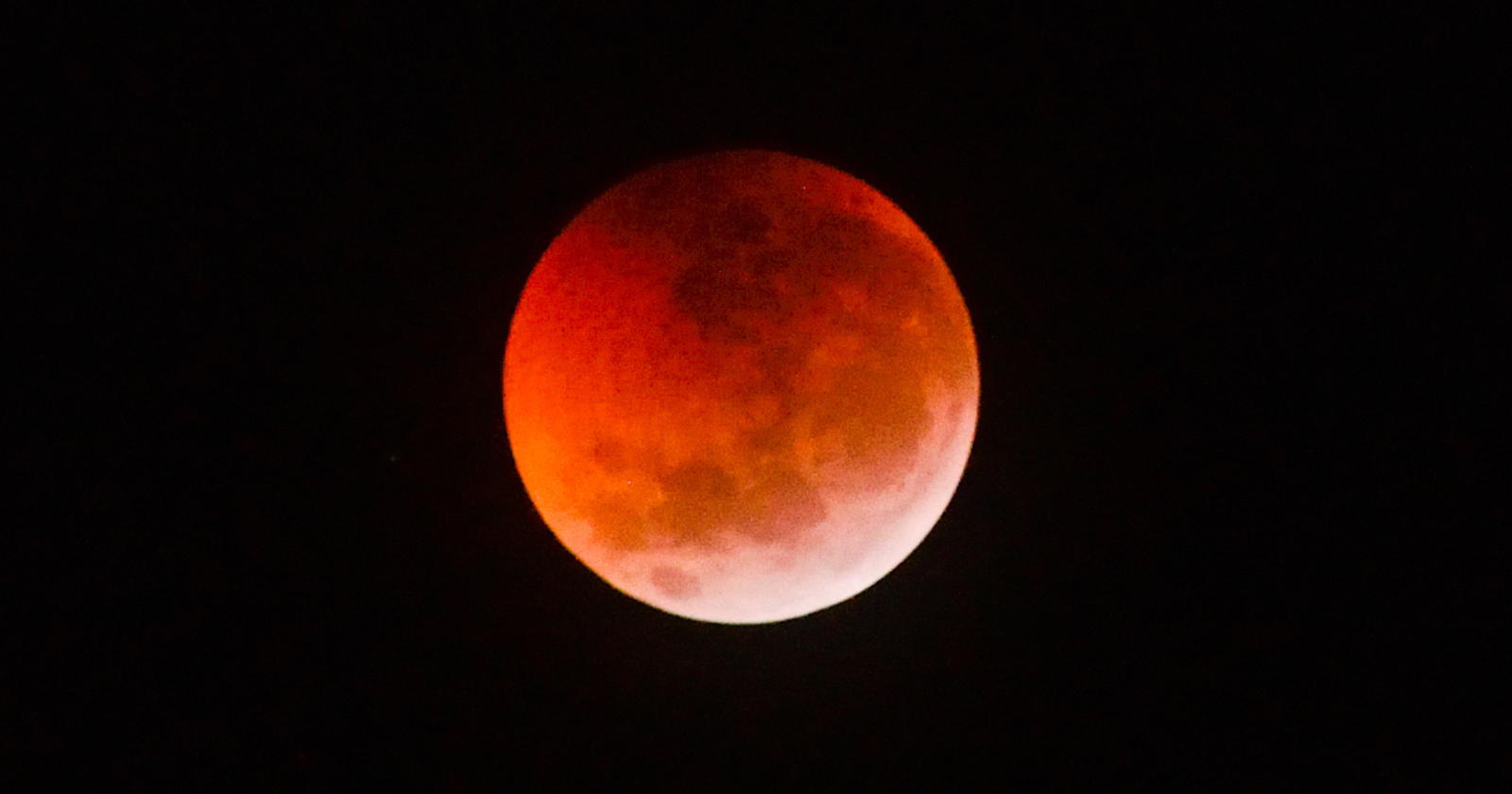
Tomorrow night, weather permitting, the full Moon over the Americas is going to do something it will not do again for more than two years. Beginning in the late evening of Thursday, August 27, Earth’s shadow will creep across the lunar surface until, a little after midnight on the East Coast, 96 percent of the Moon sits inside it, glowing a dim, rusty copper with only a bright sliver left along one edge.
Technically it is a partial lunar eclipse. Practically, it is about as close to a total one as a partial can get, and astronomers are calling it the best lunar eclipse anywhere on Earth until New Year’s Eve 2028.
What happens, hour by hour
A lunar eclipse is the simplest show in astronomy: the Sun, Earth and full Moon line up, and the Moon flies through our planet’s shadow. Tomorrow night the alignment is just barely imperfect, so a thin slice of the Moon’s southern edge stays out of the deepest shadow, which is the only thing separating this event from a total eclipse.
For viewers in the eastern half of North America, the timeline runs like this. The subtle penumbral shading begins around 9:24 pm Eastern time on the 27th. The real event, the partial phase, starts at 10:34 pm, when the curved edge of Earth’s dark inner shadow, the umbra, takes its first visible bite out of the Moon. The shadow advances for the next hour and a half until maximum eclipse at 12:12 am Eastern, when 96.3 percent of the disk is immersed and the Moon hangs copper-red in the sky. The shadow then slides off, with the partial phase ending at 1:52 am and the whole affair over by 3 am.
Subtract the hours for other zones: maximum comes at 11:12 pm Central, 10:12 pm Mountain, 9:12 pm Pacific. West Coast viewers see the Moon rise with the eclipse already underway, low in the southeastern sky, which is a gift for photographers who want a shadowed Moon hanging over a skyline. Central and South America get the entire event high in the sky. Western Europe and West Africa catch the eclipse toward dawn, near moonset.
Why copper
The color is the part that catches people, and the physics behind it is lovely. Earth’s shadow is not black. Sunlight grazing the edges of our planet passes through the atmosphere, which scatters away the blue light, exactly the effect that makes our sky blue and our sunsets red, and bends the surviving red and orange light inward, into the shadow, onto the Moon.
What lands on the eclipsed Moon, in other words, is the combined light of every sunrise and sunset on Earth at that moment, projected onto a screen a quarter of a million miles away. The exact shade, anywhere from bright copper to deep brick, depends on the state of our atmosphere that night; volcanic ash or heavy wildfire smoke anywhere on Earth darkens the Moon noticeably. Because a sliver of this Moon stays directly sunlit, expect a striking two-tone object: a dim red disk wearing a brilliant white edge, which many observers find more photogenic than a fully total eclipse.
How to watch
The instructions barely deserve the word. Go outside during the eclipse hours and look at the Moon. That is the complete list.
Unlike a solar eclipse, a lunar eclipse is perfectly safe to watch with bare eyes; the Moon is never brighter than a full Moon, and gets dimmer as the show proceeds. No glasses, no filters, no telescope required, though binoculars will show the coppery shadow edge crawling across craters in real time. City lights do not spoil it, since the Moon punches through urban skyglow easily. The only enemy is cloud, and late August, with summer storm systems generally quiet across much of the United States, offers decent odds for most of the country.
The one preparation worth making is timing. The deepest, reddest phase lasts a limited window around maximum, roughly the hour surrounding 12:12 am Eastern, when the Moon is more than nine-tenths covered. Set an alarm for fifteen minutes before local maximum and you will see the best of it even if you skip the rest.
Why this one is worth the late night
Eclipse watchers grade these events, and this one grades high for a specific reason: depth. Shallow partial eclipses, where the shadow nibbles a quarter of the Moon, are pleasant curiosities. At 96 percent, this eclipse crosses the threshold where the Moon genuinely transforms, dimming enough for the surrounding stars to come out and taking on the full blood-Moon color across nearly its whole face.
Roughly 3.3 billion people live where some of this eclipse is visible, and the Americas get the best seats in the house. The next lunar eclipse of any kind visible from North America is more than a year away, and the next one deeper than this is the total eclipse of December 31, 2028. Tomorrow night’s Moon, the full Sturgeon Moon of August, is the sky’s last big free show for a while. All it asks is that you stay up past midnight, or step outside at nine if you are lucky enough to live in the Pacific zone, and look up.
