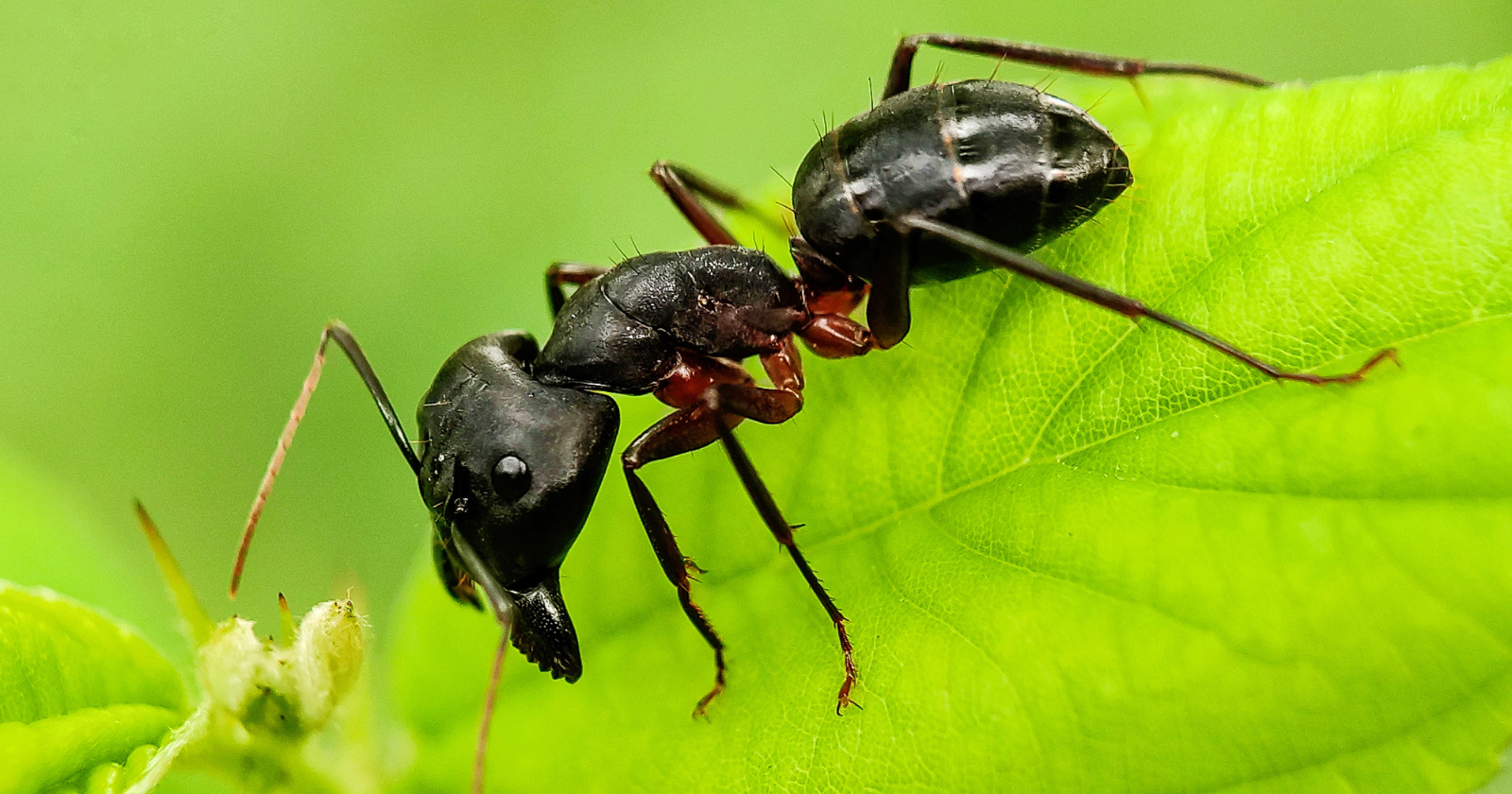
The species in question is called the Florida carpenter ant. It’s brown, about half a centimetre long, common across the southeastern United States, and until very recently was mostly interesting to entomologists for reasons unrelated to medicine. Then a research team led out of the University of Würzburg took a closer look at what happens when one of them gets injured, and found something almost nobody had expected.
When a Florida carpenter ant returns to the nest with a wound on its leg, its nestmates don’t just leave it alone. They approach it, examine the injury, and make a decision about what to do next. If the wound is on the lower part of the leg, near what would be the shin, the nestmates clean the wound with their mouths and let the ant recover on its own. If the wound is higher up the leg, closer to the body, the nestmates do something completely different. They bite it off. The whole leg. And the ant, on the emerging evidence, survives at a rate that no untreated carpenter ant with the same injury has any chance of matching.
What the researchers actually saw
According to a July 2024 paper by Dr Erik Frank of the University of Würzburg, with Dany Buffat, Joanito Liberti, Lazzat Aibekova, Evan Economo and Laurent Keller across institutions in Germany, Switzerland and Japan, published in Current Biology under the title “Wound-Dependent Leg Amputations to Combat Infections in an Ant Society”, the researchers ran a controlled experiment in the lab. They took worker ants, injured one of the legs of each ant at either the femur or the tibia, meaning the upper leg or the lower leg, and then watched what happened once each ant was returned to its nest.
The response depended entirely on where the injury was. When the wound was on the femur, nestmates began by licking the injury clean. Then they moved their mouthparts up the leg to the trochanter, the tiny joint that connects the leg to the body. And then they started biting. Not quickly. Repeatedly. Persistently. Until the leg came off. The whole procedure took, on average, fourty minutes from the moment the injury was inflicted to the moment the amputated leg was removed. Once the leg was off, the same nestmate typically returned to clean the resulting stump.
When the injury was on the tibia, none of this happened. In not a single tibia-injury case did nestmates attempt amputation. What they did instead was clean the wound with their mouths for extended periods, sometimes for hours, and then leave the ant to recover.
If the weird and wonderful facts about our world, check out the video we made on how one side of the world quietly feeds the other:
The survival numbers were startling. Ants with untreated femur injuries died at high rates from infection. Ants with the same injury who received the full amputation procedure survived at approximately 90 per cent, and returned to normal work in the nest despite the loss of one of their six legs. For tibia injuries, meanwhile, the researchers ran a control experiment in which they experimentally amputated the leg themselves, without giving the nestmates a chance to do it. The forced amputations didn’t improve survival for tibia-injured ants at all. Which means the ants weren’t just doing amputation as a general response to leg wounds. They were doing it in the specific cases where it worked, and not doing it in the cases where it didn’t.
Which raises the obvious next question. How does an ant, working without any of the tools of veterinary medicine, know the difference between an injury that should be amputated and one that shouldn’t?
Why the ants can tell the difference
The Frank team, having found the behavioural pattern, wanted to know what physical mechanism was making the two kinds of injury different. So they put the ants’ legs under a micro-CT scanner and looked at the internal anatomy of the femur and the tibia in fine detail.
The scans revealed something the surface behaviour hadn’t fully explained. The femur, the upper leg, contains a substantial amount of muscle mass. Those muscles have a specific secondary function beyond leg movement. They pulse rhythmically, and that pulsing helps circulate hemolymph, which is the insect equivalent of blood, up and down the length of the leg. When the femur is injured, the pulsing muscle mass is either directly damaged or interrupted, and the hemolymph flow slows sharply. Which gives the nestmates a window. Pathogens in the wound have to travel through the hemolymph to reach the rest of the body, and if the flow has slowed, they take longer to get there. Long enough, on the Frank team’s analysis, for the four-hour amputation procedure to remove the compromised leg before the infection has spread.
The tibia, on the same scans, was structurally different. It contains far fewer muscles. What it does have is a proportionally larger hemolymph channel running along its length. Which means that when the tibia is injured, hemolymph flow doesn’t slow the way it does with a femur injury. Pathogens travel much faster from a tibia wound into the rest of the body. And four hours of nestmate biting to remove the leg wouldn’t get the amputation done in time. By the time the leg came off, the infection would already be inside.
Which suggests, on the researchers’ interpretation, that the ants are performing a rough triage. Femur injury slows hemolymph enough to make amputation viable. Tibia injury doesn’t. And the ants, without anything resembling conscious medical reasoning, have evolved a response that maps onto the physical reality of the underlying anatomy. They amputate when it works, and don’t when it doesn’t.
The Frank team’s earlier work on the topic, published in Nature Communications in 2023 on a different ant species, sits in a related but distinct place. According to that 2023 paper, “Targeted Treatment of Injured Nestmates with Antimicrobial Compounds in an Ant Society”, Matabele ants in sub-Saharan Africa treat injured nestmates by applying antimicrobial secretions from a specialised gland in their thorax. Most ant species have this gland, called the metapleural gland, and use it as a chemical defence against infection. Florida carpenter ants have, over evolutionary time, lost the gland entirely. Which the Frank team’s 2024 paper argues is probably why they developed the more physically brutal alternative. Without antibiotics on hand, they had to solve the same problem mechanically. So they solved it by removing the infected limb.
According to the University of Würzburg’s own institutional statement on the finding, Frank has described the amputation behaviour as the only known case in the animal kingdom, outside of humans, of one member of a species systematically performing surgery on another member. Everything else the wider zoological literature has documented, from primates to marine mammals, sits closer to individual self-care or general wound licking. The Florida carpenter ants are, on the current evidence, doing something categorically different. They’re triaging. They’re intervening. They’re saving each other’s lives in a way that has, until this study, been thought of as a specifically human capacity.
Whether that will remain the case as more species get studied carefully is an open question. What’s already established is that the six-legged brown ant walking across a Florida garden right now is, on any honest reading of the current animal-behaviour literature, one of the more remarkable creatures on the planet.
Kiran Athar writes about biology, animal behaviour, and the ordinary corners of the natural world where the two intersect. This piece draws on peer-reviewed research in Current Biology and Nature Communications, alongside institutional reporting from the University of Würzburg.