

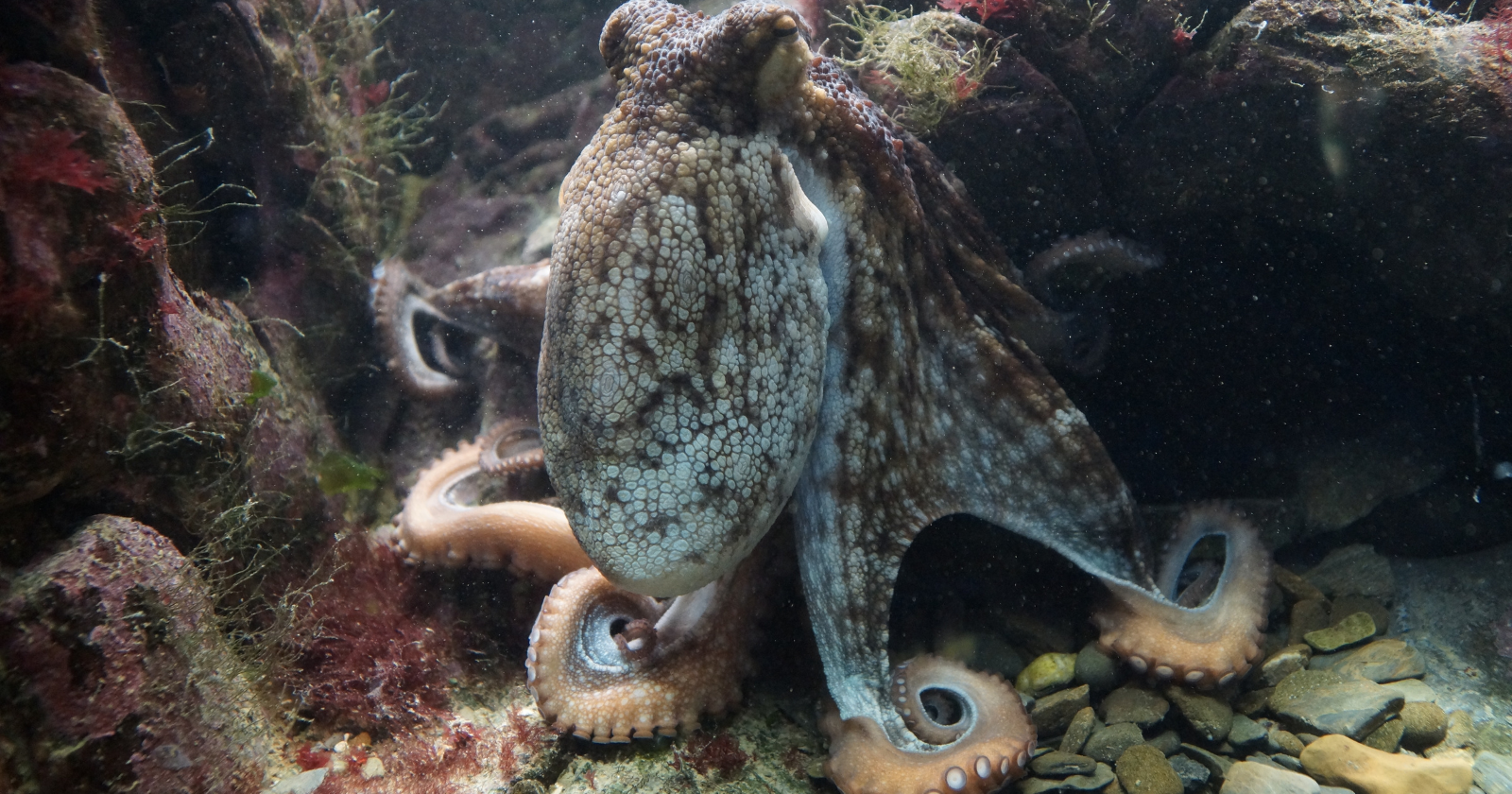
A day octopus flashes black and white for a fraction of a second, extends an arm, and strikes its hunting partner across the head. In some of the documented cases, the researchers could tell exactly why: the fish had been crowding the octopus’s next meal, or dragging its feet. In others, they couldn’t connect the punch to anything the fish had done.
The footage is part of a small but pointed body of work led by Eduardo Sampaio, now a postdoctoral researcher affiliated with the University of Lisbon and the Max Planck Institute of Animal Behavior, documenting something unusual in the waters off Eilat, Israel, and El Quseir, Egypt: octopuses and fish hunting together, and octopuses occasionally punishing the fish they are hunting with.
What the original footage showed
The punching behaviour was first formally described in a 2021 paper in the journal Ecology, “Octopuses punch fishes during collaborative interspecific hunting events,” by Sampaio and co-authors Martim Costa Seco, Rui Rosa and Simon Gingins. Working from field observations of day octopuses (Octopus cyanea) hunting alongside species including blacktip and lyretail groupers and tailspot squirrelfish, the team documented eight incidents in which an octopus struck a fish partner with a single extended arm.
In most cases the logic was straightforward enough: a fish crowding in on prey the octopus was working to flush out, or muscling in early, got knocked back. But in at least two of the eight incidents, the researchers could not connect the punch to any food the octopus stood to gain. The strike didn’t clear a rival away from a meal or open up better access to prey hiding in the reef. It just happened.
Sampaio has described the reaction to first witnessing the behaviour in blunt terms, recalling that he nearly choked on his own regulator laughing the first time he saw an octopus land a punch.
Punishment, spite, or something more mundane
The 2021 paper doesn’t settle on a single explanation, and it isn’t trying to. It lays out several competing ideas. One is punishment in the functional sense biologists use for other cooperative species: a costly act inflicted on a partner now, in the hope of better behaviour later. Another is that lashing out costs the octopus less than the alternative of persisting with a hunting partner that isn’t pulling its weight, making the punch a form of low-effort behavioural control. A third, more provocative option raised in the paper is something closer to spite: imposing a cost on the fish with no direct benefit to the octopus at all, beyond, perhaps, discouraging the fish from tagging along again.
These explanations aren’t mutually exclusive, and the sample size is honest about its own limits: eight incidents, drawn from opportunistic diving observations. This is one study’s read of a strange behaviour, not a settled account of octopus psychology.
A bigger dataset, a clearer pattern
A follow-up study gave the behaviour more structure. In a 2024 paper in Nature Ecology & Evolution, Sampaio worked with Iain Couzin, director at the Max Planck Institute of Animal Behavior, and other colleagues to analyse more than 100 hours of footage from mixed-species hunting groups in the Red Sea and on Australia’s Great Barrier Reef. These groups typically paired one day octopus with anywhere from two to ten fish, including blue goatfish acting as active scouts that locate prey by smell and movement, and blacktip groupers that tend to hang back and wait to exploit whatever the group flushes out.
In this larger dataset, punching came into focus as a mechanism. The octopus, the authors argue, functions as the group’s central decision-maker: it controls when and where the hunt moves mainly by inhibiting motion. Fish that loiter instead of contributing, particularly groupers, get hit disproportionately. As Sampaio told National Geographic, “if the group is moving, everyone’s happy,” and the fish that keep things moving are largely spared.
That framing, sometimes called partner control, is the closest thing to a consensus explanation the research currently offers. But it applies most cleanly to the punches with an obvious payoff. The no-reward strikes documented in 2021 sit awkwardly alongside it, and the 2024 paper doesn’t claim to have resolved them.
The 2024 paper’s bigger contribution is describing how these mixed hunting groups actually divide labour. Goatfish and other active foragers move fast, probing sand and crevices by smell, and are usually the ones that first locate prey. The octopus, by contrast, exerts control mainly by stopping: inhibiting the group’s movement until it decides the timing is right to strike. In Sampaio’s framing, the fast fish are the ones that locate the food, while the octopus is what makes that food accessible to the rest of the group once it acts. Groupers occupy a different niche again, hanging back to ambush whatever the group’s disturbance flushes into the open, which is also, not coincidentally, the role most associated with getting punched.
What still isn’t agreed on
Not every researcher who has looked at this footage reads it the same way. Octopus cognition researcher Jennifer Mather has pushed back on the idea that the fish are genuine partners at all, arguing that they behave more like followers exploiting the disturbance an octopus creates as it forages. On that reading, a punch reads as a solitary predator swatting an opportunist out of its way, with no rebuke between allies implied.
The disagreement is worth taking seriously, and there’s no need to force a resolution between the two readings here. Both readings can explain most of the footage; neither cleanly explains all of it, and the punches thrown for no discernible food reward are exactly where the two interpretations pull furthest apart. What is documented, carefully and repeatedly now across two papers and two field sites, is that these hunts carry real structure. A day octopus working a reef with several fish in tow appears to be tracking who is helping, who is loitering, and occasionally acting on that assessment in ways that don’t map neatly onto what it stands to eat.