

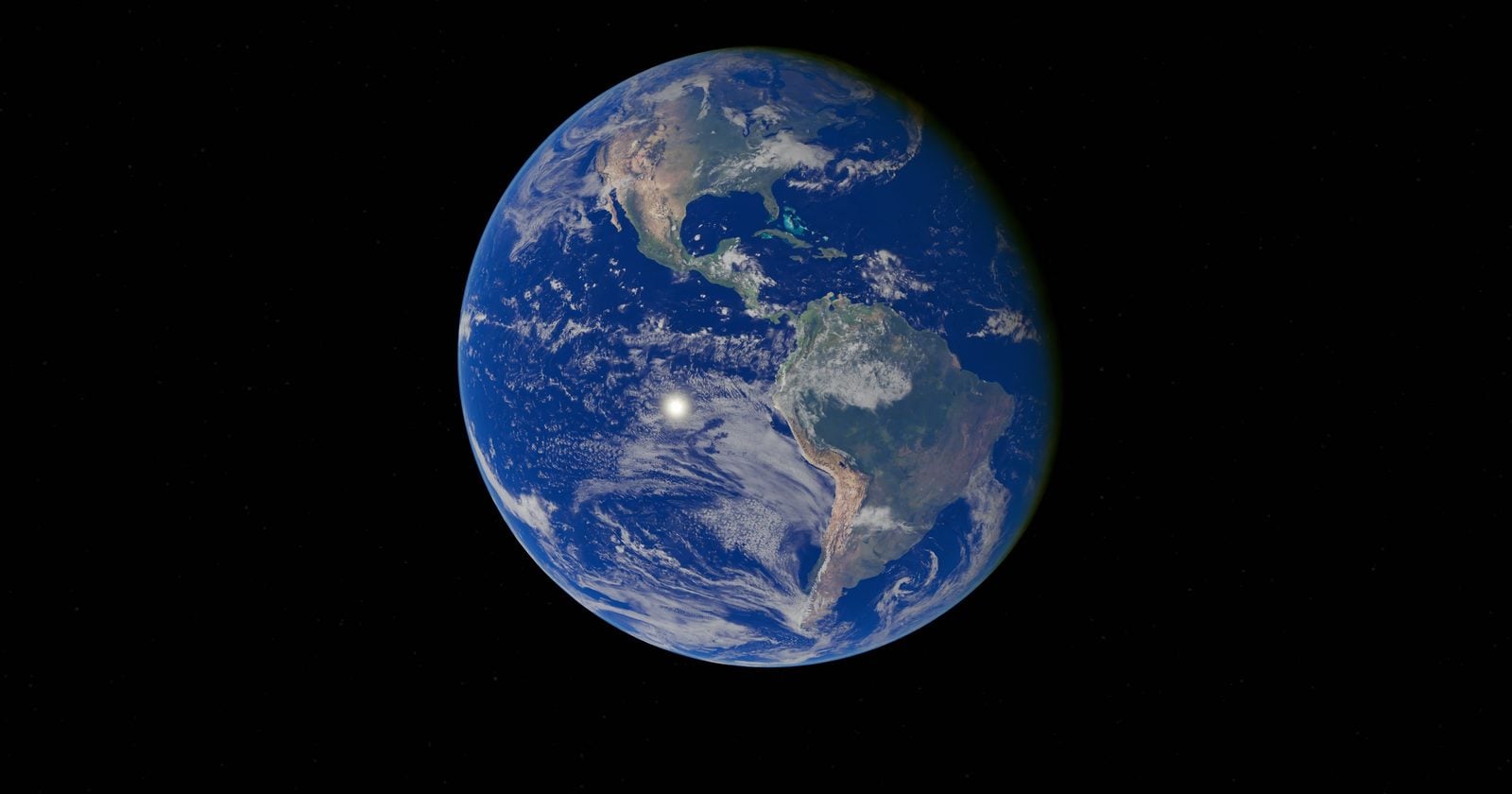
Ask most people what Earth is made of and, somewhere in the back of the mind, the answer is water.
We picture the blue planet, the oceans wrapping most of the globe, and we quietly file water under “main ingredient.” It’s natural but almost entirely wrong. Water is what Earth wears, not what Earth is.
Two numbers reset the whole picture. Water covers about 71 per cent of the surface. But by weight, it makes up only about 0.02 per cent of the planet. The blue we see from space is real, and it dominates the view. By mass, it barely registers.
The blue-marble illusion
The image is genuinely seductive. As a piece republished on phys.org from Universe Today puts it, “The Earth is often compared to a majestic blue marble, especially by those privileged few who have gazed upon it from orbit.” From up there, water is the story. The continents look like interruptions in an ocean, not the other way around.
The surface figures back up the impression. NASA notes that “Water on Earth is very abundant – about 71 percent of Earth’s surface is covered by water.” Nearly three quarters of everything you could stand on, if you could stand on it, is sea. The eye isn’t lying. It just can’t see through the surface to the huge, dry bulk underneath.
Surface area versus mass
This is where the intuition breaks. Surface area and mass answer two different questions. One asks how far something spreads. The other asks how much of it there is. A coat of paint can cover a whole car and still weigh almost nothing next to the engine.
Run the numbers on the oceans and the mismatch is hard to believe. The same phys.org piece reports that “while the oceans cover 71% of the Earth’s surface, they only account for 0.02% of our planet’s total mass.” That’s an estimate, not an exact figure, and it works out to about one part in 4,400 of Earth’s weight.
So 71 and 0.02 sit side by side, both true, describing the same water. The first is about how far it reaches across a surface. The second is about how much it weighs against a planet. What strikes us is how easily the first stands in for the second in everyday thinking, and how far off that swap turns out to be.
What Earth is actually made of
If water is a rounding error, what makes up the rest? Rock and metal, mostly, arranged in layers.
In a review article in Elements, Guillaume Fiquet, François Guyot and James Badro describe a planet where “More than 90 percent of the Earth’s mass is composed of iron, oxygen, silicon and magnesium, distributed among a metal-rich core, a silicate-rich mantle and more highly fractionated crustal rocks (less than 1% of the total).” Four elements, more than nine tenths of the whole. Do keep in mind that these are estimates built on models of the planet’s makeup, not direct measurements of the deep interior.
The layering matters as much as the ingredients. One analysis puts the rocky mantle at 67.3% of Earth’s mass and the metal core at 32.5%, even though the core takes up only about 15 per cent of the volume. It’s heavy because it’s mostly iron.
Why water sits on top
Water pools where it does for a plain reason: it’s light, so it collects at the outside. The mantle and core are far denser, so they settle into the middle, and the thin, light stuff, crust and water and air, ends up as the outermost shells. The crust itself is less than 1% of the total mass. Water is a thinner film still, spread over that already-thin skin.
None of which makes water minor in any way that counts for us. Weight and habitability are two different measures. The oceans, at roughly 0.02 per cent of the planet, are a tiny fraction of the whole, yet their existence sets Earth apart from its neighbors and is essential for life.
A rock planet that happens to be wet
Earth isn’t a water world with some rock in it. It’s a ball of iron and rock, mostly, with a wet film so thin it disappears in the weighing, painted across the top.
That film is where everything we care about happens. All the weather, all the coastlines, every creature that has ever lived, sit in the fraction of a per cent that would round to zero if you were only weighing the planet. The blue we recognize from orbit is honest about the surface and silent about the bulk. Underneath the marble is the part almost no one pictures: dry, heavy, and far larger than the sea that makes it look alive.