

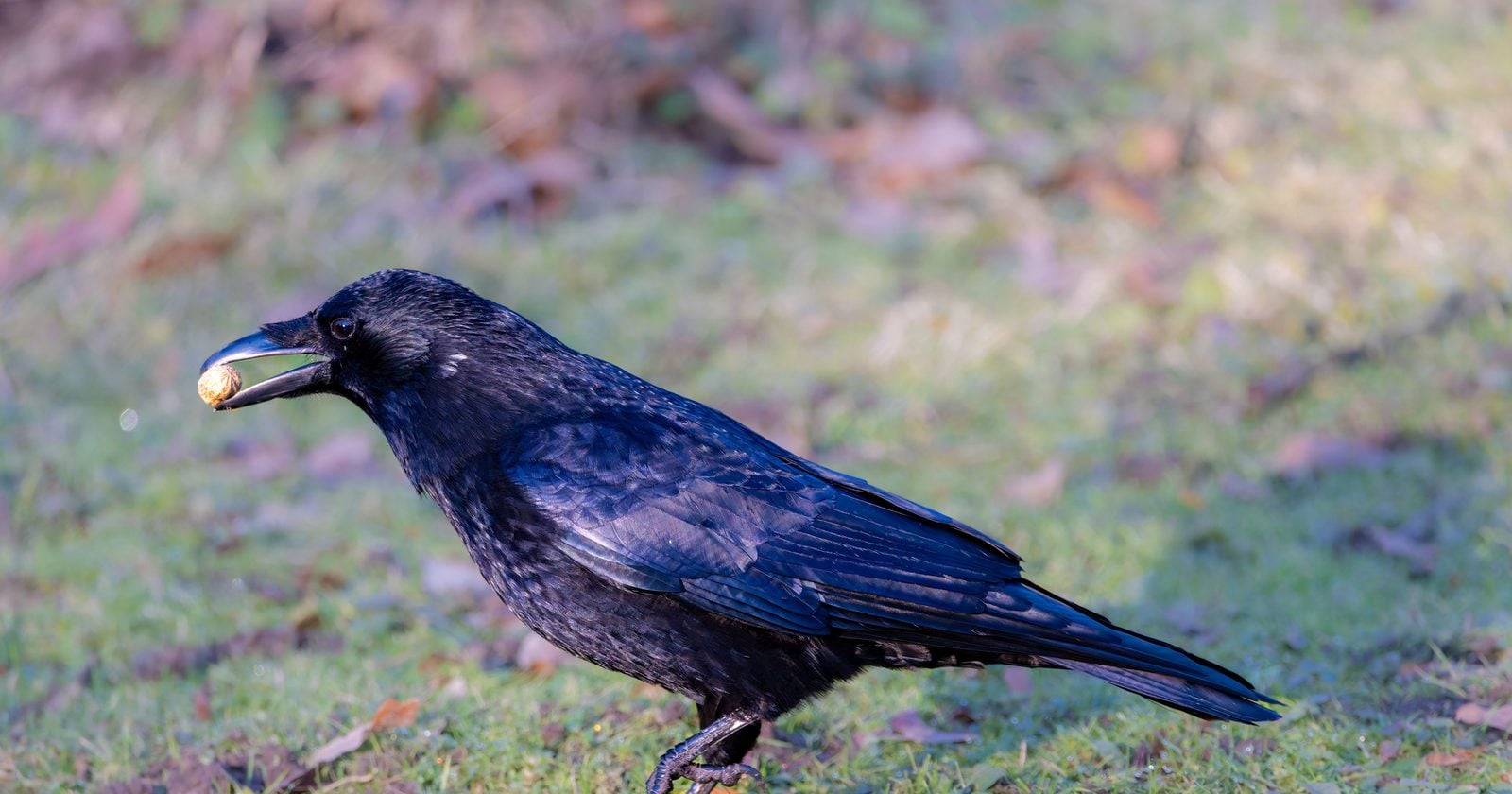
A road junction in Sendai, Japan, in the early 1990s. The light turns red, a line of cars stops, and a crow drops onto the road just ahead of a front tire. It sets down a walnut, then flies back to the curb and waits. The light turns green, a tire rolls over the shell, and once the cars clear the crow returns to eat the kernel.
This is roughly what Yoshiaki Nihei watched happen again and again, and wrote up in a 1995 paper titled “Variations of behaviour of Carrion Crows Corvus corone using automobiles as nutcrackers.”
The story usually gets told as “crows are geniuses.” What we find more interesting is the actual record: what one observer documented at one set of intersections, what he concluded, and why other researchers pushed back. The gap between the anecdote and the evidence is where the good questions live.
What Nihei actually recorded
Nihei described the sequence plainly. He wrote that “a crow puts a walnut in front of the automobile that is stopped by a traffic signal ; then the car run over the walnut and the crow eats the fragements of the walnut” (the typos are his). That is the whole behaviour: place, wait, retrieve.
What gives it weight is how often he saw it. Nihei reported that “This behaviour was frequently seen during the 21 months of the observation period and 43 occurrences of these were recorded in detail.” Forty-three documented events across nearly two years is not a lucky one-off. It is a pattern someone stood and watched, again and again.
Crows crack nuts without cars too. Dropping hard food from a height onto a hard surface is a common crow trick, and Nihei saw crows drop walnuts from more than 10 metres up. On his reading, the car version was a twist on that older habit, useful for walnuts too tough to break by dropping alone.
Systematic, or a lucky byproduct?
Here is where interpretation enters, and where the story stops being simple.
Nihei looked at the details around each event and drew a firm conclusion. He argued that “The analyses of these variables suggest that the car-using behaviour of the crows is not accidental but rather systematic.” He went further, saying he considered the behaviour “intentional”.
That word, intentional, is the disputed one. Saying a behaviour reliably happens is one thing. Saying the bird is deliberately using a car as a tool, understanding what the tire will do, is another. Nihei’s 43 events support his interpretation, but they cannot settle exactly what the birds understood.
Two years later, Daniel Cristol and colleagues tested the idea on American crows in Davis, California, and were unconvinced. The crows they watched showed no clear change when cars approached, and often dropped walnuts where no tire could reach them. In 200 car-present observation periods, not one walnut was actually struck by a car.
Their conclusion was that the apparent car-using behaviour in Davis could be an incidental byproduct of dropping nuts onto hard paved surfaces. In plain terms: the crows may have been choosing roads because roads are hard, with cars occasionally helping by accident.
Cristol’s team was careful, though. They did not claim that crows could never deliberately use cars. Their point was narrower: the behaviour was not regularly demonstrated in the Davis birds they studied.
That makes the contrast useful. What looked systematic in Sendai did not look systematic in California. Different crow populations may have been doing different things.
A different version in Hakodate
A later comparison sharpens the point. In observations made in 2016, a team including Osamu Mikami studied carrion crows in Hakodate, Hokkaido, and compared them with the Sendai birds.
They did not find the neat Sendai routine of placing walnuts directly in front of stopped cars. The Hakodate birds more often dropped nuts from power lines onto roads in a looser way. The authors judged the behaviour “less sophisticated” than the Sendai version.
They suggested several possible reasons, including differences in local learning history, environment and the walnuts themselves. Those were possibilities, not proven causes.
What a clever crow can and can’t tell us
Perhaps the most useful thing here is how little a single vivid observation can settle on its own, and how much more interesting the picture gets once you stop asking whether crows are “smart.”
The car-cracking crows of Sendai are real and well documented. Nihei recorded 43 detailed events. Whether any individual bird understood that a tire would do the breaking is harder to answer, and Cristol’s Davis results are a fair warning against reading intention into every nut that happens to get crushed by a car.
What holds up best is the least mind-reading part of the story: Sendai crows repeatedly used cars in a highly structured way, while crows studied in California did not show the same pattern, and birds in Hakodate used a “less sophisticated” version. That does not tell us exactly what any individual crow understands. It does show that the same broad nut-cracking problem can produce strikingly different behaviour in different crow populations.