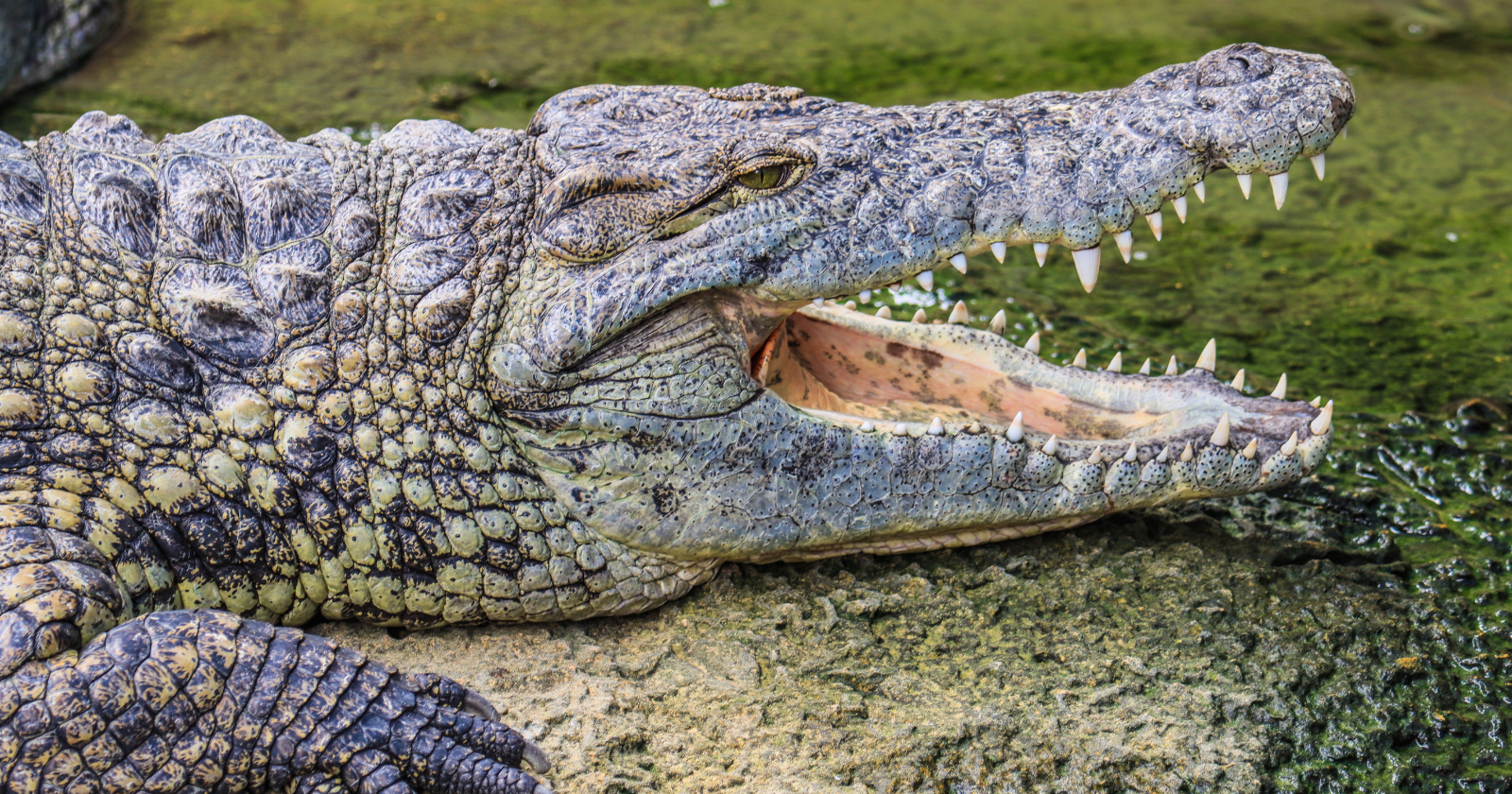
On a riverbank in far north Queensland, an eleven-year-old boy once crouched beside a two-metre saltwater crocodile and patted her tail. It looked like recklessness. It was the opposite. The crocodile had been pinned to the ground, blindfolded, her jaws wrapped shut with rope and gaffer tape, the standard method wildlife handlers use whenever they need to work safely around a live crocodile. Smithsonian magazine, which covered the handling, named the reason the method works at all: plenty of muscle slams a crocodile’s jaws shut, and hardly any of it pulls them open.
Even among ambush predators, that lopsidedness is remarkable.
How the record was measured
Nailing down the number took more than a decade and a great deal of nerve. Palaeobiologist Gregory Erickson of Florida State University and his team wrangled adults from all 23 living crocodilian species onto a force transducer. Erickson cheerfully described the instrument to National Geographic as “a very expensive, very durable, waterproof bathroom scale that’s padded with leather.” A single reading, he said, could take ten people.
The top figure came from a saltwater crocodile: 16,414 newtons, or roughly 3,700 pounds of force. Guinness World Records recognises it as the hardest laboratory-measured bite from any living animal. The specimen was 4.59 metres long, and it knocked off the previous record holder, a 3.9-metre American alligator measured at 13,300 newtons.
Some comparisons help. A bite into a steak, per the same report, lands around 890 newtons. Hyenas, lions and tigers manage somewhere near 4,450.
Writing in PLOS ONE, Erickson’s team also found something they had not expected. Bite force tracked body size closely, and snout shape, tooth form and diet barely moved the needle. Slender-snouted fish eaters and broad-snouted bone crushers were running much the same engine at different displacements. This is one study, though a uniquely thorough one, since nobody has put every species on the same instrument before or since.
Where all that force comes from
Look at a crocodile head and the giveaway is the jowls. Closing muscle fills the entire back half of the skull, anchored high above the hinge and pulling down on a long jaw with excellent leverage. Laura Porro of the University of Chicago, who was not involved in the bite-force work, told National Geographic that dissecting a croc head reveals an astonishing quantity of muscle, nearly all of it dedicated to shutting the mouth.
The muscle stuck with the opposite job
Opening falls mainly to a slip of tissue called the depressor mandibulae. It sits behind the jaw hinge and yanks downward on a short bony stub at the very back of the lower jaw. That leaves it a poor lever to work with and not much room to grow.
Architecture makes it worse. In a 2022 review of crocodylian jaw mechanics in The Anatomical Record, Casey Holliday and colleagues describe the depressor as parallel-fibred, meaning its fibres run straight along the line of pull. One of the major closing muscles is built the other way, with fibres set at an angle to it, like the barbs on a feather. That angling packs far more of them into the same volume of head, and more fibres means more force. Running them straight buys speed and range of movement instead, which is what a mouth needs when nothing is resisting it.
How handlers use the imbalance
So how do you get a health check done on something that bites at 16,000 newtons? Field biology has quietly built its handling protocols around the imbalance, and nobody has needed to invent a gadget for keeping a crocodilian’s mouth closed, because tape and rope do that job for a fraction of the cost.
Holding one open is the hard problem.
In the Wildlife Society Bulletin, Miriam Boucher and co-authors describe building an adjustable device to prop alligator jaws apart, giving vets access to the mouth for health checks and hook removals. It replaces the sections of plastic pipe researchers had wedged in there for decades. They deployed it on 76 wild alligators. Bench testing put the heavy-duty version’s tolerance at 18 kilonewtons, a number that exists because the animal might decide to close.
Why none of this is an escape plan
A snorkeller attacked off Cape York in 2023 did lever a juvenile’s jaws off his head, as NBC News reported at the time. That says more about the size of that particular animal than about anyone’s grip. The weak-opening trick only holds before the bite lands. Once the jaws close, the feeble muscles are irrelevant, because the enormous ones are the only ones still working.
And the jaws are only the front end. Attached to them is 500 kilograms of reptile with a tail it knows how to use, sitting in murky water on its own home ground.
Nothing in that design was built for escaping trouble, and it never needed to be. For 85 million years the crocodile has been the trouble.