

Picture the last plane you flew on. However big or small it was, the basic layout was the same one passengers have known since the 1950s: a long metal tube, seats packed in rows, one or two aisles running front to back like corridors in a train.
Now picture a plane with no tube at all. The body is so wide it simply becomes the wings, and inside, instead of one long corridor, there are four aisles side by side, more like a cinema than an aircraft. That plane is being built right now in California, and some of the biggest airlines in America have already lined up to buy it.
The manta ray
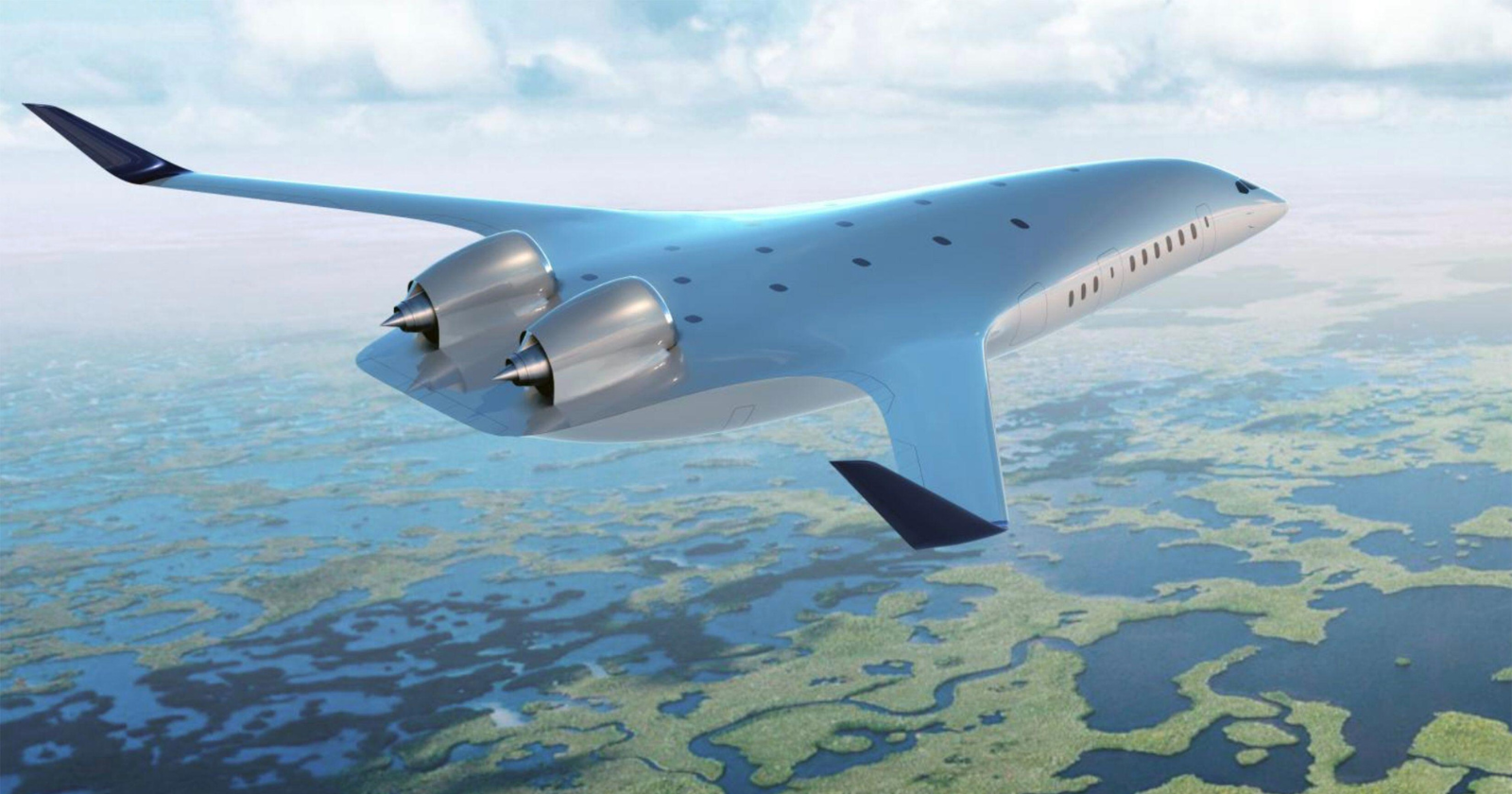
The aircraft is called the Z4, and it comes from JetZero, a startup based in Long Beach. Seen from above it looks less like an airliner than a manta ray: a broad, flattened triangle in which the fuselage and the wings merge into one smooth shape. Engineers call the design a blended wing body.
The idea is simple to state. On a normal jet, only the wings produce lift, and the tube full of passengers is essentially dead weight the wings have to drag through the sky. On a blended wing body, almost the entire aircraft is wing, so nearly every part of it is lifting. Less drag, less fuel. JetZero claims savings of 30 to 50 percent compared with today’s tube-and-wing jets of similar size.
None of this is a new dream. NASA and Boeing spent years and more than a billion dollars flying small-scale blended wing prototypes, and Airbus studied the shape before shelving it. What is new is that someone is trying to carry it all the way to a certified 250-seat airliner.
Related – watch our video on “Your Next Long Flight Now Includes a Dose of Cosmic Radiation”:
Why four aisles
The strange cabin follows directly from the strange shape. Squeeze 250 people into a tube and the tube has to be long and narrow, so one or two aisles are all that fit. Spread the same 250 people through a wide, flat lifting body and everything changes. The cabin becomes short and enormously broad, with rows more than a dozen seats across, wider than anything flying today. The densest widebody rows currently in service are ten seats across.
You cannot ask fourteen people to shuffle past each other to reach one corridor. So the floor is divided into bays, with four aisles running through them. Instead of 25 or 30 rows, there may be only 10 or 15. Add up to four boarding doors and the airline’s promise is a cabin that loads and unloads far faster than a tube, with wider aisles, a dedicated overhead bin for every passenger, and floor space for things airliners gave up decades ago. Concept images shown by JetZero and Delta include a central lounge area in the middle of the cabin.
There is one trade-off passengers will notice immediately: almost nobody gets a window. When the cabin is that wide, most seats are nowhere near an outside wall, and the design leans on digital screens and skylights instead.
The money arrives
The Z4 has been inching forward for a few years. The U.S. Air Force put in $235 million in 2023 to fund a full-size demonstrator, which is being built by Scaled Composites in the Mojave Desert and is aimed at a first flight in 2027. United signed for up to 200 aircraft if the program hits its milestones. Delta and Alaska are advising, and Japan Airlines joined the project at the Farnborough Airshow in July.
Then came the biggest step so far. This summer JetZero secured preliminary federal financing of up to $3 billion to help move the Z4 toward production. The company is pitching it as a replacement for the aging Boeing 757s and 767s that dominate mid-range routes, and, more ambitiously, as the first serious American challenge to Boeing’s home-turf monopoly in decades.
The catch, or several
Plenty of people in aviation think the renderings are easier than the physics. A January study from Hamburg University of Applied Sciences questioned whether blended wings can really deliver the promised fuel savings for passenger aircraft, as opposed to cargo or military versions. Passengers seated far out toward the wings will feel turns more strongly, since they are further from the aircraft’s centerline. Windowless cabins may worsen motion sickness for some flyers. And nobody has ever certified an airliner like this, which means the safety case, from emergency evacuation of a four-aisle cabin to ditching behavior, has to be built from scratch.
JetZero’s own timeline acknowledges the climb: even if the demonstrator flies in 2027, the company does not expect a commercial version before 2030 at the earliest.
The end of the tube?
For seventy years, every attempt to rethink the shape of the airliner has lost to the tube. The tube is cheap, understood and certified. What has changed is that its efficiency is, in the words of JetZero’s president, maxed out. Fuel is the industry’s biggest cost and aviation is under growing pressure over emissions, and there is no 30 percent saving left inside the old shape.
Whether the Z4 makes it to an airport gate is still an open bet. But if it does, the experience of flying will change more in one aircraft than it has in most passengers’ lifetimes: four aisles, a seat that might be fifteen across from the far wall, a screen where the window used to be, and a wing that you are sitting inside.
