

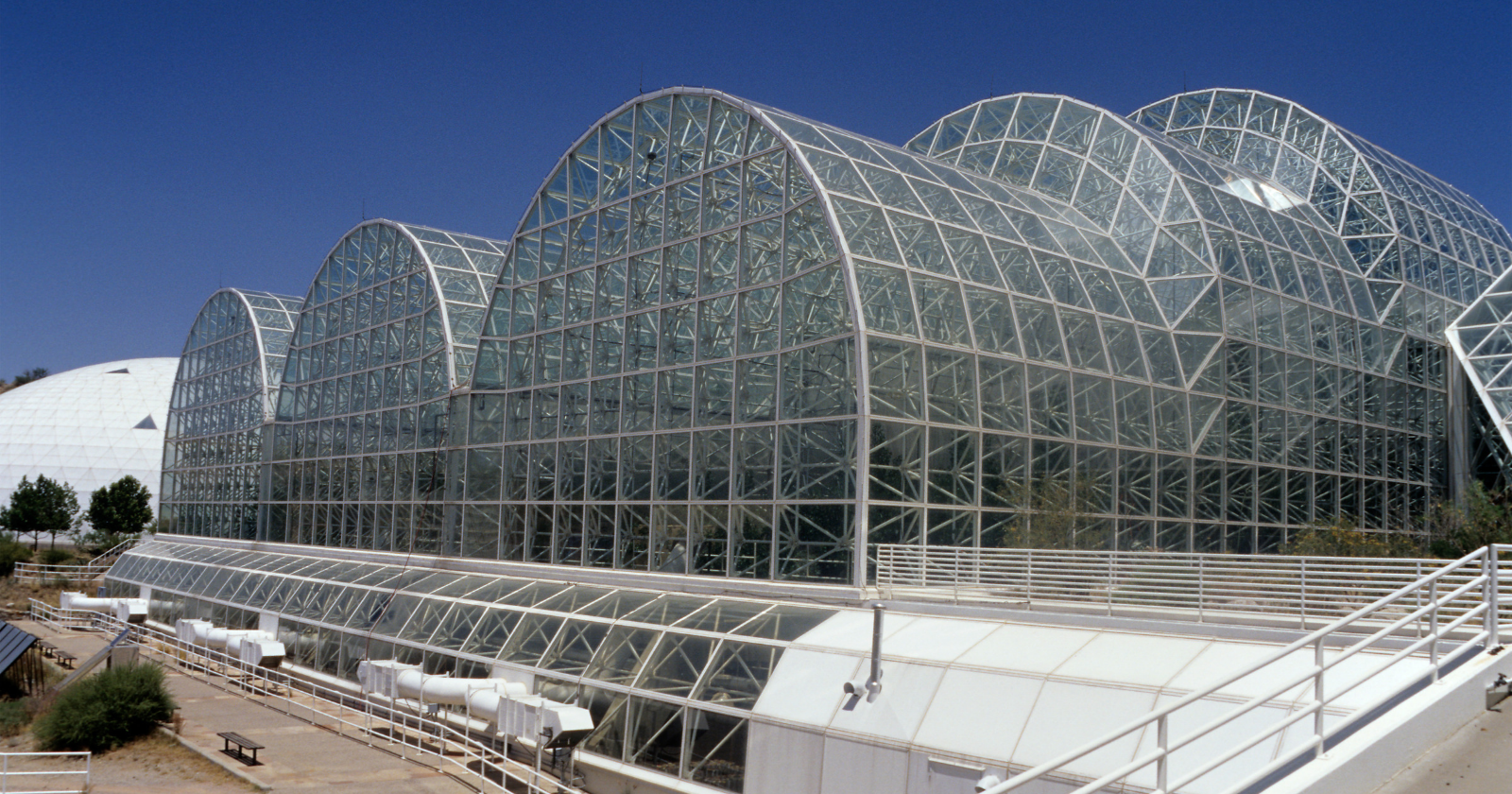
Picture two versions of Earth. One is the planet outside your window, running its rainforests and coral reefs and pollinators for free, no bill attached. The other is a three-acre copy sealed under glass in the Arizona desert, built to do the same work on purpose, with a science team, a fortune behind it, and eight people living inside.
The strange part: when the sealed version was cut off from the real one, the animals people wanted mostly died, and the animals nobody invited took over.
That is the short story of Biosphere 2, and it’s easy to file under “expensive failure.” Our read is that the more interesting question is what it accidentally proved: how much invisible work the living world does for us, and how hard that work is to fake.
We are not ecologists, biologists, or life-support engineers, and this is reading and reflection on one experiment rather than a settled account of how sealed ecosystems behave. Biosphere 2 was a single, one-off project, so what happened inside its glass is best read as a striking case, not a general law about nature.
The dream: a miniature Earth meant to run itself
The idea was hugely ambitious. Dreamed up by John Allen and funded largely by the Texas billionaire Ed Bass, Biosphere 2 was a glass-and-steel enclosure near Oracle, Arizona.
Into just over three acres it packed a rainforest, an ocean with a coral reef, a desert, a savanna, mangrove wetlands, and a working farm. Building it reportedly cost around $150 million but the goal was partly practical: if humans ever want to live for years on the Moon or Mars, someone has to figure out how to keep a self-contained slice of life running.
Eight people, four men and four women, were sealed inside to find out. One of them, Mark Nelson, opens his own account plainly: “Our two-year experiment began on September 26, 1991.” They came out two years later, on the same date in 1993, having stayed the whole time. On that count, the mission worked. The inside is where things went sideways.
The winners: crazy ants and cockroaches
Sealed systems, it turns out, have favorites, and they’re rarely the ones on the brochure. Among the roughly 3,800 species enclosed, the big success stories were the least glamorous residents in the building.
One of them wasn’t even meant to be there. A hardy species called the longhorn crazy ant had come along as a stowaway, and once inside it spread across the biomes. A team led by James Wetterer found that by 1996 almost every ant showing up at bait in the enclosure was this one species. Cockroaches did the same. What was designed as a careful mix of rainforest and reef became, in places, a home for the toughest opportunists on the guest list.
Vines followed the same pattern. Fast-growing weedy plants surged while more delicate species struggled, and the crew ended up pulling weeds by hand to keep the growth down. Mongabay’s account of the aftermath lists exactly this: vines, cockroaches, and ants booming while the fragile species collapsed.
The losers: pollinators and the birds
The collapse was steep. By the end of the mission, 19 of the 25 backboned animal species brought into Biosphere 2 had died out, and all of the pollinating insects were gone. One essay puts the total loss at roughly 30 percent of the enclosed species, pollinators included.
Losing every pollinator is not a small thing. Without bees and other insects moving pollen, flowering crops don’t set fruit. So the crew took over the job by hand, flower by flower. The birds went too, hummingbirds and finches among them. A garden built to feed eight people had lost the invisible workforce that makes a garden work, and the people inside had to become that workforce themselves.
There was a second, scarier problem in the air. As Nelson tells it, “Oxygen had been slowly disappearing for sixteen months. No one knew where it had gone.” The oxygen level fell from about 20.9 percent to 14.2 percent, roughly what you’d breathe near the top of a high mountain. The cause was worked out later: microbes in the soil were pumping out carbon dioxide faster than the plants could turn it back into oxygen, and bare concrete was absorbing that carbon dioxide, so the gas wasn’t showing up where anyone expected. At the time, it was just a mystery the crew lived inside, getting short of breath.
Why the opportunists won
None of this was random. Ants, cockroaches, and vines are generalists. They handle a wide range of conditions, breed fast, and don’t rely on one specific partner species to get by. Drop them into a sealed box with shaky air, dim light through the glass, and a food web missing most of its predators, and they do what generalists do: fill the space.
The specialists had no such luck. A hummingbird that needs particular flowers, or a bee tuned to one kind of bloom, depends on a fragile deal with the rest of the system. Break one link and the whole arrangement falls apart. Out in the open, those species can move, switch, or be replaced by more of their kind from the surrounding countryside. Under glass there is no surrounding countryside. There is only the box, and whatever survives the box’s worst week sets the terms for everyone else.
The scientists who assessed the project afterward chose their words carefully. A pair of Columbia University researchers, writing about a 1996 paper in the journal Science, concluded that “isolating small pieces of large biomes and juxtaposing them in an artificial enclosure changed their functioning and interactions rather than creating a small working Earth as originally intended.” The parts were real, but they never added up to a working whole.
What we take from a garden that turned to weeds
Everything the crew had to do by hand, pulling vines and pollinating crops flower by flower, is work that happens outside for free, every day, done by insects and birds and microbes nobody is paying.
Scientists looking back put the cost bluntly, noting that the “Biospherians, despite annual energy inputs costing about $1 million, had to make enormous, often heroic, personal efforts to maintain ecosystem services that most people take for granted.” A fortune in energy, plus eight people working as if the crops depended on them, because they did, and it still fell short of what the planet outside was doing without a thought.
The Columbia team’s 1996 verdict has aged well. “No one yet knows how to engineer systems that provide humans with the life-supporting services that natural ecosystems provide for free,” they wrote. As far as we can tell, that conclusion has been underlined rather than overturned every time someone tries.
The facility is still there, run now by the University of Arizona as an open environmental research lab rather than a sealed one. The glass no longer keeps the world out. That feels about right. The sharpest thing the experiment ever showed had nothing to do with living on Mars. The residents you’d never invite, the cockroaches and the stowaway ants, are the ones tough enough to thrive when a piece of the world gets cut off from the rest. The pollinators and the hummingbirds, doing the quiet work that keeps a garden fed, need the whole planet behind them just to survive.