In astronomy, a broad emission line in hydrogen with no matching broad line in the forbidden oxygen doublet is a specific fingerprint: gas moving fast enough to smear the line out, packed densely enough to switch the forbidden transitions off. That combination is read as the broad-line region of gas whipping around an accreting black hole.
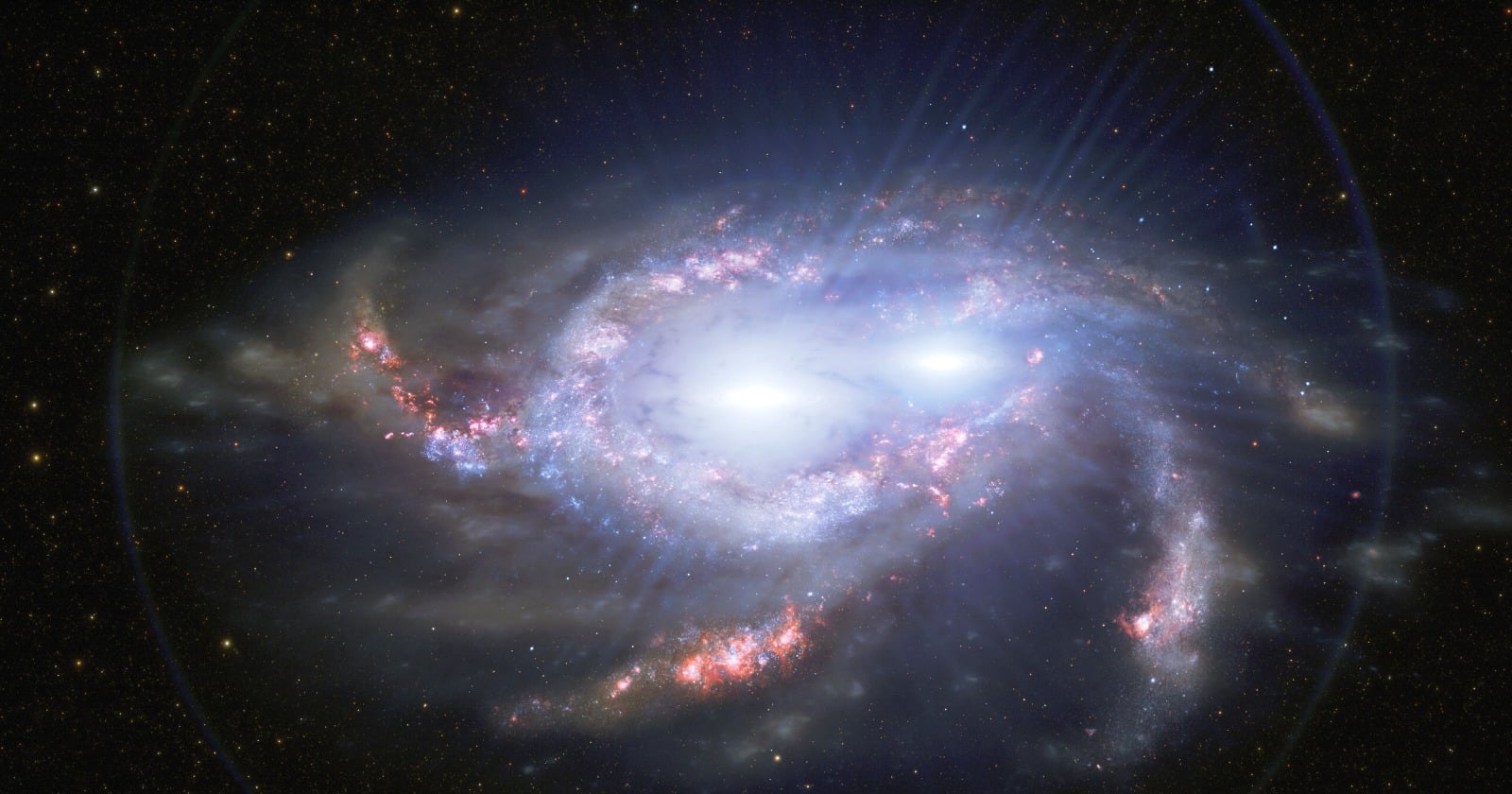
A galaxy called J0148-4214, observed with the James Webb Space Telescope, shows three of those fingerprints at once. Two sit in the galaxy’s centre, about 190 projected parsecs apart. The third lies roughly 1.7 kiloparsecs out towards the north-west. The paper reporting it, published in Astronomy & Astrophysics on 12 August, is titled BlackTHUNDER: Evidence of three massive black holes in a z ~ 5 galaxy, and its own title stops short of calling the count confirmed.
What the instrument separated
J0148-4214 was already known. Matthee and colleagues reported it in 2024 as a Type I active galaxy at redshift 5.019, hosting a single black hole. The new observation measures its redshift as 5.01672, and the paper places it “just 1.2 Gyr after the Big Bang” in one section and 1.15 billion years in another. Redshift and cosmic age are the only distance measures the article gives. The widely quoted 12.5 billion light years comes from the institute’s announcement rather than the paper, which contains no distance in light years at all.
What changed was the instrument. The team, led by Hannah Übler at the Max Planck Institute for Extraterrestrial Physics, pointed Webb’s NIRSpec in integral field mode at the galaxy on 15 December 2024, collecting about an hour on the high-resolution grating and half an hour on the prism. Integral field spectroscopy records a spectrum at every point in the image, so light that a single slit would blend arrives separated in space. An earlier grism spectrum had already hinted at a complicated line shape, but only the spatial information could say whether that shape came from one object or two.
The central hydrogen line is asymmetric and fits poorly as one Gaussian. Splitting it into two components gives widths of 2920 and 430 kilometres per second. Mapping each component separately across the wavelength channels puts their light centres 190 parsecs apart, with an uncertainty of 40 parsecs. A second centroid measurement using only the higher-signal pixels returned 160 parsecs. A mock recovery test returned 200 parsecs and warned that the 40-parsec uncertainty may itself be understated by 10 to 20 parsecs. For scale, the authors note that a single black hole’s broad-line region is typically smaller than a parsec, “at least 150 times smaller than the centroid separation we measure.”
Masses good to a factor of ten
Using a locally calibrated relation between line width, line luminosity and mass, the team estimates masses of 107.9, 105.8 and 106.3 solar masses for the primary, the secondary and the north-western object, each carrying an uncertainty of 0.4 to 0.5 in the exponent. The secondary, at roughly 600,000 solar masses, sits below the million-solar-mass line usually implied by the word supermassive, although the institute’s announcement calls all three supermassive in its summary and body text. The word appears in the paper only once, in its keyword list. The paper’s own title says massive, and the secondary would be “among the lowest-mass black holes so far discovered above z ~ 5” if the interpretation holds.
The accretion rates split oddly. The heavy primary is feeding below its Eddington limit. The much lighter secondary, on these numbers, is feeding above it. The north-western object is the faintest of the three and also sub-Eddington, a combination the authors describe as “a regime of low black hole mass and low accretion rate, so far unpopulated by moderate-luminosity high-z AGNs.”
The masses are the softest part of the result. The paper notes that local calibrations may carry systematic errors of 0.5 to 1 in the exponent at these redshifts, that a denser covering of gas could inflate the estimates by a factor of two or three, and that super-Eddington feeding could inflate them further. Interferometric masses for four black holes at redshift 2, plus an upper limit on a fifth, suggest this calibration may overshoot “by factors of two to ten.” One of the paper’s figures carries an arrow marking a possible downward correction of a full order of magnitude. Pushing the other way, the same section notes that radiation pressure at high accretion rates can narrow the observed line and so understate a mass, and that a separate study of five galaxies at redshift 2 found local relations may hold up for black holes feeding at lower rates, which is what the primary and the north-western object appear to be doing here.
The things that also make broad hydrogen lines
A single black hole with an oddly shaped broad-line region would produce one point source. What the channel maps show instead is two light centres that shift apart from one wavelength slice to the next. A blue-shifted absorber carving a notch in one broad line also fits the spectrum, but it would require densities so extreme that it would have to lie inside the broad-line region, where it too would show no positional shift, and a statistical comparison favours the two-component model by a wide margin.
Supernovae produce broad hydrogen as well, usually at several thousand to ten thousand kilometres per second, often blue-shifted or carrying a P Cygni profile, and none of that appears here. The team also had an older Webb grism spectrum from January 2023, roughly 120 rest-frame days earlier. A supernova caught near peak should have faded measurably over that span; refitting the older data returns luminosities consistent with the new ones, a test the paper could run only on the two central components. Shocks were tested against a model grid and predict both too little hydrogen light and a neutral oxygen ratio the data do not show.
Winds were ruled out on two grounds. The north-western line is wider than 1000 kilometres per second, where star-formation-driven winds in early galaxies typically run 400 to 500. The reason the authors call more important is a different one: an outflow bright enough to make that hydrogen line should show a matching broad oxygen line, and nothing in this galaxy does. The same oxygen test disposes of a wind at the 430-kilometre-per-second central component, where hiding the oxygen would demand densities above a million particles per cubic centimetre and a gas cloud that would collapse under its own weight. Very massive stars fail on a different measure, equivalent width, which drops below 20 angstroms within about 10 million years and runs far higher in all three components here.
Corrections against the coverage
The 82 per cent that has travelled with this story is a rounding of a number in the paper, and it does not measure what the coverage implies. Using the simulator GWFish, the article estimates the probability that the planned gravitational-wave observatory LISA would detect each merger, on the assumption that the merger happens: 81.8 plus or minus 1.8 per cent for the merger 5.9 billion years out, the north-western object joining a pair that has already coalesced, and 38.2 plus or minus 4.2 per cent for the close central pair, the one likely to go first. Substitute the galaxy’s dynamical mass for its stellar mass in the inspiral calculation and the two detection probabilities fall to 78.2 plus or minus 0.8 and 24.2 plus or minus 1.9 per cent. All four assume the black holes gain no further mass and do merge on the estimated timescales, with spin and precession left out.
The merger itself is conditional. At about 190 projected parsecs the separation exceeds the primary’s roughly 50-parsec sphere of influence, so on a circular orbit the two central black holes are, in the paper’s words, “not (yet) gravitationally bound”, though an eccentric orbit could change that, and the authors judge the pair likely to be in the efficient dynamical-friction phase either way. The inspiral estimate of 0.66 billion years comes from a calculation they call simplistic, one that omits gas and dark matter and assumes a true separation of 0.3 kiloparsecs rather than the measured projection.
The paper also does not claim a first. The announcement does, in its headline,, and Übler’s quoted wording sitting under that headline is narrower than it: “the first evidence of three active black holes in a single galaxy in the distant Universe.” The article itself puts the novelty as “the possible discovery of a black hole triplet at high redshifts”, set against four references it cites to triplets already found in the nearby universe, and its conclusions drop the word “possible”.
The recoil case is the checkable one
If the north-western object was kicked out of the centre by an earlier black hole merger, the recoil needed to clear the galaxy’s escape velocity is at least 200 kilometres per second, which in turn constrains the mass ratio of whatever merged. The oxygen maps hint at a velocity change and a rise in velocity dispersion in that direction, consistent with an object on the move, though the paper says the same signal would fit an object falling in as readily as one on its way out, and it declines to lean on the hint because the signal there is weak.
They lean towards a recoil over a three-body ejection for two reasons that are themselves checkable: the north-western object is still feeding, and it is not the lightest of the three. A third path stays open, in which the object was thrown out earlier and will fall back to merge with the central pair after all.
Data at higher spatial and spectral resolution than this observing mode delivers will help pin down how the central pair is moving. Several other early galaxies show the same lopsided line profiles in their integrated spectra, and the same instrument mode would test them one at a time.