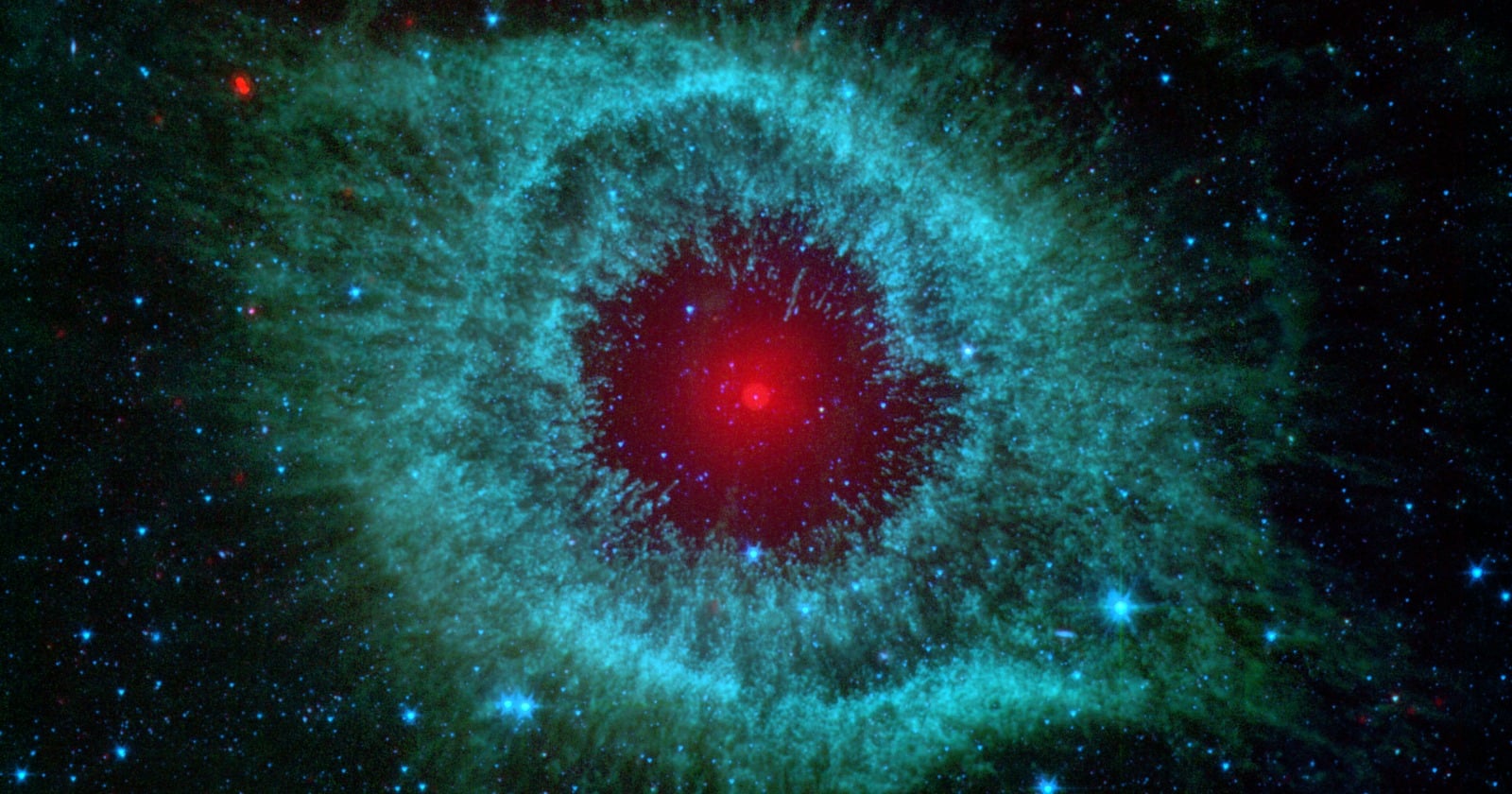
Pieter van Dokkum and seven colleagues were still bolting a telescope array together in the Chilean desert when they aimed its first five mounts at the Helix Nebula, a commissioning target of the kind new instruments are pointed at while they are being checked out. The image that came back, published in Nature on 12 August, carries at least 22 bow shocks in the nebula’s faint outer halo.
Almost none of them has anything visible at its centre. Each arc is the shock front of an object nobody can see, ploughing through the thin gas between stars at supersonic speed.
The paper, Numerous bow shocks in the outer Helix Nebula, comes from the Dragonfly Focused Research Organization, Yale, the University of Toronto and NRC Herzberg. The full text is open on arXiv, and the continuum-subtracted image itself is posted on Zenodo.
Shed before the nebula existed
The Helix, catalogued as NGC 7293, is one of the closest and brightest planetary nebulae, about 650 light-years away. That distance comes from the Gaia astrometric solution for its central white dwarf, WD 2226-210: 198.6 parsecs, with error bars under two parsecs either way. The bright ring at its heart has been photographed for decades. The arcs in this paper sit well outside it, in a halo faint enough to have gone largely unmapped in hydrogen-alpha light.
Shock modelling puts the ejecta out there moving outward at 35 to 45 kilometres per second. At about one parsec from the star, that gives the clumps a travel time of 20,000 to 30,000 years. The nebula itself is only around 12,000 years old.
So the material in the halo most likely predates the nebula. The team reads it as an older circumstellar envelope shed during the star’s late asymptotic giant branch phase, the long exhalation that comes before the core is finally unveiled. The bows also sit at about the same radius as an infrared halo found in WISE data by Zhang, Hsia and Kwok, which had already been attributed to dust from an AGB wind.
An old shell, in pieces. The bow shocks are those pieces announcing themselves on the way out.
Nothing sits where the objects should be
The team fitted each arc with a parabola and marked its focus, roughly where the object driving the shock ought to be. Searching those positions in hydrogen-alpha, oxygen and nitrogen light turned up almost nothing, which the paper reads as consistent with the fragments being largely neutral. Where a focus actually falls depends on each bow’s three-dimensional orientation and shape, neither of which is measured, so the clump positions carry that uncertainty with them.
Most of the 22 appear to be new. A few, including the large complex feature the team numbers 14, can be picked out in older GALEX and hydrogen-alpha frames, and earlier work by Meaburn, Boumis and Akras had already turned up one bow shock and a fast jet in this halo. The new picture adds the crowd.
Line ratios say how hard the arcs are being hit. In the brightest region of arc 14 the nitrogen line comes in at 6 per cent of hydrogen-alpha, and the oxygen line is undetected down to 1.5 per cent at two sigma. Fed into the MAPPINGS V shock code, that combination points to shock velocities of 80 to 90 kilometres per second on the eastern side, and the paper adopts 85, about 190,000 miles per hour. Once the nebula’s own 45 kilometres per second of motion relative to the surrounding gas is subtracted, the ejecta themselves are moving at 35 to 45. That expansion speed is modelled here rather than measured directly, though it agrees with hydrogen-alpha kinematics recorded around the brightest bow years earlier.
On the western side the ejecta push into a wake that has already passed through the nebula, and the shock drops to about 35 kilometres per second. The features there are faint arcs and bubbles rather than sharp bows, and the team offers them only as possible counterparts. The paper also sets aside the region’s 300 kilometre per second jet as their cause, since a jet-driven shock would light up strongly in oxygen and these do not.
The bows shrink by a factor of a hundred
Close to the white dwarf, at about 0.4 parsecs or 1.3 light-years, the bows are large, thin and cleanly drawn. By 1.4 parsecs, roughly 4.6 light-years, they are small, broad and patchy. The characteristic curvature scale falls by a factor of about 100 across that range, and a line through the points gives an e-folding length of 0.27 parsecs.
Divide distance by the expansion speed and that becomes an e-folding time of about 7,000 years. The team rounds to an order of magnitude: the fragments lose coherence on a timescale of roughly 10,000 years. Classical bow shocks around mass-losing stars, the kind standing in front of Mira, last something closer to 100,000 years.
Nothing here was timed, though. The 10,000 years is read off the gradient of a size-against-distance plot, and it only becomes an age if the bows at larger radii are the same sort of object as the bows nearer in, further along. The curvature radius is a purely geometric quantity, the paper says, and by itself does not specify the momentum balance inside the flow; parabolas were adopted because they survive projection tidily, with the spread across four fitting families used as the error bar. The authors state plainly that the figure should be read as the survival time of the coherent fragment and bow system, and not as a direct measurement of any particular momentum or mass-loss rate.
There is a further wrinkle in what the outer arcs even are. As fragments are stripped, the paper expects a growing share of the hydrogen-alpha light to come from mass-loaded mixed gas around them, and less of it from a thin, well-defined forward shock. The outermost features may be shocks only loosely speaking.
Five mounts out of thirty
MOTHRA, the Modular Optical Telephoto Hyperspectral Robotic Array, is being assembled at the El Sauce Observatory in Chile. Finished, it will carry 1,140 Canon 400 mm telephoto lenses across 30 mounts, 28 of them narrow band and two broad band, and gather light like a 4.8 metre refractor. Most of the narrow-band lenses sit behind tiltable ultra-narrow filters; a few on each mount carry wide continuum filters with a notch cut out at the emission line, so the continuum can be measured without the line contaminating it.
In November 2025 only the first five mounts were working. The Helix was observed on the 16th and again from the 19th to the 24th, for what the team records as 172.5 single-lens-equivalent hours in hydrogen-alpha, since the number of active lenses kept changing during the run. On the completed array, with its 504 hydrogen-alpha lenses, the same image would take about 20 minutes.
The design descends from the Dragonfly Spectral Line Mapper, whose 120-lens first light was reported by Seery Chen and colleagues in 2025.
The last step in a very long chain
The step being watched here has until now been mostly theoretical. Stars enrich galaxies by dying, and the enrichment only counts once the ejected material stops being a discrete object and becomes part of the general interstellar medium. Galaxy formation simulations cannot resolve that transition, so they stand in for it with subgrid mixing and diffusion prescriptions. A measured survival time, even a rough one, gives those prescriptions something to be checked against.
Whether the number generalises rests on the Helix being ordinary, which the paper argues it is. Any planetary nebula moving through its surroundings faster than about 40 kilometres per second should show the same forest of arcs, and the dark clumps are within reach of the molecular hydrogen and carbon monoxide observations that already work on the Helix’s famous cometary knots.
The image behind all of this was a test frame: five mounts out of thirty, run to see whether the array worked. Aimed at one of the closest and best-studied planetary nebulae in the sky, it came back with at least 22 arcs nobody had counted, every one of them the mark of something being taken apart.