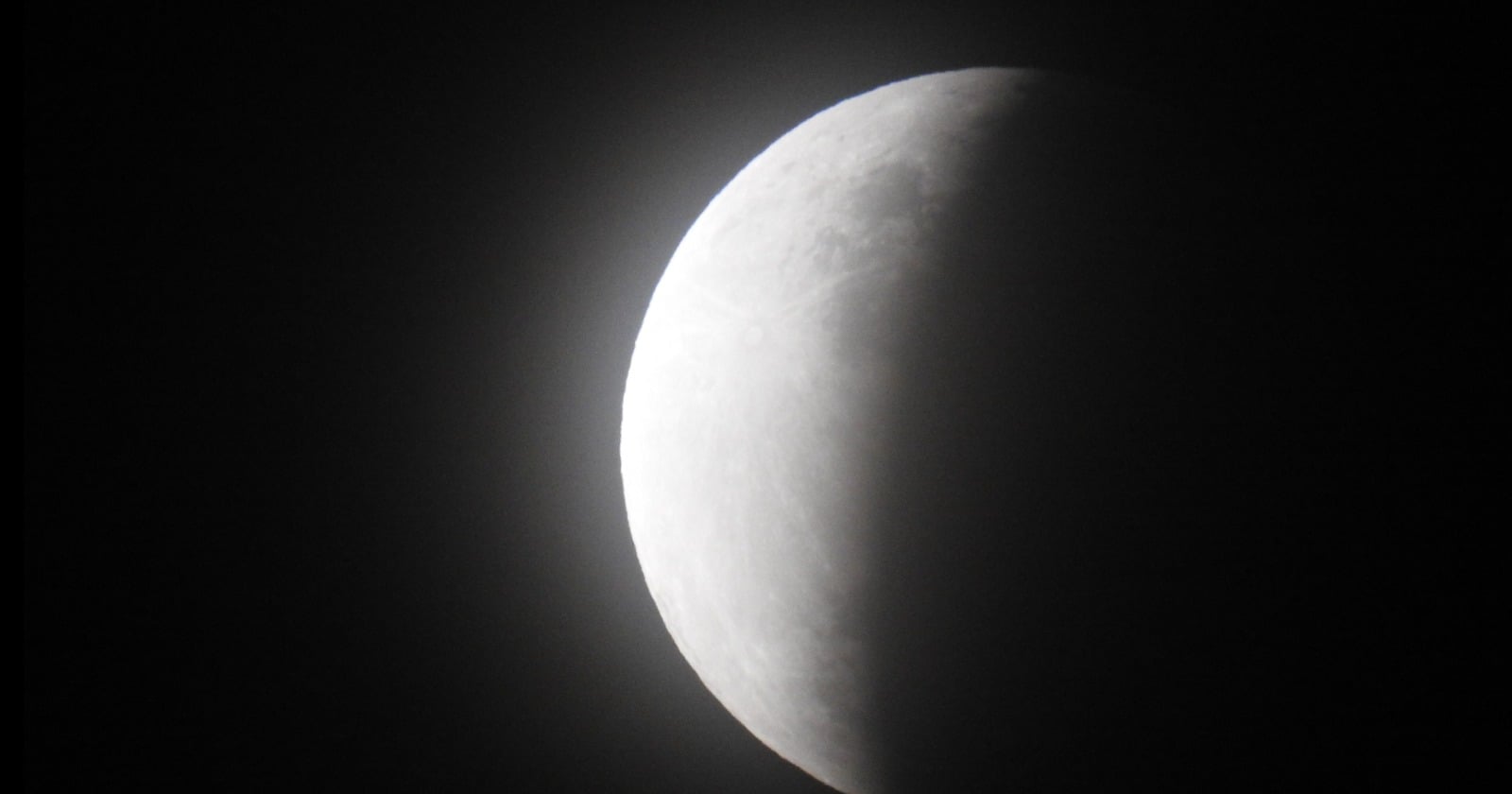
You are going to hear this one called a blood moon. Go outside on the night of August 27 expecting a red Moon and you will spend an hour waiting for something that is not coming. Go outside expecting a clean dark arc cut across almost the whole disc and you will get it, on schedule, for three hours and eighteen minutes.
The Moon crosses into the dark core of Earth’s shadow late on August 27 and stops just short of vanishing. NASA’s decade table of lunar eclipses, calculated by Fred Espenak for NASA’s Goddard Space Flight Center, lists the umbral magnitude as 0.930: 93 percent of the Moon’s diameter inside the umbra at greatest eclipse. It belongs to Saros series 138. No other partial lunar eclipse between 2021 and 2030 goes deeper except the one on 19 November 2021, which reached 0.974.
The 500-fold contrast
Earth casts two shadows. The umbra is the inner cone where the planet blocks the whole Sun. Around it sits the penumbra, a much wider cone where Earth blocks only part of the Sun, so much of the sunlight still gets through.
At a partial eclipse the Moon straddles both, and the split is brutal to the eye. Espenak and Meeus, writing in NASA’s Five Millennium Canon of Lunar Eclipses, record that the limb inside the umbra “usually appears very dark or black,” and that this is primarily a contrast effect: the portion still in the penumbra may be brighter by a factor of about 500.
That figure is the general case for partial eclipses rather than a prediction for this one, and this eclipse is an unusual specimen. Its penumbral magnitude is 1.965, which means the entire Moon sits inside the penumbra at maximum. The surviving rim is therefore itself dimmed, and the true contrast on the night may run lower than 500. It will still be enormous, and a dark-adapted eye parked next to a bright crescent has no chance of registering a subtle tint beside it.
The canon also notes that Earth’s umbra is typically about 2.7 times wider than the Moon. That is why the shadow’s edge reads as a smooth curve taking a semi-circular bite out of the disc, and why 93 percent of the width can go missing while a bright sliver survives at one limb.
Red belongs to totality. When the Moon passes entirely inside the umbra, the only light reaching it has been bent through Earth’s atmosphere, which scatters away the short wavelengths and refracts the oranges and reds inward. That is the mechanism behind the phrase people reach for. On August 27 the Moon never gets there, and for the Americas the next total lunar eclipse is 26 June 2029.
Which leaves the one part of this night nobody can put on a schedule. Whether a patient observer picks up any rust or copper along the inner edge near greatest eclipse depends on the night, the air and the sky overhead, and no table forecasts it. The canon’s answer for partial eclipses is very dark or black, usually; some coverage this month has promised a subtle orange glow instead. The canon is the better guide, and neither settles what an unusually deep partial will look like through one particular sky. A related tool you may see quoted, the five-point Danjon brightness scale, was defined for total eclipses and has nothing to say about this one.
The 96 percent is an area measurement
Much of this month’s coverage puts the figure at 96 percent. That figure is real. It is measuring something else.
Umbral magnitude, the quantity NASA publishes, is the fraction of the Moon’s diameter inside the umbra. Obscuration is the fraction of the Moon’s disc area the umbra covers. Once the shadow’s edge is cutting deep across a circle, area disappears faster than width does, so the two numbers pull apart: for this eclipse, timeanddate’s calculated obscuration is 96.2 percent alongside the same 0.930 magnitude.
Nobody invented anything here. A width measurement is being reported as though it were a coverage measurement, and 96 percent covered sounds like a Moon that is nearly gone. Ninety-three percent of the width is a Moon with a rim, and the rim is the entire visual story.
Clock times for the United States
Contact times of this kind are computed decades ahead and hold to within seconds, and the 0.930 magnitude falls out of the same calculation. Greatest eclipse falls at 04:13 universal time on August 28, which puts it after midnight on the east coast and mid-evening on the west. The full sequence in universal time, all on August 28: penumbral phase begins 01:24, partial phase begins 02:34, greatest eclipse 04:13, partial phase ends 05:52, penumbral phase ends 07:02.
- Eastern: partial begins 10:34 p.m. on the 27th, deepest at 12:13 a.m., partial ends 1:52 a.m.
- Central: partial begins 9:34 p.m. on the 27th, deepest at 11:13 p.m., partial ends 12:52 a.m.
- Mountain: partial begins 8:34 p.m., deepest at 10:13 p.m., partial ends 11:52 p.m., all on the 27th.
- Pacific: partial begins 7:34 p.m., deepest at 9:13 p.m., partial ends 10:52 p.m., all on the 27th.
A lunar eclipse can only happen at full moon, and a full moon rises around sunset, so from the Eastern, Central and Mountain zones the Moon is comfortably up and climbing for the whole partial phase.
The Pacific zone gets the friendlier clock and much the worse geometry. This is a late-August full moon, which sits south of the celestial equator so it rises later the farther north you live, and along the west coast moonrise falls close to the moment the partial phase begins. From Seattle and San Francisco the partial phase begins before the Moon has cleared the horizon at all. Southern California catches the start only a couple of degrees up, in a sky still washed with evening twilight. West-coast viewers should treat the deepest phase at 9:13 p.m. as the appointment and forget the opening.
Alaska and Hawaii do get a piece of this, but nearly everywhere in both states the Moon rises only after the deepest phase is over, so what most viewers there see is the closing stretch of an already-bitten Moon low in the east. Check your local moonrise before making plans.
No filters, no glasses, no equipment. Unlike a solar eclipse, this one is safe to look at directly for as long as you want to stand there.
Aristotle already had what he needed
The oldest use anyone ever found for a night like this required no instrument at all.
Aristotle, in the fourth century BCE, compared observations of several eclipses and noticed that Earth’s shadow on the Moon was curved the same way every time, wherever the eclipse took place and whether the Moon stood high overhead or low near the horizon. Only a sphere, he reasoned, casts a round shadow from every angle. It was the first proof that the world is round, and the evidence was a dark arc across a bright disc, free to anyone who looked up.
That arc is what will be on offer on the 27th: the curve of the planet underfoot, thrown a quarter of a million miles across empty space and landing on rock. Aristotle got a spherical Earth out of it with nothing but patience and a clear night. The colour was never the point.