

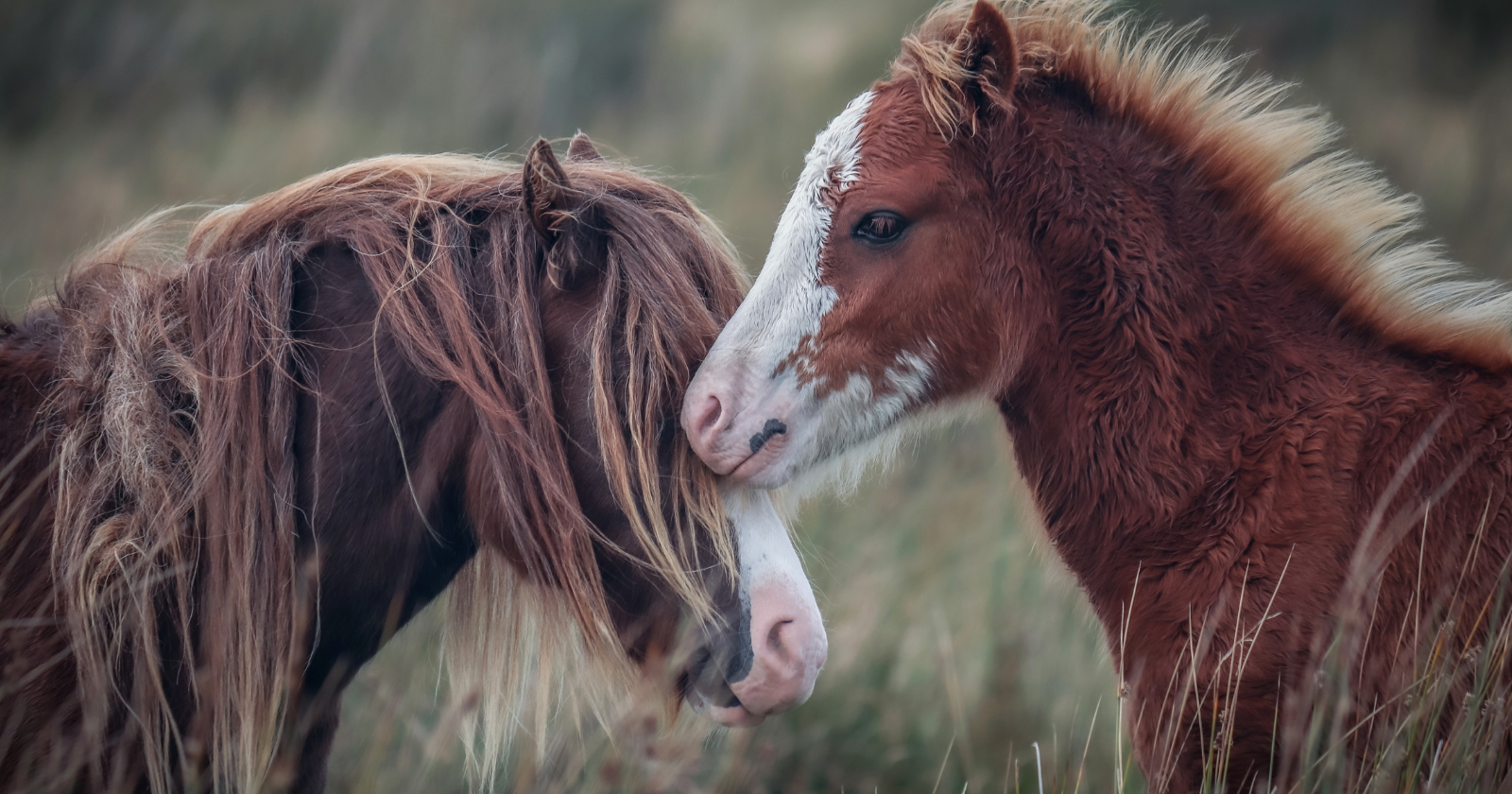
On Sable Island, a thin, wind-scoured crescent of sand roughly 300 kilometres off the coast of Nova Scotia, several hundred feral horses live without predators, without veterinary care, and without any human management of who breeds with whom. Researchers from the University of Calgary, the University of Saskatchewan and the University of Exeter have spent years collecting fecal samples from these horses as part of a long-running monitoring programme, and their newest analysis has found that horses closely related to each other carry gut bacteria communities that are far more similar than would be expected by chance — and, more novel still, that this heritability is tied to survival and outweighed by a social effect stronger than genetics itself.
The finding comes from a study led by Mason Stothart, posted in late July as a preprint on bioRxiv under the title “Host genetics and social relationships jointly shape fitness-associated microbiome variation in a population of feral horses.” It has not yet completed peer review, which matters here because the claim it makes is a genuinely new one: that a wild population’s microbiome may be heritable enough, and consequential enough for survival, to act as a lever that evolution can act on.
What the data actually shows
The team drew on 2,394 fecal samples collected from 794 individually known horses, animals that have been tracked since 2007 as part of Parks Canada’s monitoring of the island’s population. Because Sable Island’s horses have detailed pedigree records, the researchers could separate out how much of the variation in gut bacteria was explained by shared genetics, by a shared environment, and by social relationships, meaning which horses spend time near which other horses, independent of whether they are related.
Combined, genetic relatedness, a horse’s own stable environment, and its social associations accounted for 47 percent of the variation in the specific microbiome traits linked to survival, and 38 percent of variation in the microbial gene families those bacteria carry. Social effects, in particular, were two to four times stronger than the direct genetic effects. In plain terms: horses that spend time together end up with more similar gut bacteria than horses that are related but rarely interact, and that social sharing was a bigger factor than inheritance from a parent. No maternal effect, the boost a foal might get from its mother’s specific microbial community early in life, was detected at all.
Why “heritable” does not mean “genetic”
It would be easy to misread “heritable” here as meaning the bacteria themselves are inherited the way eye colour is, passed down directly in DNA. That is not what the study found. Gut bacteria colonise a horse’s gut after birth, picked up from the environment, from other animals, and from whatever the animal eats. What the researchers are describing is that a horse’s genetic background appears to shape which bacterial communities take hold and thrive in its gut, alongside a separate and apparently larger effect from which other horses it spends its life around.
That distinction is the reason the researchers frame this as evidence for “microbiome-mediated adaptive evolution,” in the study’s own phrasing, rather than as evidence that gut bacteria are simply hardwired. A trait doesn’t need to be encoded directly in DNA to be shaped by natural selection; it only needs to be consistently transmitted, whether genetically or socially, and to affect survival and reproduction. This study is a first attempt, in a wild population, to show that a microbiome plausibly meets both conditions at once.
The stakes of a mediocre gut
The reason this matters beyond horses traces back to earlier work from the same research group, published in 2024 in Nature Communications, which found that horses whose gut microbes produced less methane during digestion, a byproduct of inefficient fermentation, had meaningfully better odds of surviving Sable Island’s harsh winters. Methane production is essentially wasted energy: bacteria that generate more of it are extracting less usable energy from the same mouthful of marram grass. On an island with no supplemental feeding and a landscape that offers little in the way of shelter, that efficiency gap can be the difference between a horse making it through to spring and one that does not.
Put the two studies together and the picture becomes more specific: gut microbiome composition affects a horse’s odds of survival, and which microbiome a horse ends up with is itself shaped, in part, by its genes and by its social world — both of which can in principle be passed on or reinforced across generations. That is the mechanism by which a microbiome could, at least in theory, become a target for natural selection rather than just a passive byproduct of one.
What this does not show
The authors are careful, and the preprint’s own scope should be kept in view. This is one population, on one island, studied by one group, and it has not yet been through peer review. Correlational heritability estimates in a single wild population do not amount to proof that horse gut microbiomes have actually changed the trajectory of the species’ evolution; they show that the ingredients for that kind of process, a trait that is partly transmissible and that affects survival, are present and measurable. Sable Island’s horses are also an unusual population in some relevant ways: descended from a small founding group, isolated for generations, and living somewhere with no natural predators, so what holds there may not generalise cleanly to more typical wild horse populations, let alone to other species.
What the researchers have shown is narrower and still notable: that in this specific population, a microbiome tied to survival is neither noise nor just a byproduct of every horse eating from the same patch of grass. Some of it travels with bloodlines, and more of it travels with company.
A natural next question, one the preprint doesn’t resolve, is whether these microbiome differences persist across a horse’s lifetime or shift as its social ties change, which would help separate how much of the effect is set early from how much keeps being renegotiated. Sable Island’s horses, tracked individually for close to two decades now, are one of the few wild populations detailed enough for that question to even be answerable.