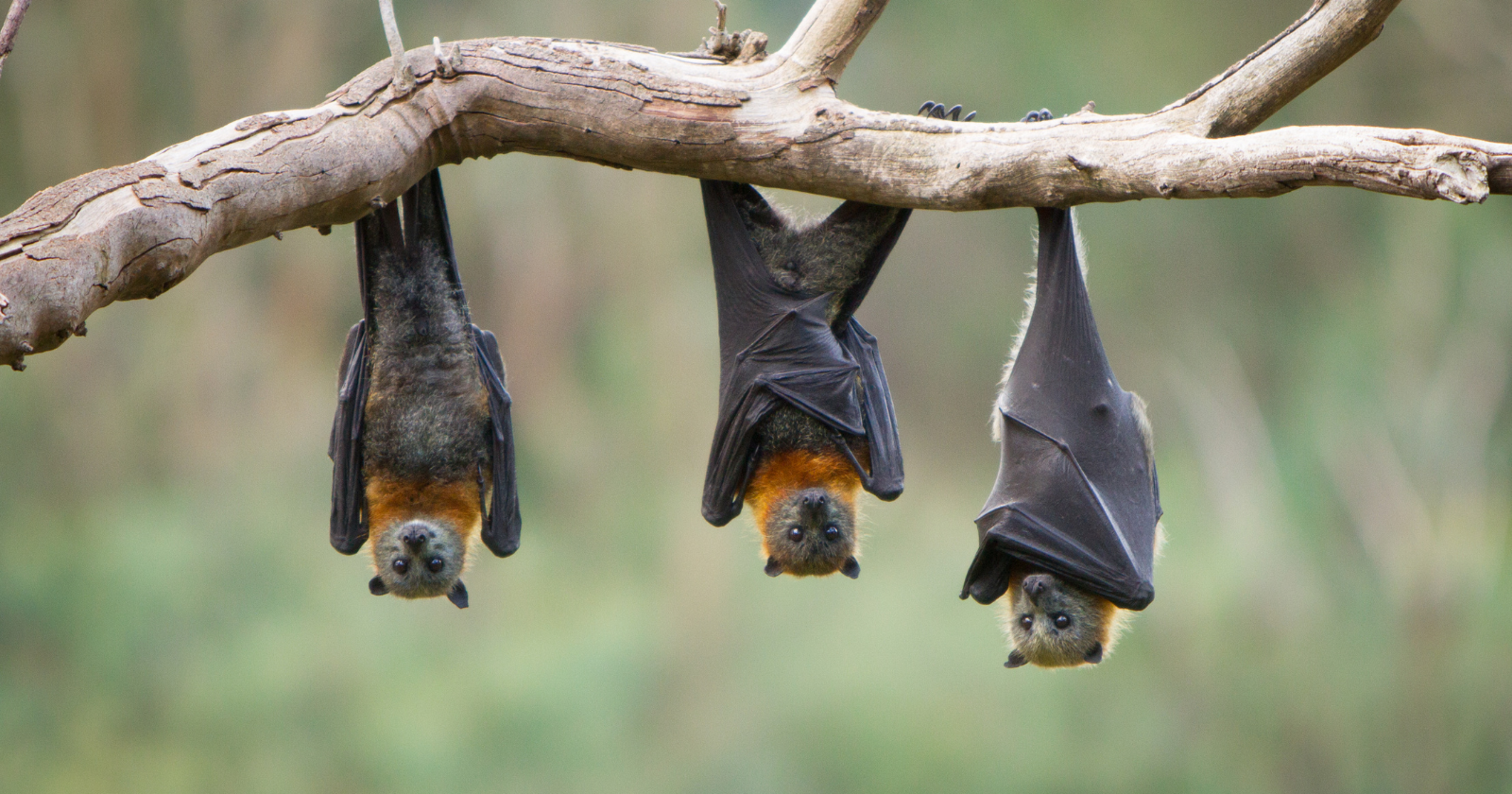
Somewhere in a hollow tree in Panama, a bat that came home hungry is being fed by a neighbour who gets nothing obvious out of it.
The donor leans in, the hungry bat licks at her mouth, and up comes a share of last night’s blood meal. Grim to watch. Also one of the clearest cases in the animal kingdom of an unrelated animal paying a real cost to keep another alive, then being paid back later.
Vampire bats run on a brutal budget. Blood is watery, and bats have almost no ability to bank the energy in it. Their glycogen stores run far below other mammals on similarly protein-heavy diets, so a meal gets burned for fuel almost immediately and nothing carries over to the next night. A common vampire bat that goes without feeding for two or three nights in a row is at real risk of dying, a fragility documented in a University of Brasilia fasting study.
Two bad nights in a row is a crisis.
A roost-mate with a full stomach is the difference between an inconvenience and a corpse, which is why biologists have spent forty years arguing about who gets fed and on what terms.
The paper that started it
Gerald Wilkinson worked this out the slow way, spending hundreds of hours lying on his back under Costa Rican roosts with a headlamp, a stretch of fieldwork described by Lee Alan Dugatkin writing in Skeptic. His 1984 paper in Nature found that regurgitated blood moved between relatives and non-relatives alike, and that donations tracked both relatedness and what he called an index of opportunity for reciprocity, meaning how much time two bats had spent in each other’s company.
That was one study, at one site, on one population, and Wilkinson himself has since pointed out that his bats may have been unusually related to each other. What made it famous was the suggestion that memory, not just genetics, was doing the work.
Putting a number on the favour
Testing that properly took another three decades. Gerald Carter and Wilkinson fasted 20 captive bats one at a time and induced sharing on 48 separate days, publishing the results in Proceedings of the Royal Society B in 2013. Blood previously received from a partner predicted blood given back, and did so 8.5 times better than how closely the two bats were related. Sixty-four per cent of the sharing pairs were not related at all.
One detail quietly demolished the cynical explanation. Donors started the sharing more often than the hungry bats did, which is hard to square with the idea that starving bats simply pester their neighbours into giving up dinner.
Carter has been blunt about how strange this is. He told Ohio State News that paying an obvious cost to help a non-relative is “pretty rare outside of humans”.
How a stranger becomes a partner
So how does a bat decide who deserves a blood meal? Cautiously, by the look of it. Carter and colleagues introduced unfamiliar females and watched what happened over 15 months, and their 2020 Current Biology report describes pairs escalating cheap grooming first, then graduating to expensive food donations.
Evolutionary theorists have a name for it: raising the stakes. Start with a small, low-risk investment, see whether the other party returns it, then commit more. Bats appear to run the same audition process, and a bad partner costs them nothing much if they fail it early.
Who they remember
A bat in a Y-shaped maze, two ultrasonic speakers, each playing the isolation calls of a different colony member. Carter and Wilkinson ran that experiment and published it in Animal Behaviour in 2016. Bats moved towards the voice of whichever caller had fed them more in the past. When sharing history was held constant and kinship varied, the pull towards closer relatives disappeared.
A vampire bat’s social pull, in other words, tracks service record more closely than family tree.
Whether it survives contact with the real world
The obvious objection is that captive bats have nothing else to do. Simon Ripperger and Carter tested it by fitting bats with proximity sensors weighing less than a coin, then releasing them into their home roost, a hollow tree holding around 200 bats. The devices logged encounters every couple of seconds for more than a week, and the resulting 2019 study in Current Biology reported that partners from captivity kept seeking each other out despite the crowd of alternatives.
The bonds also travel.
A 2021 paper in PLOS Biology followed the same animals out hunting and found the strongest captive partnerships were the likeliest to meet up over cattle pasture, kilometres from the roost. Whether they coordinate deliberately or simply drift towards familiar company remains open.
Where the analogy breaks
One paper proves very little on its own. Four decades of separate experiments, using different methods in cages and in hollow trees, are what make this case unusually solid for a field where clean demonstrations of reciprocity are thin on the ground. It helps to know the lineage is a small one, running from Wilkinson to his student Carter to Carter’s collaborator Ripperger, so this is depth of method more than a wide spread of independent labs.
Nobody serious claims these bats are keeping ledgers. There is no accounting, no debt collection, no grudge in the human sense, and the researchers who run these experiments are careful about the word friendship for exactly that reason. What the evidence supports is narrower and stranger: an animal that remembers who has been good to it, weights future generosity accordingly, and starts small with anyone unproven.
Which is more or less what happens in a new share house, a fishing crew or a trench, minus the moral vocabulary humans layer on top. The bats got there first, on a diet of blood, in the dark, without a single word for gratitude.