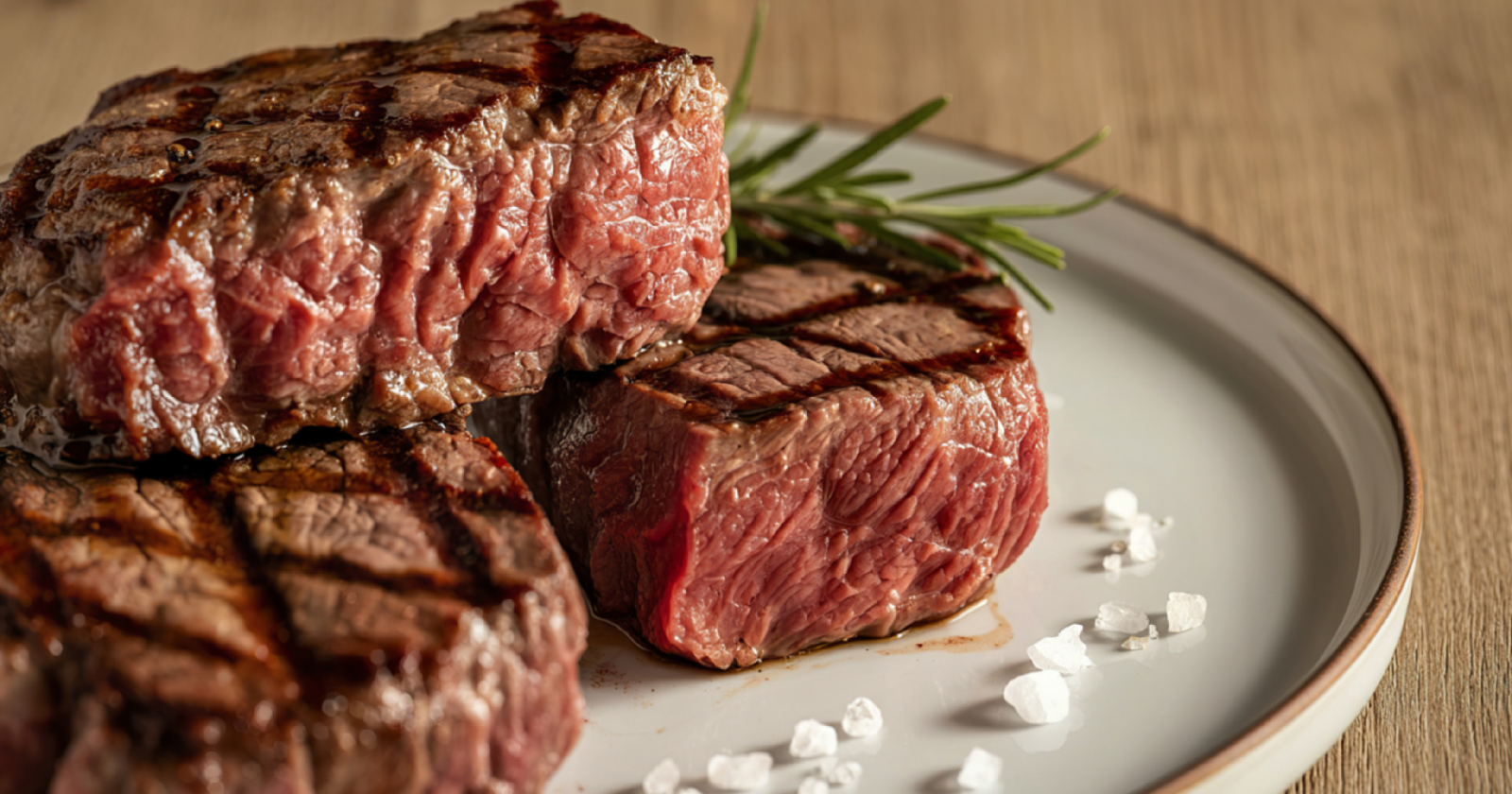
One kilogram of beef takes roughly 15,000 litres of water to produce. One medium-length chatbot reply takes about a mouthful. Both figures come from published research, and only one of them has ever filled a town hall with furious residents.
I’ve run each of these numbers before, separately: the beef figure in one piece, the data centre figure in another. Nobody has put them side by side, and once you do, the current fight over server farms looks a little lopsided.
Two numbers already on the record
The beef figure comes from Mesfin Mekonnen and Arjen Hoekstra at the University of Twente, whose global assessment of the water footprint of farm animal products put boneless beef at 15,415 litres per kilogram worldwide. Around 94 per cent of that is green water, rain that falls on pasture and feed crops rather than anything pulled from a tap, per the breakdown published by the Water Footprint Network. Diffuse as it is, it is not free. The same researchers found beef’s water footprint per calorie runs about twenty times that of cereals and starchy roots, and rain that grows cattle feed is rain that isn’t growing something else.
The AI figure comes from a single 2023 paper. Pengfei Li, Jianyi Yang, Mohammad Islam and Shaolei Ren, working out of UC Riverside, published Making AI Less “Thirsty” and estimated that training GPT-3 in Microsoft’s American data centres could evaporate 700,000 litres of clean freshwater on site, rising to about 5.4 million litres once the water used to generate that electricity is counted. Ten to fifty medium-length replies, they calculated, consume roughly a 500ml bottle, an estimate built from public efficiency data rather than meter readings. That number deserves a caveat: it describes GPT-3, a model several generations old in an industry that moves in months. Estimates for newer models have kept shifting since. Ren now puts a single GPT-4 prompt at around 15 millilitres, including roughly five for on-site cooling, and told Forbes that some of the per-query estimates circulating just a couple of years ago are already outdated.
The comparison
Agriculture as a whole still accounts for something like 72 per cent of global freshwater withdrawals, as documented in the FAO’s 2025 AQUASTAT snapshot, which also clocked renewable freshwater per person falling 7 per cent over the past decade. Beef is the single thirstiest item on that ledger. Data centres, whatever their headlines, are not.
Corporate reporting makes the gap concrete. Google’s data centre water consumption climbed from 4.3 billion gallons in 2021 to 6.1 billion in 2024, a year when 78 per cent of everything it withdrew simply evaporated rather than returning to the system, per the MOST Policy Initiative. Convert that 6.1 billion gallons to litres and you land near 23 billion. Divide by 15,415, the litres-per-kilogram figure above, and you get water use equivalent to roughly 1,500 tonnes of beef.
Global beef production runs around 62 million tonnes a year, per USDA Foreign Agricultural Service data, which averages out to roughly 7,000 tonnes an hour. On that arithmetic, a full year of water use across every Google data centre on the planet works out to somewhere around thirteen minutes of global beef production. It is rough arithmetic, mixing carcass weight against boneless weight and one company’s numbers against a global average. Treat it as a direction rather than a decimal. As directions go, this one is not subtle.
Why the smaller number starts the bigger fight
Because it lands in one postcode.
Green water is diffuse. It falls across millions of hectares and more than a hundred countries, and no household ever sees it itemised on a bill. Data centre water is treated, potable, municipal supply, arriving through the same pipes that serve the street next door. In The Dalles, Oregon, Google’s consumption quintupled between 2012 and 2025 to around 550 million gallons, close to 40 per cent of the town’s entire usage, as reported by Latitude Media. That is rivalrous water in the plainest sense: what the servers use, the town does not get back.
Nationally, the totals still look survivable. Researchers at Lawrence Berkeley National Laboratory put direct consumption by American data centres at 17 billion gallons in 2023 and projected it could double or quadruple by 2028, figures summarised by The Current. That is a rounding error against national supply, but a community handing two-fifths of its water to a warehouse full of servers still has a real grievance. Whatever a feedlot in Queensland happens to be doing at the same time is beside the point.
Outrage tracks visibility, not volume. A data centre is one building with a name on it, an owner, a planning application and a water meter, all of which makes it something a person can drive to and shout at. Beef turns up as a plastic-wrapped tray with no watershed attached, its cost smeared across decades of rainfall and a hundred-odd countries.
The thing with the biggest water bill in most people’s day is sitting in the fridge, waiting for the barbecue.