

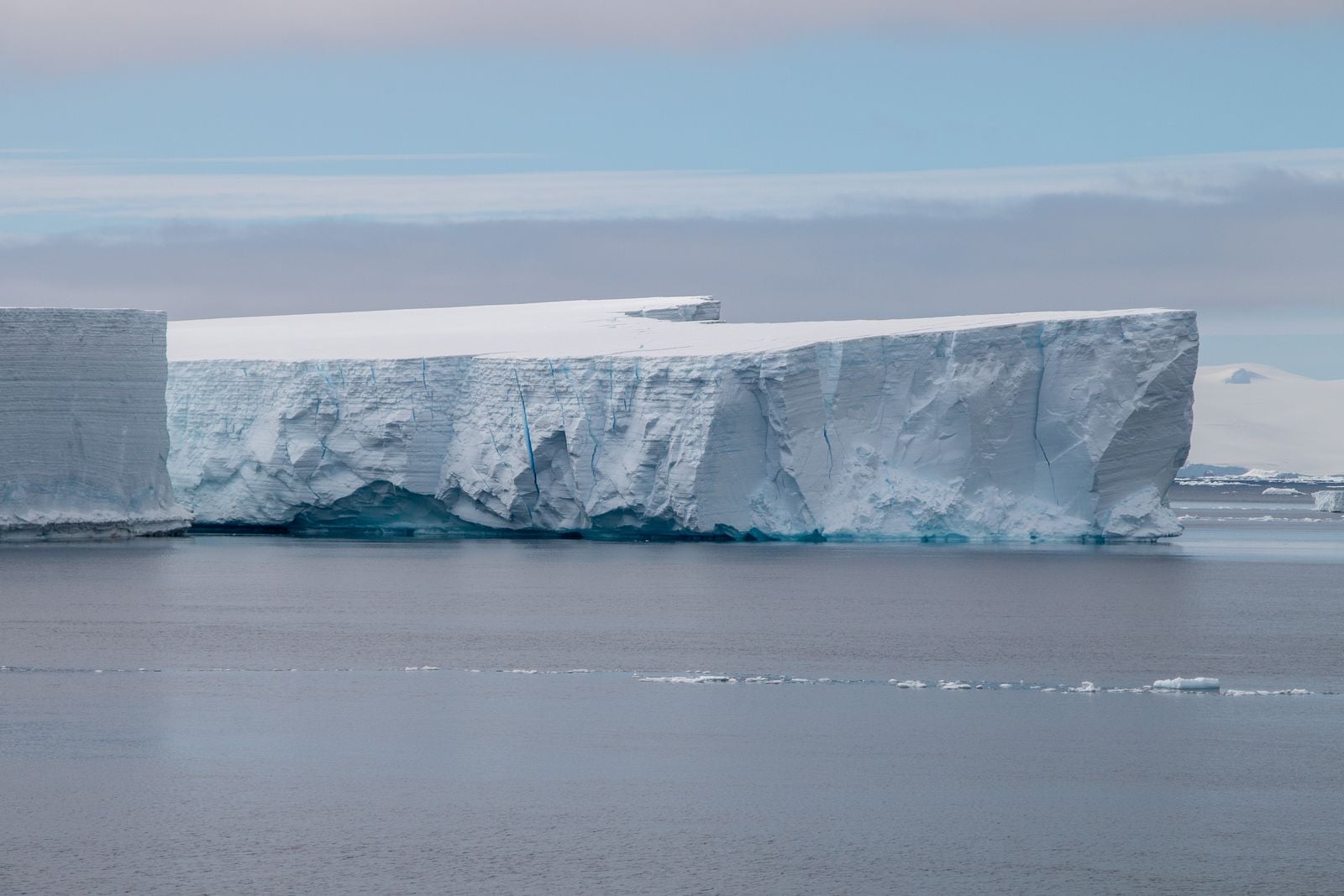
On the eastern edge of Antarctica’s Taylor Glacier, a slab of ice the colour of a wedding cake weeps a thick rust-red stain that reaches Lake Bonney like spilled paint. The feature is called Blood Falls, and the colour is not algae, not blood, not a trick of the light. It is iron. The brine feeding it has been sealed under the glacier long enough that when it finally reaches the air, dissolved iron oxidises on contact and turns the ice the colour of a slaughterhouse floor.
The reservoir behind the stain is stranger than the stain itself. It is salty, sunless, oxygen-free, and, according to recent research, teeming with a community of microbes whose closest relatives live in the sea more than 30 kilometres away.
What is actually leaking out of the ice
Blood Falls sits at the terminus of Taylor Glacier in the McMurdo Dry Valleys, one of the coldest and driest deserts on Earth. Australian geologist Thomas Griffith Taylor came across it in 1911 and assumed the red came from algae. He was wrong. As Gizmodo notes in its account of the century-long puzzle, later work confirmed the colour was iron oxide, but the mechanism took decades to pin down.
The brine that produces it is roughly two to three times saltier than seawater. That salinity is what keeps it liquid at temperatures well below the freezing point of freshwater. It is loaded with dissolved ferrous iron, which stays colourless while sealed underground. The moment the brine hits the atmosphere at the glacier face, that iron reacts with oxygen and precipitates as iron oxide — the same chemistry that rusts a garden shovel, running at glacial scale.
The outflow is not continuous. It comes in bursts. Research summarised by Earth.com links sudden red discharges to measurable drops in the glacier’s surface above the reservoir, suggesting the brine is pressurised beneath the ice and vents when the pathway opens.
How old the water is, roughly
The dating is imprecise, and honest reporting requires saying so. Estimates for when the brine was sealed off from the open ocean cluster in the range of 1.5 to a few million years. The Scripps Institution of Oceanography places the isolation event during a warmer period when seawater flooded the Taylor Valley, with the reservoir cut off as the Taylor Glacier advanced. A Smithsonian summary of the new work puts the trapping event at around 2.5 million years ago.
Either figure lands the reservoir in the Pliocene or early Pleistocene. That is a long time to sit in the dark.
Whatever the precise number, the water underneath Taylor Glacier has been closed off since a period when Antarctica looked very different — warmer, wetter, with an ocean reaching into valleys that today are among the driest places on the planet.
Life without sunlight or oxygen
The interesting part is not the rust. It is what lives in the brine.
Earlier work established that Blood Falls hosted bacteria running on iron and sulphur chemistry — organisms that pull energy from redox reactions rather than photosynthesis. Recent research, led by Angela Zoumplis at the J. Craig Venter Institute and Scripps, extends the census to eukaryotes: single-celled organisms with a proper nucleus, the same lineage as everything from oak trees to whales.
The team analysed 167 samples of water, sediment and air from the Dry Valleys and nearby McMurdo Sound. According to the Scripps release on the study, marine-associated diatoms made up more than 60 percent of the diatom community in samples from red mud and sediment at the glacier terminus, rising to about 80 percent in some analyses. Nearby freshwater sites were dominated by completely different, land-and-lake species.
Diatoms are single-celled algae with glass shells. Different groups belong to different habitats, and they do not easily cross over. Finding a marine assemblage locked into a polar desert more than 30 kilometres from open water is not what anyone expected.
Dinoflagellates, haptophytes and ciliates showed up in the same samples, all groups with strong ocean affinities.
Not just fossils — active cells
A signature in DNA alone would only prove that marine organisms passed through at some point. The team also ran metatranscriptomics, sequencing RNA rather than DNA to catch which genes were being actively expressed.
RNA degrades quickly. If it is there, something is making it.
Genes for photosynthesis, cellular repair, stress response and salt tolerance were switched on in the Blood Falls community. According to researchers, the genetic evidence suggests active biological processes rather than merely preserved remnants from the past. The research team found evidence that organisms are actively responding to environmental stressors including temperature fluctuations, high salinity, iron exposure, and dormancy periods.
Senior author Andrew Allen, a marine biologist at Scripps, noted the remarkable discovery of a thriving marine ecosystem in a polar desert located more than 20 miles from the ocean. Allen explained that the community maintains links to an ancient marine environment while showcasing how life can adapt to extreme conditions.
Some of the eukaryotes appear to survive as resting cysts or spores, dormant for long stretches and reactivating when brine chemistry shifts.
How the ocean got locked under a glacier
The prevailing reconstruction is straightforward geology. During a warmer interval millions of years ago, sea level was higher and the coastline of East Antarctica sat further inland. Marine water flooded what is now the Taylor Valley. When temperatures dropped and the Taylor Glacier advanced, a body of that seawater was pinned underneath, cut off from the retreating ocean.
Isolated, it evaporated and concentrated. The salt kept it from freezing solid. Iron leached from the bedrock. Oxygen ran out. Whatever life had been trapped either died, adapted, or slowed to a near-halt.
An alternative had been proposed: that the marine microbes found in previous studies were carried inland by wind, sprinkled over the ice and swept into the meltwater. The new results argue against wind as the main route. Wind-collected samples in the study contained very little marine material, and the community at the terminus was genetically distinct from modern McMurdo Sound populations. If today’s wind were doing the work, the two should look more alike.
The finding does not overturn wind transport entirely. It just puts an ancient flooding event back at the centre of the explanation.
Why this matters beyond a rust-red stain
The Dry Valleys are the closest terrestrial analogue to the surface of Mars, and the subglacial brine under Taylor Glacier is one of the tightest available analogues for the kind of environment now suspected under the ice shells of Europa and Enceladus. Dark, salty, cold, oxygen-poor, chemically active. Space Daily has written about the ongoing effort to probe for life in the icy crusts of ocean worlds, and Blood Falls sits squarely in that intellectual pipeline.
An organism that runs its metabolism on iron and sulphur, in the dark, in brine, is exactly the kind of thing astrobiologists are looking for elsewhere.
The complication cuts the other way too. Enceladus, as a recent piece on habitability and the null result argued, has water, chemistry and hydrothermal energy in apparent abundance. If Blood Falls can sustain a marine community sealed off for a million years or more, it suggests that conditions for habitability may be less stringent than previously thought.
What the study does not show
A few qualifiers worth keeping in mind. The paper does not claim that the microbes now living at the Blood Falls terminus are unchanged descendants of a Pliocene ocean. It argues for a community shaped by ancient marine input, redistribution within the valley over time, some limited modern transport, and heavy selection by the extreme conditions at the glacier face. What emerged is not a preserved snapshot but a survivor community.
The paper also does not settle the exact date of the sealing event. It offers biological evidence consistent with an ancient marine origin, and the authors have suggested that future genomic work — comparing divergence between marine and terrestrial lineages — could sharpen the timeline. That work has not been done yet.
And Blood Falls is not the only strange outflow on the continent. Life Signs has previously written about the Byrd Glacier draining an area larger than California through a gap in the Transantarctic Mountains at up to 800 metres a year. Antarctic ice does not sit still, and it does not seal things off cleanly.
What it looks like from the air
The stain is visible from satellite. On Google’s imagery of the McMurdo Dry Valleys, a thumb-shaped smear of ochre marks the point where Taylor Glacier meets the west lobe of Lake Bonney. In summer, meltwater carries some of the iron oxide out onto the lake ice, and the red bleeds sideways in feather-shaped tongues.
On the ground, according to recent reporting, the falls do not gush. They ooze. The brine emerges slowly, freezes in place, and layers new red over old.
Sometimes it stops for months at a time. Sometimes a fresh burst arrives after a measurable settling of the glacier surface above the reservoir, as if the ice had exhaled.
Elsewhere on the continent, in July 2026 the temperature hit minus 119.4 degrees Fahrenheit at Concordia Station on the Antarctic Plateau, the coldest recorded on Earth since 2012. The brine underneath the glacier stays liquid through all of it, held in the dark at roughly minus 5 degrees Celsius, kept fluid by salt.
The organisms in that water were locked in before the first stone tools were struck in East Africa. They are still, on the RNA evidence, turning genes on and off — running a metabolism against the odds, in a pocket of ancient sea that the continent forgot to release.