

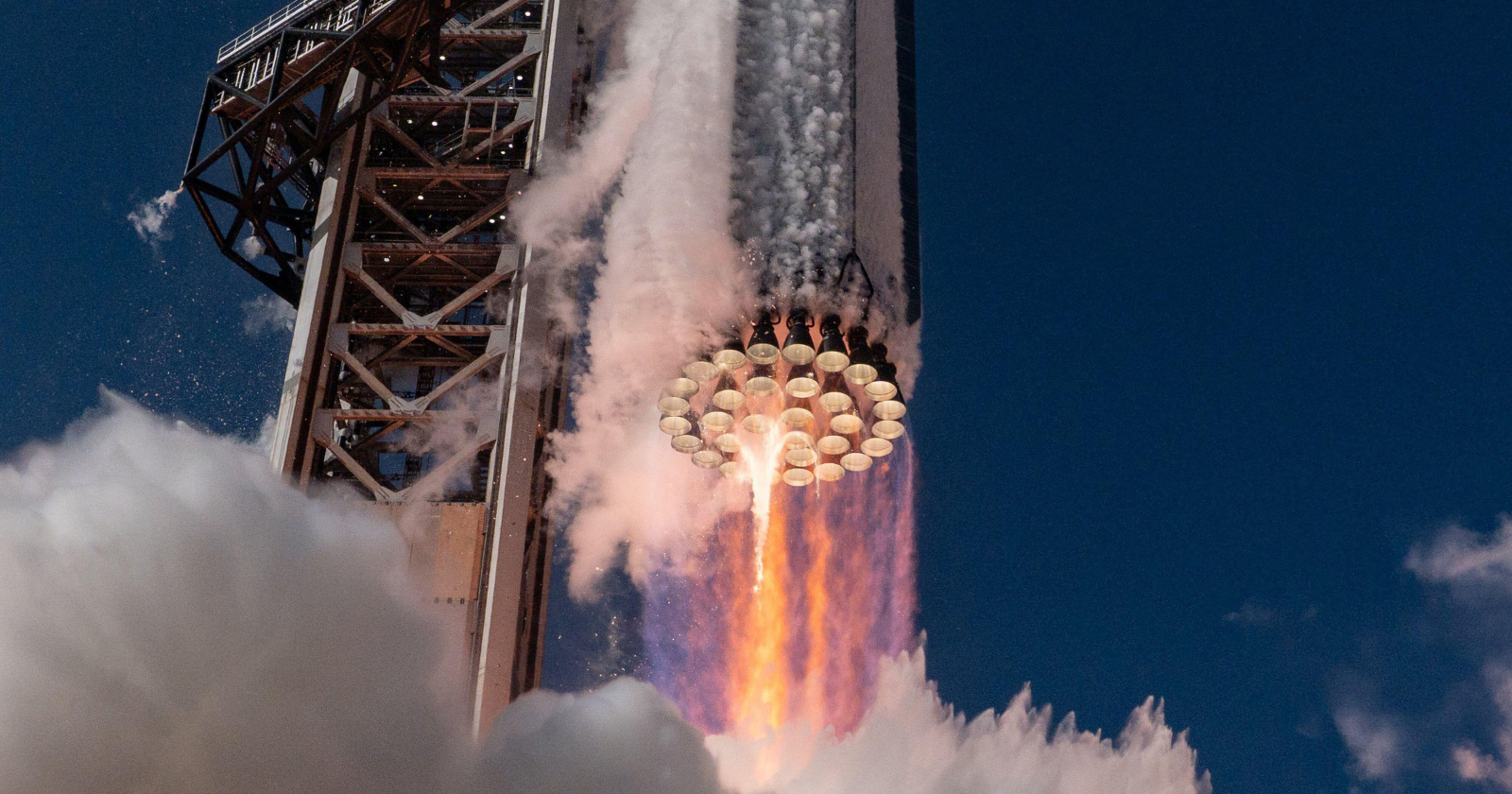
At the moment of liftoff, SpaceX’s Starship pushes off the launch pad with approximately 74.4 million newtons of thrust — enough force, in principle, to lift roughly 7,500 tonnes of mass directly against gravity.
For context, that is about twice the thrust of the Saturn V rocket that carried the Apollo astronauts to the Moon between 1969 and 1972. The vehicle itself is taller — 121 metres compared to Saturn V’s 111 — and heavier when fully fuelled, with a total mass at liftoff exceeding 5,000 tonnes.
By raw physical output, Starship is the most powerful rocket ever built.
But raw thrust is not really the point of Starship. Saturn V hit similar physical scales half a century ago. What Starship is actually attempting to prove — and what its engineering choices really reflect — is not the maximum size of a rocket. It is the maximum turnaround time between launches. If it works, that is the innovation that changes what humans can do in space.
What actually happens at liftoff
The Super Heavy booster — the massive first stage of Starship — is powered by 33 Raptor 2 engines burning liquid methane and liquid oxygen.
Each Raptor 2 produces approximately 2,260 kilonewtons of thrust at sea level, roughly 230 tonnes-force. Multiplied across 33 engines, the total is about 74.4 million newtons, or 16.7 million pounds-force. This is more than the current maximum thrust of NASA’s Space Launch System (about 39,144 kilonewtons) and more than double that of the Saturn V (about 35,000 kilonewtons).
The rocket burns through propellant at an extraordinary rate. Super Heavy contains 3,400 tonnes of liquid methane and liquid oxygen. All 33 engines burn continuously for approximately 166 seconds during the first stage of ascent, consuming roughly 20 tonnes of propellant per second at peak flow.
At that point, the second stage — the Starship spacecraft itself — separates and continues to orbit under its own six Raptor engines, while the Super Heavy booster reverses course and returns to the launch site.
That return is where the specific engineering revolution actually lives.
Why Saturn V comparisons only get you halfway
Saturn V was, by any measure, an extraordinary rocket. It launched 13 times between 1967 and 1973. Every one of those launches ended with the entire rocket falling into the ocean, breaking apart, or burning up. Not a single Saturn V was ever recovered, refurbished, or flown again.
Every subsequent large rocket, until roughly 2015, followed the same pattern. Rockets were manufactured, flown once, and discarded. A typical expendable launch cost hundreds of millions of dollars for a single flight, with essentially all of that expense written off the moment the rocket left the pad.
SpaceX’s earlier Falcon 9 rocket began changing that pattern in 2015 by recovering and reusing its first stage — landing propulsively on a barge or landing pad and being refurbished for subsequent flights. Falcon 9 first stages have now flown as many as 20 times each, dropping the effective cost per launch substantially.
Starship pushes the reusability logic further. Both stages — the Super Heavy booster and the Starship spacecraft — are designed to return to Earth and be reused. And the specific mechanism by which the booster returns is one of the strangest engineering choices in modern spaceflight.
The chopstick catch
Instead of landing on legs, the Super Heavy booster returns to its launch site and is caught in mid-air by two enormous mechanical arms mounted on the launch tower. The arms are officially called “Mechazilla.” Everyone calls them the chopsticks.
The specific reason for the choice is engineering economy. Landing legs add weight to the booster. Weight subtracts from payload capacity. A booster caught by the tower does not need to carry its own landing gear, which means every kilogram of tower catch mechanism is a kilogram less that the booster has to lift on every flight for the rest of its operational life.
The catch itself is precise. The booster returns from space at hypersonic speeds, decelerates using its own engines during a landing burn, and hovers briefly near the tower before the arms close around it and grip specific hard points on the vehicle’s outer hull. The whole approach and catch typically takes less than a minute.
SpaceX first successfully caught a returning Super Heavy on October 13, 2024, during flight test IFT-5. A second successful catch followed on March 6, 2025, during IFT-8. A third has since been achieved. The technique is not routine yet, but it has been demonstrated to work.
Why “flown again the next day” is the actual point
The specific reason all of this matters is not that catching rockets is cool. It is that it makes rockets economically comparable to airplanes.
An airplane costs a lot of money to build, but it flies thousands of times over its operational life. That is what makes air travel affordable. A rocket, historically, costs about the same as an airplane per unit but flies exactly once. That is why sending anything to orbit has always been extraordinarily expensive.
If Starship can be caught, refurbished, and flown again within days rather than months, the per-flight cost drops by orders of magnitude. SpaceX’s stated design target is a full stack turnaround measured in hours to a few days, with the same booster potentially flying multiple times per week at full operational cadence.
Whether SpaceX will actually hit that target is genuinely uncertain. The technology has not yet demonstrated it. As of the most recent test flight in May 2026, individual boosters have not been re-flown from a catch. The company continues to work through the specific engineering problems — thermal fatigue, structural stress, hardware refurbishment — that separate a caught booster from a re-launched one.
But the framework is now in place. A rocket has been built that can produce twice the thrust of Saturn V and be caught back at the launch tower like an oversized bird returning to its perch. Whether the same rocket will be launching again within 24 hours is the question the next few years of Starship development are entirely about.
If the answer turns out to be yes, the economics of everything else in spaceflight will change. Sending humans to Mars, refuelling spacecraft in orbit, building lunar bases — all of these become possible in ways that expendable rockets could never have supported.
The 74 million newtons of thrust is the specific engineering credential that makes Starship serious. The catch-and-refly system is what makes it revolutionary. What still remains to be proven is whether the tower can catch what it catches, and let it go again, quickly enough to actually matter.
