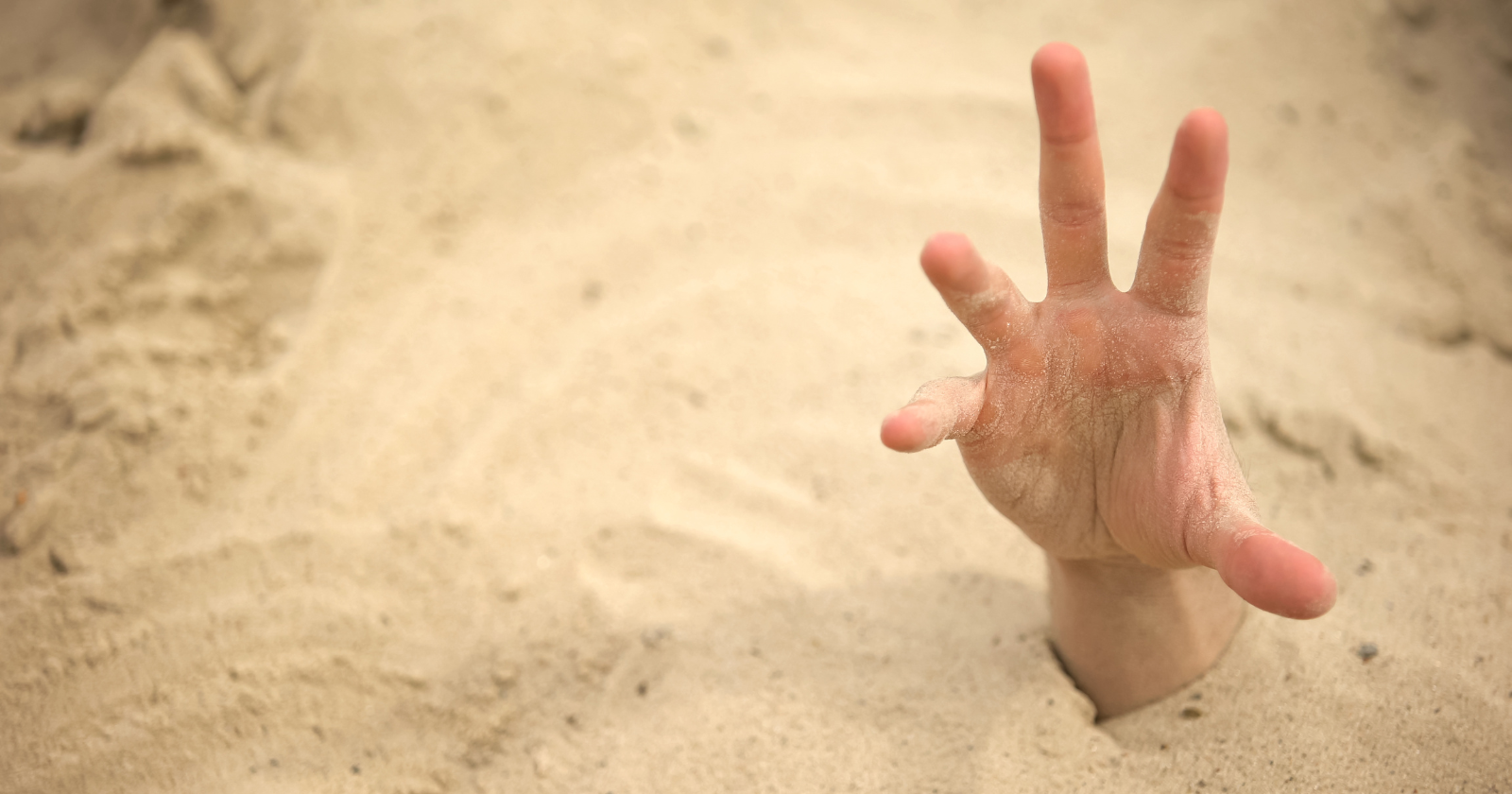
Almost every adult in the world grew up watching some version of the same scene. A character, usually a supporting one, wanders off the marked path in a jungle, or a swamp, or occasionally a desert, and steps into what looks like ordinary ground. The ground gives way. The character sinks. They struggle. They cry out. They reach for a vine, or a stick, or a hand, and depending on the mood of the film, either grab it and pull themselves out or fail to grab it and disappear entirely beneath the surface, leaving only a hat behind. Between about 1950 and 1980, according to research compiled by some enterprising film critics, quicksand appeared in roughly one in every thirty-five Hollywood films made in that period. For an entire generation of moviegoers, it was one of the most reliably terrifying environmental hazards the natural world had to offer.
The problem with almost all of this, on the accumulated fluid-dynamics evidence, is that it does not happen.
What quicksand actually is
According to a 2005 paper by A. Khaldoun, E. Eiser, G. H. Wegdam and Dr Daniel Bonn at the Van der Waals-Zeeman Institute in Amsterdam, published in Nature under the title “Liquefaction of Quicksand Under Stress”, quicksand is not a mysterious geological phenomenon. It is a specific and predictable colloidal mixture of fine sand, water, and a small quantity of clay or salt, which forms in particular locations where groundwater is rising through loose granular soil. Undisturbed, the mixture behaves like a firm surface. A person can walk on it. The sand grains rest against each other under gravity, held in place by the tension of the surrounding water.
What happens when a person steps into quicksand and applies pressure is that the delicate equilibrium of the mixture is broken. The sand grains, which had been holding each other in place, briefly reorganise themselves. The water is squeezed out of the interstitial spaces. The compacted grains sediment together into a denser, tighter packing, and the water rises above them. The whole system reorganises into a top layer of water sitting above a dense sand-and-mud sediment that is now much less liquid than before. Which is why the foot that stepped in cannot easily be pulled out. The grains have compacted around it, into a specific configuration a physicist would describe as an unusually stubborn suspension, and the shear force required to move the foot back up through that suspension is enormous.
Related watch – can you imagine a world without sand?
Bonn’s team measured this precisely, using both field samples from Iran’s Lake Namak and laboratory simulations at the University of Amsterdam. The force required to pull a foot out of compacted quicksand at a speed of one centimetre per second, on their calculations, is comparable to the force required to lift a small car. Which is what makes quicksand feel, to the person stuck in it, like something with an active grip.
But it does not, and cannot, pull the person under. The reason is buoyancy, and it is one of the more genuinely surprising facts in ordinary physics. Quicksand has a density of approximately two grams per cubic centimetre. The human body has a density of approximately one gram per cubic centimetre, meaning humans are considerably less dense than quicksand. On any straightforward application of Archimedes’ principle, a person stepping into quicksand can only sink to the depth at which the weight of the displaced quicksand equals their own body weight. In practice, this works out to roughly waist height. Below that, the buoyant force pushes back up with sufficient strength to prevent further sinking, no matter how much the person struggles.
Aluminium, for context, is denser than quicksand and would float on top of it. A stone, a human body, and a plastic toy are all, on the physics, incapable of full submersion in a quicksand mixture. The Hollywood scene, in which the character disappears entirely beneath the surface and vanishes, is not a dramatic exaggeration of a real phenomenon. It is not a phenomenon that occurs at all.
What actually kills people, and what saves them
The real danger of quicksand, on the accumulated field evidence assembled by Bonn’s team and by soil-mechanics researchers, is not the quicksand itself. It is what happens next. According to the 2005 Nature News summary of Bonn’s findings, published on 28 September 2005 in the journal’s online news section with direct quotes from Bonn and from Dr Thomas Zimmie of the Rensselaer Polytechnic Institute’s soil-mechanics programme, the fatal cases historically recorded from quicksand exposure have almost all involved secondary environmental hazards rather than sinking as such.
The most reliable of these hazards is the tide. Coastal quicksand, of the kind found in shallow estuaries, deltas, and mudflats around the world, becomes fully submerged when the sea returns. A person trapped up to their waist in coastal quicksand at low tide, unable to extract themselves, will find the water rising around them at the same steady rate the tide is coming in, until it eventually reaches their head. Bonn himself, in the 2005 coverage, describes tidal quicksand as the real killer. The mechanism is drowning by the incoming sea, not sinking by the sand.
Away from coastal areas, the other historical dangers have been exposure and thirst. A person stuck for days in an inland quicksand deposit is genuinely stuck. Rescue is often the only way out. In hot climates, hypothermia can also strike at night when temperatures drop. But the sand does not, on any of the recorded cases, pull the person any lower than the point their buoyancy allows.
Which brings us to the counter-intuitive escape technique. The instinct any person has when they realise their leg is trapped is to try to pull straight up and out. Which is, on the physics, almost the worst possible response. Pulling directly against the compacted sand is what triggers the enormous shear force Bonn measured. It also, on the mechanics of the mixture, further compacts the sand around the trapped limb, making the problem incrementally harder with each attempt.
What actually works, on the fluid-dynamics evidence, is the opposite. Move slowly. Wiggle the trapped limb in small circular motions rather than pulling upward, which reintroduces water into the compacted sand and re-liquefies the mixture. Lean backward and lie flat on the surface of the quicksand, distributing body weight across as large an area as possible. Once the body is horizontal, floating is trivially easy. The trapped foot or leg can then be gradually worked free at leisure. The whole process may take twenty or thirty minutes. The person will be covered in mud. They will not, on any recorded case, have been in real danger.
Which leaves the whole cultural picture of quicksand, on the accumulated evidence, as one of the more thoroughly wrong things a generation of films quietly persuaded us to believe. The mud does not swallow anybody. The sand does not have a grip that can drag a person under. The single scene those films kept repeating, in which the terrified victim slowly disappears beneath a placid surface leaving only ripples behind, describes a physical process that does not, in the natural world, happen at all. The actual danger is quieter, stranger, and more patient than the movie version. And the escape from it is not the desperate upward pull the character in the film always tries. It is, on the physics, the specific act of lying down.
Kiran Athar is not a physicist or a soil scientist. She writes about science, natural history, and the ordinary corners of modern life where the two intersect, drawing on peer-reviewed research and primary-source scholarship.